



 Chat with AI
Exam 22: The Competitive Firm

Exam 1: Economics: the Core Issues152 Questions
Exam 2: The Useconomy: a Global View146 Questions
Exam 3: Supply and Demand164 Questions
Exam 4: The Role of Government153 Questions
Exam 5: National Income Accounting152 Questions
Exam 6: Unemployment147 Questions
Exam 7: Inflation152 Questions
Exam 8: The Business Cycle153 Questions
Exam 9: Aggregate Demand149 Questions
Exam 10: Self-Adjustment or Instability140 Questions
Exam 11: Fiscal Policy151 Questions
Exam 12: Deficits and Debt151 Questions
Exam 13: Money and Banks146 Questions
Exam 14: The Federal Reserve System146 Questions
Exam 15: Monetary Policy149 Questions
Exam 16: Supply-Side Policy: Short-Run Options147 Questions
Exam 17: Growth and Productivity: Long-Run Possibilities143 Questions
Exam 18: Theory Versus Reality146 Questions
Exam 19: Consumer Choice136 Questions
Exam 20: Elasticity141 Questions
Exam 21: The Costs of Production151 Questions
Exam 22: The Competitive Firm148 Questions
Exam 23: Competitive Markets150 Questions
Exam 24: Monopoly147 Questions
Exam 25: Oligopoly145 Questions
Exam 26: Monopolistic Competition144 Questions
Exam 27: Natural Monopolies: Deregulation144 Questions
Exam 28: Environmental Protection144 Questions
Exam 29: The Farm Problem132 Questions
Exam 30: The Labor Market137 Questions
Exam 31: Labor Unions144 Questions
Exam 32: Financial Markets146 Questions
Exam 33: Taxes: Equity Versus Efficiency146 Questions
Exam 34: Transfer Payments: Welfare and Social Security146 Questions
Exam 35: International Trade149 Questions
Exam 36: International Finance142 Questions
Exam 37: Global Poverty141 Questions
Select questions type


The fact that a perfectly competitive firm's total revenue curve is an upward-sloping straight line implies that
(Multiple Choice)
4.9/5  (83)
(83) An increased tax on profits leaves the optimal rate of output unchanged in the short run.
(True/False)
4.9/5 (80)
(80) All of the following are ways a business can earn economic profits except
(Multiple Choice)
4.9/5 (77)
(77) The basic incentive to supply goods and services is the expectation of profit.
(True/False)
4.8/5 (77)
(77) 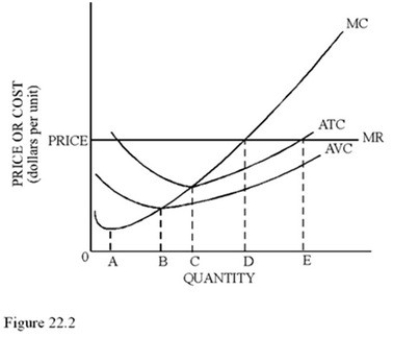 Refer to Figure 22.3 at quantity level B
The market price for any good or service sold in a perfectly competitive market is determined by
(Multiple Choice)
4.8/5 (79)
(79) 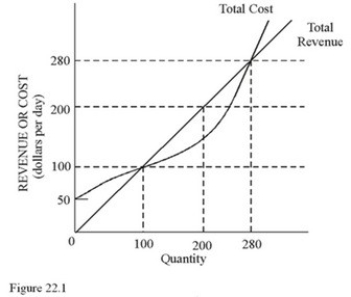 Refer to the data in Figure 22.1.The shape of the total revenue curve indicates that the price of this good
 (Multiple Choice)
4.7/5 (72)
(72) 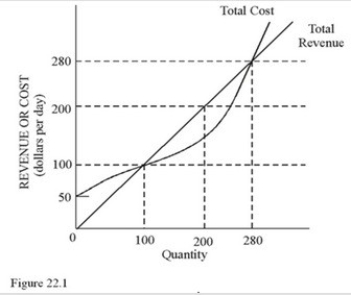 Refer to the data in Figure 22.1.The total fixed costs for this firm are approximately
 (Multiple Choice)
4.7/5 (70)
(70) Suppose a firm has an annual budget of $200,000 in wages and salaries,$75,000 in materials,$30,000 in new equipment,$20,000 in rented property,and $35,000 in interest costs on capital.The owner/manager does not choose to pay himself,but he could receive income of $90,000 by working elsewhere.The firm earns revenues of $360,000 per year.What are the annual economic costs for the firm described above?
(Multiple Choice)
4.9/5 (92)
(92) In which of the following types of markets does a single firm have the most market power?
(Multiple Choice)
4.9/5 (81)
(81) A competitive firm should always continue to operate in the short run as long as
(Multiple Choice)
5.0/5 (87)
(87) Which of the following should not be included when calculating accounting profit?
(Multiple Choice)
4.9/5 (76)
(76) When payroll taxes are raised,the firm's marginal cost curve shifts
(Multiple Choice)
4.9/5 (86)
(86) Which of the following affects the ATC curve for a firm but not the MC curve?
(Multiple Choice)
4.9/5 (77)
(77) The profit motive encourages businesses to produce the goods and services that consumers desire.
(True/False)
4.7/5 (85)
(85) In the News article,"Are Profits Bad?" most Americans feel that the profit motive
(Multiple Choice)
4.8/5 (91)
(91) 
Filters
- Essay(0)
- Multiple Choice(0)
- Short Answer(0)
- True False(0)
- Matching(0)