



 Chat with AI
Exam 22: The Competitive Firm

Exam 1: Economics: the Core Issues152 Questions
Exam 2: The Useconomy: a Global View146 Questions
Exam 3: Supply and Demand164 Questions
Exam 4: The Role of Government153 Questions
Exam 5: National Income Accounting152 Questions
Exam 6: Unemployment147 Questions
Exam 7: Inflation152 Questions
Exam 8: The Business Cycle153 Questions
Exam 9: Aggregate Demand149 Questions
Exam 10: Self-Adjustment or Instability140 Questions
Exam 11: Fiscal Policy151 Questions
Exam 12: Deficits and Debt151 Questions
Exam 13: Money and Banks146 Questions
Exam 14: The Federal Reserve System146 Questions
Exam 15: Monetary Policy149 Questions
Exam 16: Supply-Side Policy: Short-Run Options147 Questions
Exam 17: Growth and Productivity: Long-Run Possibilities143 Questions
Exam 18: Theory Versus Reality146 Questions
Exam 19: Consumer Choice136 Questions
Exam 20: Elasticity141 Questions
Exam 21: The Costs of Production151 Questions
Exam 22: The Competitive Firm148 Questions
Exam 23: Competitive Markets150 Questions
Exam 24: Monopoly147 Questions
Exam 25: Oligopoly145 Questions
Exam 26: Monopolistic Competition144 Questions
Exam 27: Natural Monopolies: Deregulation144 Questions
Exam 28: Environmental Protection144 Questions
Exam 29: The Farm Problem132 Questions
Exam 30: The Labor Market137 Questions
Exam 31: Labor Unions144 Questions
Exam 32: Financial Markets146 Questions
Exam 33: Taxes: Equity Versus Efficiency146 Questions
Exam 34: Transfer Payments: Welfare and Social Security146 Questions
Exam 35: International Trade149 Questions
Exam 36: International Finance142 Questions
Exam 37: Global Poverty141 Questions
Select questions type


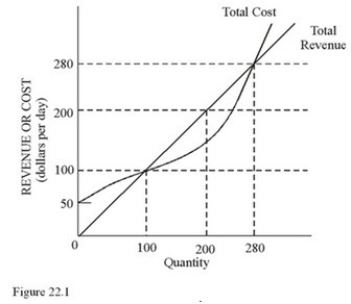 Refer to the data in Figure 22.1.The price of this good

One In the News feature reports that General Motors planned to essentially quit making cars and trucks in the United States for nine weeks from mid-May through July 2009 and Omaha Power planned to close one of its nuclear plants permanently.Based on these particular news clips,what is the difference between GM's and Omaha Power's decisions?
(Multiple Choice)
4.8/5  (71)
(71) Perfect competition is a market in which no buyer or seller has market power.
(True/False)
5.0/5 (72)
(72) Assuming an entrepreneur does not pay herself,the $1,000 she could earn as an employee elsewhere is considered
(Multiple Choice)
4.9/5 (88)
(88) For the perfectly competitive firm,the marginal revenue is always
(Multiple Choice)
4.9/5 (91)
(91) 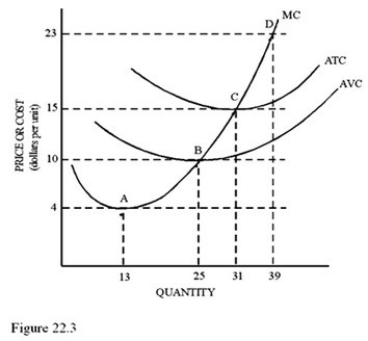 Refer to Figure 22.3 for a perfectly competitive firm.If the market price is $23,
 (Multiple Choice)
4.8/5 (83)
(83) Explain how a firm's cost curves and optimal rate of output are affected by (a)property taxes; (b)payroll taxes;and (c)taxes on profits.
(Essay)
5.0/5 (76)
(76) If price is less than marginal cost,a perfectly competitive firm should decrease output because
(Multiple Choice)
4.8/5 (73)
(73) If price is greater than marginal cost,a perfectly competitive firm should increase output because
(Multiple Choice)
4.8/5 (74)
(74) 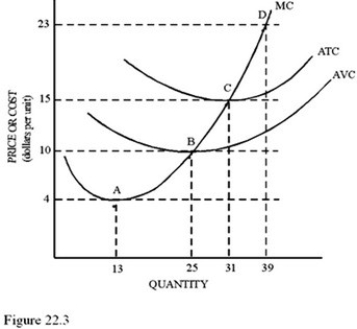 Refer to Figure 22.3 for a perfectly competitive firm.If the market price is $10,
 (Multiple Choice)
4.9/5 (79)
(79) In reference to table 22.1,the $600 paid in property taxes counts as
(Multiple Choice)
4.8/5 (87)
(87) 
Filters
- Essay(0)
- Multiple Choice(0)
- Short Answer(0)
- True False(0)
- Matching(0)