



 Chat with AI
Exam 24: Monopoly

Exam 1: Economics: the Core Issues152 Questions
Exam 2: The Useconomy: a Global View146 Questions
Exam 3: Supply and Demand164 Questions
Exam 4: The Role of Government153 Questions
Exam 5: National Income Accounting152 Questions
Exam 6: Unemployment147 Questions
Exam 7: Inflation152 Questions
Exam 8: The Business Cycle153 Questions
Exam 9: Aggregate Demand149 Questions
Exam 10: Self-Adjustment or Instability140 Questions
Exam 11: Fiscal Policy151 Questions
Exam 12: Deficits and Debt151 Questions
Exam 13: Money and Banks146 Questions
Exam 14: The Federal Reserve System146 Questions
Exam 15: Monetary Policy149 Questions
Exam 16: Supply-Side Policy: Short-Run Options147 Questions
Exam 17: Growth and Productivity: Long-Run Possibilities143 Questions
Exam 18: Theory Versus Reality146 Questions
Exam 19: Consumer Choice136 Questions
Exam 20: Elasticity141 Questions
Exam 21: The Costs of Production151 Questions
Exam 22: The Competitive Firm148 Questions
Exam 23: Competitive Markets150 Questions
Exam 24: Monopoly147 Questions
Exam 25: Oligopoly145 Questions
Exam 26: Monopolistic Competition144 Questions
Exam 27: Natural Monopolies: Deregulation144 Questions
Exam 28: Environmental Protection144 Questions
Exam 29: The Farm Problem132 Questions
Exam 30: The Labor Market137 Questions
Exam 31: Labor Unions144 Questions
Exam 32: Financial Markets146 Questions
Exam 33: Taxes: Equity Versus Efficiency146 Questions
Exam 34: Transfer Payments: Welfare and Social Security146 Questions
Exam 35: International Trade149 Questions
Exam 36: International Finance142 Questions
Exam 37: Global Poverty141 Questions
Select questions type


Assume a monopoly confronts the same costs and demand as a competitive industry.In this case,the monopolist produces
(Multiple Choice)
4.9/5  (82)
(82) If a firm can change market prices by altering its output,then it
(Multiple Choice)
4.8/5 (94)
(94) If a company is the sole U.S.producer of good X,the market may still be contestable because of all but which one of the following?
(Multiple Choice)
4.8/5 (87)
(87) All of the following are limitations on the market power of a monopoly except
(Multiple Choice)
4.8/5 (89)
(89) The World View article titled "Russia's Sable Monopoly Persists" provides evidence that Russia experienced
(Multiple Choice)
4.7/5 (90)
(90) Which of the following is true about the output level where marginal revenue equals marginal cost?
(Multiple Choice)
4.8/5 (86)
(86) Table 24.1 Monopoly Costs and Revenue
Quantity Price Total Cost 1 \ 500 \ 400 2 \ 450 \ 650 3 \ 400 \ 950 4 \ 350 \ 1,300 5 \ 300 \ 1,700 In Table 24.1,using the profit maximization rule,a monopolist will charge a price of
(Multiple Choice)
5.0/5 (70)
(70) 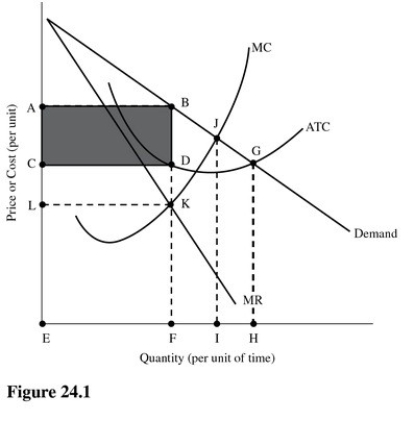 In Figure 24.1,total revenue is represented by the area
Which of the following is a barrier to entry into a monopoly market?
(Multiple Choice)
4.9/5 (86)
(86) Which of the following is the same for monopoly and competition under the same cost and demand conditions?
(Multiple Choice)
5.0/5 (88)
(88) Table 24.1 Monopoly Costs and Revenue
Quantity Price Total Cost 1 \ 500 \ 400 2 \ 450 \ 650 3 \ 400 \ 950 4 \ 350 \ 1,300 5 \ 300 \ 1,700 In Table 24.1,the maximum profit that can be achieved is
(Multiple Choice)
4.8/5 (77)
(77) Price-discriminating firms that sell in two markets will charge higher prices in the market,ceteris paribus,
(Multiple Choice)
4.8/5 (70)
(70) 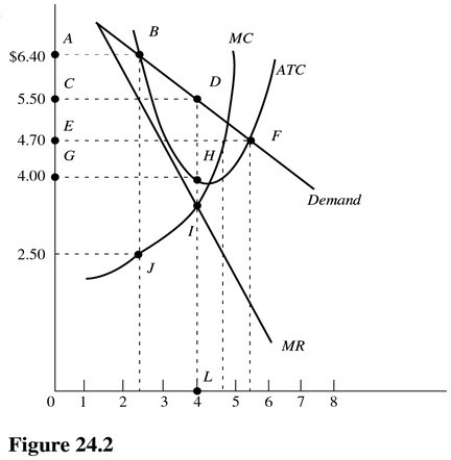 In Figure 24.2,total profit at the profit-maximizing rate of output is
 (Multiple Choice)
4.8/5 (85)
(85) 
Filters
- Essay(0)
- Multiple Choice(0)
- Short Answer(0)
- True False(0)
- Matching(0)