



 Chat with AI
Exam 24: Monopoly

Exam 1: Economics: the Core Issues152 Questions
Exam 2: The Useconomy: a Global View146 Questions
Exam 3: Supply and Demand164 Questions
Exam 4: The Role of Government153 Questions
Exam 5: National Income Accounting152 Questions
Exam 6: Unemployment147 Questions
Exam 7: Inflation152 Questions
Exam 8: The Business Cycle153 Questions
Exam 9: Aggregate Demand149 Questions
Exam 10: Self-Adjustment or Instability140 Questions
Exam 11: Fiscal Policy151 Questions
Exam 12: Deficits and Debt151 Questions
Exam 13: Money and Banks146 Questions
Exam 14: The Federal Reserve System146 Questions
Exam 15: Monetary Policy149 Questions
Exam 16: Supply-Side Policy: Short-Run Options147 Questions
Exam 17: Growth and Productivity: Long-Run Possibilities143 Questions
Exam 18: Theory Versus Reality146 Questions
Exam 19: Consumer Choice136 Questions
Exam 20: Elasticity141 Questions
Exam 21: The Costs of Production151 Questions
Exam 22: The Competitive Firm148 Questions
Exam 23: Competitive Markets150 Questions
Exam 24: Monopoly147 Questions
Exam 25: Oligopoly145 Questions
Exam 26: Monopolistic Competition144 Questions
Exam 27: Natural Monopolies: Deregulation144 Questions
Exam 28: Environmental Protection144 Questions
Exam 29: The Farm Problem132 Questions
Exam 30: The Labor Market137 Questions
Exam 31: Labor Unions144 Questions
Exam 32: Financial Markets146 Questions
Exam 33: Taxes: Equity Versus Efficiency146 Questions
Exam 34: Transfer Payments: Welfare and Social Security146 Questions
Exam 35: International Trade149 Questions
Exam 36: International Finance142 Questions
Exam 37: Global Poverty141 Questions
Select questions type


The In the News article "A Sirius Mistake? FCC Approves XM-Sirius Merger" discusses the proposed merger of two satellite radio companies.Antitrust officials will examine the merger in order to
(Multiple Choice)
5.0/5  (69)
(69) Describe how monopolists use barriers to entry to maintain their pricing power.
(Essay)
4.9/5 (85)
(85) 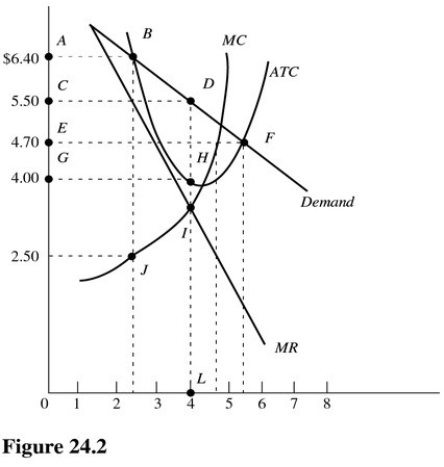 In Figure 24.2,total cost at the profit-maximizing rate of output is
 (Multiple Choice)
4.8/5 (89)
(89) 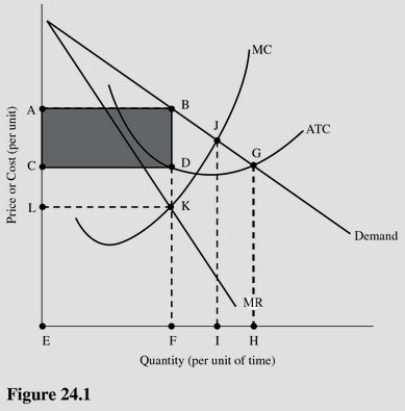 In Figure 24.1,total profit is represented by the area
Table 24.1 Monopoly Costs and Revenue
Quantity Price Total Cost 1 \ 500 \ 400 2 \ 450 \ 650 3 \ 400 \ 950 4 \ 350 \ 1,300 5 \ 300 \ 1,700 In Table 24.1,according to the profit maximization rule,at the profit-maximizing level of output,marginal revenue is
(Multiple Choice)
4.9/5 (78)
(78) Google holds market power by all of the following strategies except
(Multiple Choice)
4.8/5 (73)
(73) To maintain market power,firms will sometimes purchase their competitors.
(True/False)
4.9/5 (81)
(81) The Federal Trade Commission was created to study industry structures and behavior and identify anticompetitive practices.
(True/False)
4.9/5 (72)
(72) The primary purpose of antitrust policy in the United States is to
(Multiple Choice)
4.9/5 (83)
(83) 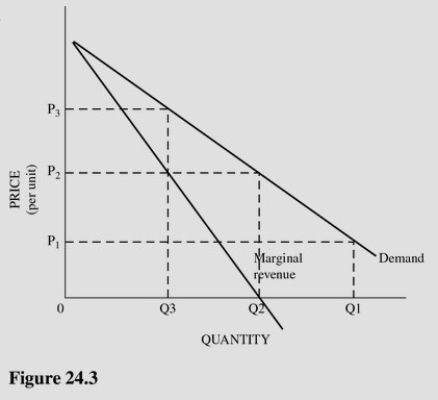 Refer to Figure 24.3.Suppose this good could somehow be produced at no cost (that is,the total cost at any level of output was zero).This single-price monopoly firm would maximize profit by
 (Multiple Choice)
4.8/5 (90)
(90) In the long run,a monopolist can continue to earn economic profits.
(True/False)
4.9/5 (100)
(100) When compared to a competitive market,monopolists tend to charge a higher price and produce a greater level of output.
(True/False)
5.0/5 (71)
(71) 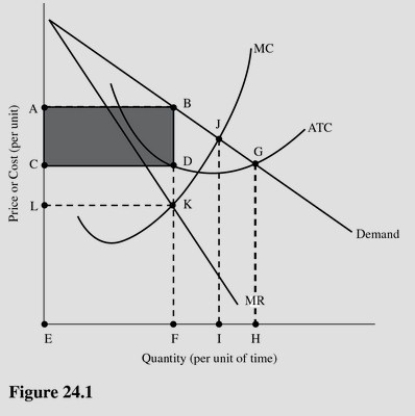 The shaded area in Figure 24.1 represents
An In the News article titled "Jury Awards $26 Million For Suppressed Technology" reported,that a county superior court jury in Oakland ordered Universal to pay $25.7 million to two California entrepreneurs.The most correct implication of this is that Universal
(Multiple Choice)
4.9/5 (89)
(89) A monopoly is considered more desirable to society than a perfectly competitive firm because a monopoly has the incentive to pursue research and development.
(True/False)
4.9/5 (86)
(86) 
Filters
- Essay(0)
- Multiple Choice(0)
- Short Answer(0)
- True False(0)
- Matching(0)