



 Chat with AI
Exam 27: Natural Monopolies: Deregulation

Exam 1: Economics: the Core Issues152 Questions
Exam 2: The Useconomy: a Global View146 Questions
Exam 3: Supply and Demand164 Questions
Exam 4: The Role of Government153 Questions
Exam 5: National Income Accounting152 Questions
Exam 6: Unemployment147 Questions
Exam 7: Inflation152 Questions
Exam 8: The Business Cycle153 Questions
Exam 9: Aggregate Demand149 Questions
Exam 10: Self-Adjustment or Instability140 Questions
Exam 11: Fiscal Policy151 Questions
Exam 12: Deficits and Debt151 Questions
Exam 13: Money and Banks146 Questions
Exam 14: The Federal Reserve System146 Questions
Exam 15: Monetary Policy149 Questions
Exam 16: Supply-Side Policy: Short-Run Options147 Questions
Exam 17: Growth and Productivity: Long-Run Possibilities143 Questions
Exam 18: Theory Versus Reality146 Questions
Exam 19: Consumer Choice136 Questions
Exam 20: Elasticity141 Questions
Exam 21: The Costs of Production151 Questions
Exam 22: The Competitive Firm148 Questions
Exam 23: Competitive Markets150 Questions
Exam 24: Monopoly147 Questions
Exam 25: Oligopoly145 Questions
Exam 26: Monopolistic Competition144 Questions
Exam 27: Natural Monopolies: Deregulation144 Questions
Exam 28: Environmental Protection144 Questions
Exam 29: The Farm Problem132 Questions
Exam 30: The Labor Market137 Questions
Exam 31: Labor Unions144 Questions
Exam 32: Financial Markets146 Questions
Exam 33: Taxes: Equity Versus Efficiency146 Questions
Exam 34: Transfer Payments: Welfare and Social Security146 Questions
Exam 35: International Trade149 Questions
Exam 36: International Finance142 Questions
Exam 37: Global Poverty141 Questions
Select questions type


One consequence of airline deregulation in the 1980s was an increased concentration ratio.
(True/False)
4.9/5  (93)
(93) The collapse of AT&T's natural monopoly in long-distance telephone service was caused by
(Multiple Choice)
4.8/5 (76)
(76) If government intervention fails to improve upon market outcomes,this is known as market failure.
(True/False)
4.8/5 (82)
(82) The "JetBlue Effect" has caused all of the following except
(Multiple Choice)
4.8/5 (84)
(84) Deregulation in railroads,airlines,and telephone service has generally resulted in higher prices.
(True/False)
4.9/5 (61)
(61) 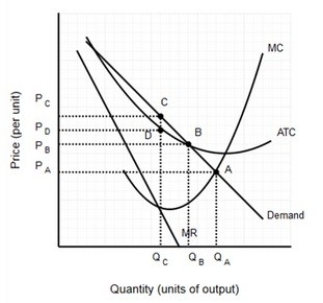 In Figure 27.2,profit regulation will lead the natural monopoly to produce
 (Multiple Choice)
4.8/5 (78)
(78) Which of the following is a form of government intervention that is designed to correct market failures?
(Multiple Choice)
4.8/5 (76)
(76) 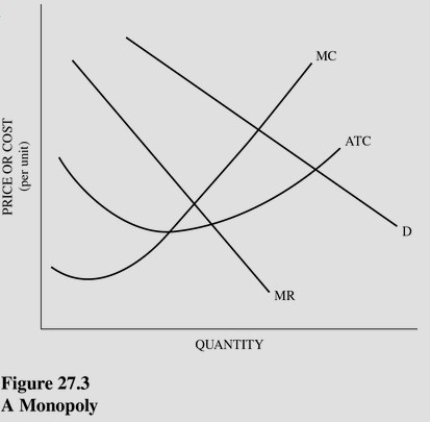 Which of the following is true about this firm?
The argument for regulation is that markets can generate imperfect outcomes,while the argument for deregulation is that government sometimes worsens market outcomes.
(True/False)
4.9/5 (73)
(73) Deregulation of the telephone industry has reduced price competition and the volume of telephone service,ceteris paribus.
(True/False)
4.8/5 (81)
(81) 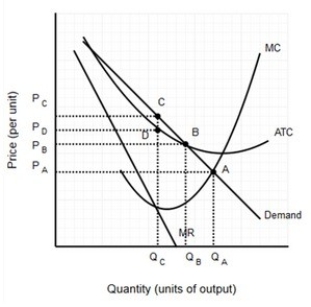 Output regulation for the natural monopoly in Figure 27.2 would result in an output of
 (Multiple Choice)
4.9/5 (67)
(67) The best way to address a natural monopoly without dismantling the economies of scale is
(Multiple Choice)
4.8/5 (77)
(77) The marginal benefits of regulation should exceed the marginal costs of regulation if additional regulations are to be imposed.
(True/False)
4.8/5 (80)
(80) According to "Sleep Rules Raise Trucking Costs," in 2013 the Federal Motor Carrier Safety Administration estimated the new rules regulating the transportation industry would cost trucking companies about $2 billion.What benefits did the government expect from the costly regulations?
(Multiple Choice)
5.0/5 (74)
(74) What development turned the cable TV market into a contestable one?
(Multiple Choice)
4.8/5 (66)
(66) A natural monopoly has no incentive to limit its costs of production under which type of regulation?
(Multiple Choice)
4.7/5 (70)
(70) Deregulation of the railroad,airline,and electricity industries has yielded substantial benefits: more competition,lower prices,and improved services.
(True/False)
4.9/5 (66)
(66) 
Filters
- Essay(0)
- Multiple Choice(0)
- Short Answer(0)
- True False(0)
- Matching(0)