



 Chat with AI
Exam 27: Natural Monopolies: Deregulation

Exam 1: Economics: the Core Issues152 Questions
Exam 2: The Useconomy: a Global View146 Questions
Exam 3: Supply and Demand164 Questions
Exam 4: The Role of Government153 Questions
Exam 5: National Income Accounting152 Questions
Exam 6: Unemployment147 Questions
Exam 7: Inflation152 Questions
Exam 8: The Business Cycle153 Questions
Exam 9: Aggregate Demand149 Questions
Exam 10: Self-Adjustment or Instability140 Questions
Exam 11: Fiscal Policy151 Questions
Exam 12: Deficits and Debt151 Questions
Exam 13: Money and Banks146 Questions
Exam 14: The Federal Reserve System146 Questions
Exam 15: Monetary Policy149 Questions
Exam 16: Supply-Side Policy: Short-Run Options147 Questions
Exam 17: Growth and Productivity: Long-Run Possibilities143 Questions
Exam 18: Theory Versus Reality146 Questions
Exam 19: Consumer Choice136 Questions
Exam 20: Elasticity141 Questions
Exam 21: The Costs of Production151 Questions
Exam 22: The Competitive Firm148 Questions
Exam 23: Competitive Markets150 Questions
Exam 24: Monopoly147 Questions
Exam 25: Oligopoly145 Questions
Exam 26: Monopolistic Competition144 Questions
Exam 27: Natural Monopolies: Deregulation144 Questions
Exam 28: Environmental Protection144 Questions
Exam 29: The Farm Problem132 Questions
Exam 30: The Labor Market137 Questions
Exam 31: Labor Unions144 Questions
Exam 32: Financial Markets146 Questions
Exam 33: Taxes: Equity Versus Efficiency146 Questions
Exam 34: Transfer Payments: Welfare and Social Security146 Questions
Exam 35: International Trade149 Questions
Exam 36: International Finance142 Questions
Exam 37: Global Poverty141 Questions
Select questions type


The industry that is the most recent target of deregulation is the
(Multiple Choice)
4.9/5  (76)
(76) The term market failure means the market mechanism has not generated the best possible mix of output.
(True/False)
4.8/5 (81)
(81) If a natural monopoly was broken into several smaller competing firms,
(Multiple Choice)
4.7/5 (77)
(77) When firms have the ability to restrict output,raise prices,stifle competition,and inhibit innovation,the market failure involved is
(Multiple Choice)
4.9/5 (76)
(76) The argument for government intervention implies that government regulation can improve market outcomes.
(True/False)
4.7/5 (69)
(69) All of the following are examples of natural monopolies except
(Multiple Choice)
4.9/5 (67)
(67) Which regulatory cost is borne by the firms that are regulated?
(Multiple Choice)
4.8/5 (69)
(69) Eliminating economic profit of a natural monopolist may be justifiable on the basis of society's equity goal.
(True/False)
4.8/5 (84)
(84) In response to deregulation,the quality and variety of airline services rose.
(True/False)
4.7/5 (71)
(71) A natural monopoly can purposely increase its cost of production by
(Multiple Choice)
5.0/5 (72)
(72) Initially the number of airline firms fell in response to deregulation.
(True/False)
4.8/5 (80)
(80) The major problem with price efficiency regulation is that the natural monopolist loses money or earns negative profits.
(True/False)
4.8/5 (82)
(82) Which of the following can the government use to alter both firm behavior and industry structure?
(Multiple Choice)
4.9/5 (78)
(78) 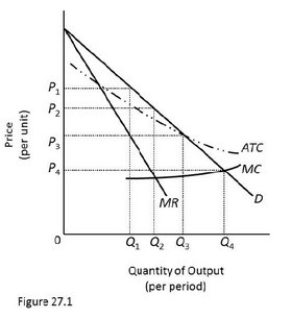 The socially optimal price and output combination in Figure 27.1 is
 (Multiple Choice)
4.9/5 (80)
(80) A natural monopolist can produce total industry output more efficiently than several smaller but competitive firms.
(True/False)
5.0/5 (84)
(84) 
Filters
- Essay(0)
- Multiple Choice(0)
- Short Answer(0)
- True False(0)
- Matching(0)