



 Chat with AI
Exam 33: Taxes: Equity Versus Efficiency

Exam 1: Economics: the Core Issues152 Questions
Exam 2: The Useconomy: a Global View146 Questions
Exam 3: Supply and Demand164 Questions
Exam 4: The Role of Government153 Questions
Exam 5: National Income Accounting152 Questions
Exam 6: Unemployment147 Questions
Exam 7: Inflation152 Questions
Exam 8: The Business Cycle153 Questions
Exam 9: Aggregate Demand149 Questions
Exam 10: Self-Adjustment or Instability140 Questions
Exam 11: Fiscal Policy151 Questions
Exam 12: Deficits and Debt151 Questions
Exam 13: Money and Banks146 Questions
Exam 14: The Federal Reserve System146 Questions
Exam 15: Monetary Policy149 Questions
Exam 16: Supply-Side Policy: Short-Run Options147 Questions
Exam 17: Growth and Productivity: Long-Run Possibilities143 Questions
Exam 18: Theory Versus Reality146 Questions
Exam 19: Consumer Choice136 Questions
Exam 20: Elasticity141 Questions
Exam 21: The Costs of Production151 Questions
Exam 22: The Competitive Firm148 Questions
Exam 23: Competitive Markets150 Questions
Exam 24: Monopoly147 Questions
Exam 25: Oligopoly145 Questions
Exam 26: Monopolistic Competition144 Questions
Exam 27: Natural Monopolies: Deregulation144 Questions
Exam 28: Environmental Protection144 Questions
Exam 29: The Farm Problem132 Questions
Exam 30: The Labor Market137 Questions
Exam 31: Labor Unions144 Questions
Exam 32: Financial Markets146 Questions
Exam 33: Taxes: Equity Versus Efficiency146 Questions
Exam 34: Transfer Payments: Welfare and Social Security146 Questions
Exam 35: International Trade149 Questions
Exam 36: International Finance142 Questions
Exam 37: Global Poverty141 Questions
Select questions type


If the area between the diagonal line of absolute equality and the Lorenz curve is greater for the United States than for Japan,we can conclude that the
(Multiple Choice)
4.7/5  (79)
(79) 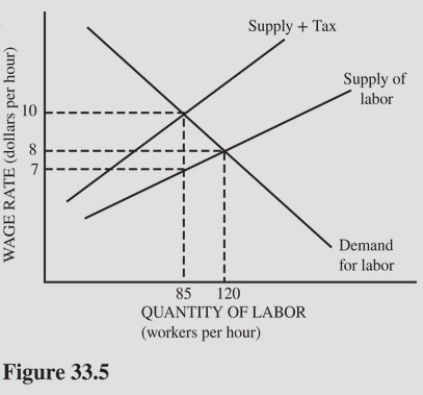 Refer to the labor market in Figure 33.5.Suppose that the government imposes a payroll tax on employers in this market.How much will the government collect in tax receipts for every worker hired?
 (Multiple Choice)
4.8/5 (68)
(68) Assume the marginal tax rate is 10 percent for the first $30,000 of income,15 percent for income between $30,000 and $70,000,and 20 percent for any income over $70,000.If Emily has taxable income equal to $80,000 for the year,what is her tax bill?
(Multiple Choice)
4.8/5 (76)
(76) A person can have a great deal of wealth but have very little income.
(True/False)
4.9/5 (78)
(78) If the tax elasticity of supply is 0.6 and tax rates increase by 10 percent,the quantity of labor supplied will
(Multiple Choice)
4.8/5 (91)
(91) The principle of horizontal equity is violated if two people who earn the same amount of income actually pay a different amount in taxes.
(True/False)
4.9/5 (81)
(81) Assume the marginal tax rate is 12 percent for the first $40,000 of income,28 percent for income between $40,000 and $100,000,and 30 percent for any income over $100,000.If Sarah has taxable income equal to $120,000 for the year,what is her tax bill?
(Multiple Choice)
4.9/5 (69)
(69) An economy with nominal tax rates significantly higher than effective tax rates has
(Multiple Choice)
4.8/5 (78)
(78) The Bush tax cuts of 2001-2010 increased education incentives,and as a result,
(Multiple Choice)
4.9/5 (84)
(84) The taxation principle that says people with higher incomes should pay more in taxes than those with lower incomes is called
(Multiple Choice)
4.8/5 (75)
(75) If a tax system has no deductions,exemptions,or other loopholes,then the effective tax rate will be
(Multiple Choice)
4.7/5 (66)
(66) 
Filters
- Essay(0)
- Multiple Choice(0)
- Short Answer(0)
- True False(0)
- Matching(0)