



 Chat with AI
Exam 33: Taxes: Equity Versus Efficiency

Exam 1: Economics: the Core Issues152 Questions
Exam 2: The Useconomy: a Global View146 Questions
Exam 3: Supply and Demand164 Questions
Exam 4: The Role of Government153 Questions
Exam 5: National Income Accounting152 Questions
Exam 6: Unemployment147 Questions
Exam 7: Inflation152 Questions
Exam 8: The Business Cycle153 Questions
Exam 9: Aggregate Demand149 Questions
Exam 10: Self-Adjustment or Instability140 Questions
Exam 11: Fiscal Policy151 Questions
Exam 12: Deficits and Debt151 Questions
Exam 13: Money and Banks146 Questions
Exam 14: The Federal Reserve System146 Questions
Exam 15: Monetary Policy149 Questions
Exam 16: Supply-Side Policy: Short-Run Options147 Questions
Exam 17: Growth and Productivity: Long-Run Possibilities143 Questions
Exam 18: Theory Versus Reality146 Questions
Exam 19: Consumer Choice136 Questions
Exam 20: Elasticity141 Questions
Exam 21: The Costs of Production151 Questions
Exam 22: The Competitive Firm148 Questions
Exam 23: Competitive Markets150 Questions
Exam 24: Monopoly147 Questions
Exam 25: Oligopoly145 Questions
Exam 26: Monopolistic Competition144 Questions
Exam 27: Natural Monopolies: Deregulation144 Questions
Exam 28: Environmental Protection144 Questions
Exam 29: The Farm Problem132 Questions
Exam 30: The Labor Market137 Questions
Exam 31: Labor Unions144 Questions
Exam 32: Financial Markets146 Questions
Exam 33: Taxes: Equity Versus Efficiency146 Questions
Exam 34: Transfer Payments: Welfare and Social Security146 Questions
Exam 35: International Trade149 Questions
Exam 36: International Finance142 Questions
Exam 37: Global Poverty141 Questions
Select questions type


Suppose a taxpayer has an income of $100,000 and a taxable income of $80,000,and pays taxes of $10,000.If the taxpayer talks of being taxed at a 10 percent rate,she is referring to the
(Multiple Choice)
4.9/5  (73)
(73) If an accountant makes $80,000 and after deductions pays $8,000 in taxes while an administrative assistant makes $35,000 and after deductions pays $2,000 in taxes,this is an example of
(Multiple Choice)
4.9/5 (87)
(87) If the area between the diagonal line of absolute equality and the Lorenz curve is greater for China than for the United States,we can conclude that the
(Multiple Choice)
4.9/5 (78)
(78) If the percentage of income paid in taxes increases as income rises,then the tax system is
(Multiple Choice)
4.8/5 (74)
(74) Suppose a taxpayer has an income of $70,000 and a taxable income of $60,000,and pays $9,000 in taxes.If the taxpayer says she is taxed at a 15 percent tax rate,she is referring to the
(Multiple Choice)
4.9/5 (74)
(74) Which of the following statements regarding the distribution of money income is most correct?
(Multiple Choice)
4.9/5 (70)
(70) Suppose Ms.Sanchez has a total income of $200,000,has a taxable income of $120,000,and pays $40,000 in taxes.Considering the information,what is Ms.Sanchez's nominal tax rate?
(Multiple Choice)
4.9/5 (83)
(83) 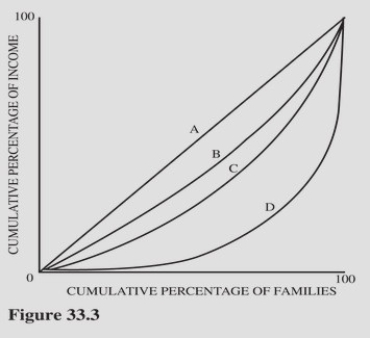 Figure 33.3 illustrates Lorenz curves for four different economies.For which economy would the lowest 20 percent of families receive the smallest share of total income?
 (Multiple Choice)
4.8/5 (85)
(85) Define vertical equity and horizontal equity.How do tax loopholes sometimes create vertical and horizontal inequity?
(Essay)
4.9/5 (78)
(78) Suppose a taxpayer has an income of $50,000 and a taxable income of $45,000,and pays $5,000 in taxes.If the taxpayer talks of being taxed at a 10 percent tax rate,she is referring to the
(Multiple Choice)
4.9/5 (80)
(80) If the Gini coefficient is greater for Zambia than for the Netherlands,we can conclude that the
(Multiple Choice)
4.9/5 (71)
(71) One World View article is titled "Bono Says "Stupid" to Pay Irish Taxes."" The band U2 moved its corporate headquarters to Amsterdam because the Irish government
(Multiple Choice)
4.8/5 (79)
(79) 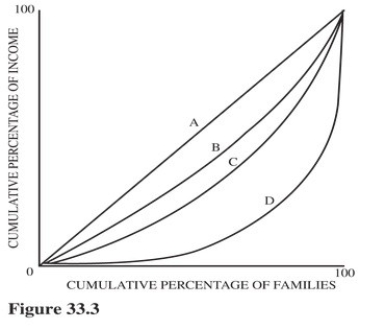 Figure 33.3 illustrate Lorenz curves for four different economies.Which economy will have a Gini coefficient of zero?
 (Multiple Choice)
4.8/5 (80)
(80) 
Filters
- Essay(0)
- Multiple Choice(0)
- Short Answer(0)
- True False(0)
- Matching(0)