



 Chat with AI
Exam 35: International Trade

Exam 1: Economics: the Core Issues152 Questions
Exam 2: The Useconomy: a Global View146 Questions
Exam 3: Supply and Demand164 Questions
Exam 4: The Role of Government153 Questions
Exam 5: National Income Accounting152 Questions
Exam 6: Unemployment147 Questions
Exam 7: Inflation152 Questions
Exam 8: The Business Cycle153 Questions
Exam 9: Aggregate Demand149 Questions
Exam 10: Self-Adjustment or Instability140 Questions
Exam 11: Fiscal Policy151 Questions
Exam 12: Deficits and Debt151 Questions
Exam 13: Money and Banks146 Questions
Exam 14: The Federal Reserve System146 Questions
Exam 15: Monetary Policy149 Questions
Exam 16: Supply-Side Policy: Short-Run Options147 Questions
Exam 17: Growth and Productivity: Long-Run Possibilities143 Questions
Exam 18: Theory Versus Reality146 Questions
Exam 19: Consumer Choice136 Questions
Exam 20: Elasticity141 Questions
Exam 21: The Costs of Production151 Questions
Exam 22: The Competitive Firm148 Questions
Exam 23: Competitive Markets150 Questions
Exam 24: Monopoly147 Questions
Exam 25: Oligopoly145 Questions
Exam 26: Monopolistic Competition144 Questions
Exam 27: Natural Monopolies: Deregulation144 Questions
Exam 28: Environmental Protection144 Questions
Exam 29: The Farm Problem132 Questions
Exam 30: The Labor Market137 Questions
Exam 31: Labor Unions144 Questions
Exam 32: Financial Markets146 Questions
Exam 33: Taxes: Equity Versus Efficiency146 Questions
Exam 34: Transfer Payments: Welfare and Social Security146 Questions
Exam 35: International Trade149 Questions
Exam 36: International Finance142 Questions
Exam 37: Global Poverty141 Questions
Select questions type


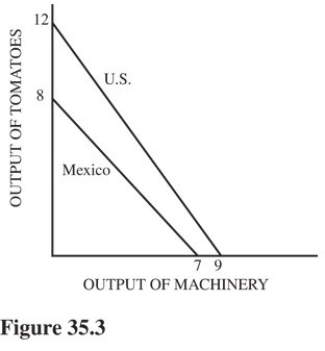 Refer to Figure 35.3 for the production possibilities curves for the United States and Mexico.These two curves indicate that
 (Multiple Choice)
4.9/5  (81)
(81) Comparative advantage refers to the ability to produce output with fewer resources than any other country.
(True/False)
4.8/5 (66)
(66) When a country has a lower opportunity cost in producing a good than any other country,
(Multiple Choice)
4.9/5 (73)
(73) Producers of paper products are most likely to be in favor of
(Multiple Choice)
4.7/5 (70)
(70) A trade deficit means that exports exceed imports over some relevant time period.
(True/False)
4.7/5 (71)
(71) If the United States raises tariffs on foreign goods,it may achieve
(Multiple Choice)
4.7/5 (58)
(58) If a country engages in trade with other countries,it is known as
(Multiple Choice)
4.9/5 (75)
(75) Assume South Korea and Vietnam have the same amount of resources.In a given time period,South Korea can produce 100,000 jackets or 1,000,000 shirts.Vietnam can produce 200,000 jackets or 2,000,000 shirts.This means that
(Multiple Choice)
4.9/5 (73)
(73) Suppose China can produce either 300 telephones or 200 DVD players,and Japan can produce either 200 telephones or 100 DVD players.Implicitly,Japan has
(Multiple Choice)
4.7/5 (83)
(83) Discuss the differences between a tariff and a quota.Explain why quotas are considered to be a greater threat to competition than tariffs.
(Essay)
4.8/5 (69)
(69) World output of goods and services increases with specialization because
(Multiple Choice)
4.7/5 (71)
(71) What is the "beggar-thy-neighbor" policy,and why is it a problem for the country that caused it?
(Essay)
4.8/5 (86)
(86) 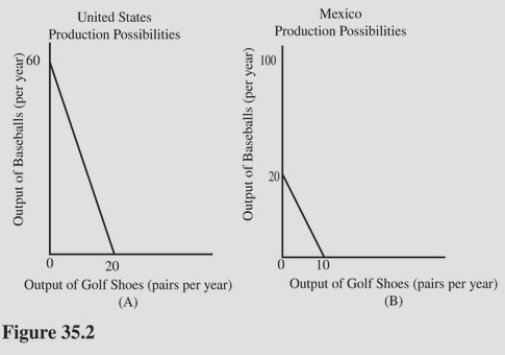 Based on the comparative cost ratios implied in Figure 35.2,it is clear that
 (Multiple Choice)
4.8/5 (79)
(79) Free trade benefits the nation as a whole but may hurt specific industries and workers.
(True/False)
4.9/5 (83)
(83) 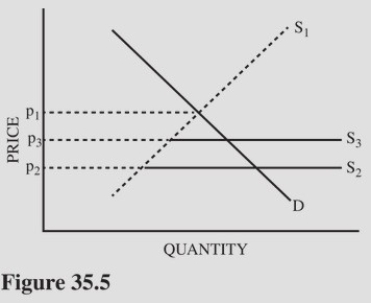 Refer to Figure 35.5.S1 represents the U.S.domestic supply of a good and S2 represents supply in the United States under conditions of free trade.If the United States imposes a tariff on this good,what will happen to the quantity imported?
 (Multiple Choice)
4.9/5 (83)
(83) 
Filters
- Essay(0)
- Multiple Choice(0)
- Short Answer(0)
- True False(0)
- Matching(0)