



 Chat with AI
Exam 35: International Trade

Exam 1: Economics: the Core Issues152 Questions
Exam 2: The Useconomy: a Global View146 Questions
Exam 3: Supply and Demand164 Questions
Exam 4: The Role of Government153 Questions
Exam 5: National Income Accounting152 Questions
Exam 6: Unemployment147 Questions
Exam 7: Inflation152 Questions
Exam 8: The Business Cycle153 Questions
Exam 9: Aggregate Demand149 Questions
Exam 10: Self-Adjustment or Instability140 Questions
Exam 11: Fiscal Policy151 Questions
Exam 12: Deficits and Debt151 Questions
Exam 13: Money and Banks146 Questions
Exam 14: The Federal Reserve System146 Questions
Exam 15: Monetary Policy149 Questions
Exam 16: Supply-Side Policy: Short-Run Options147 Questions
Exam 17: Growth and Productivity: Long-Run Possibilities143 Questions
Exam 18: Theory Versus Reality146 Questions
Exam 19: Consumer Choice136 Questions
Exam 20: Elasticity141 Questions
Exam 21: The Costs of Production151 Questions
Exam 22: The Competitive Firm148 Questions
Exam 23: Competitive Markets150 Questions
Exam 24: Monopoly147 Questions
Exam 25: Oligopoly145 Questions
Exam 26: Monopolistic Competition144 Questions
Exam 27: Natural Monopolies: Deregulation144 Questions
Exam 28: Environmental Protection144 Questions
Exam 29: The Farm Problem132 Questions
Exam 30: The Labor Market137 Questions
Exam 31: Labor Unions144 Questions
Exam 32: Financial Markets146 Questions
Exam 33: Taxes: Equity Versus Efficiency146 Questions
Exam 34: Transfer Payments: Welfare and Social Security146 Questions
Exam 35: International Trade149 Questions
Exam 36: International Finance142 Questions
Exam 37: Global Poverty141 Questions
Select questions type


To ensure mutually beneficial trade,the terms of trade between two countries should always
(Multiple Choice)
5.0/5  (73)
(73) If every country specializes in what it produces best and then trades,more will be produced than if each country tries to produce everything for its own needs.
(True/False)
5.0/5 (70)
(70) The terms of trade between any two countries for two goods cannot be between their respective opportunity costs if there are to be any gains in trade.
(True/False)
4.8/5 (71)
(71) 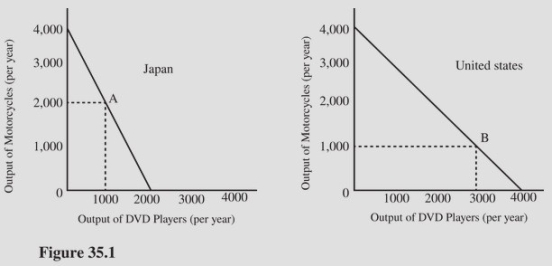 In Figure 35.1,what is the opportunity cost of DVD players in Japan?
 (Multiple Choice)
4.9/5 (66)
(66) As a result of GATT,tariff rates in developed countries have decreased from 40 percent in 1948 to less than 4 percent today.
(True/False)
5.0/5 (84)
(84) 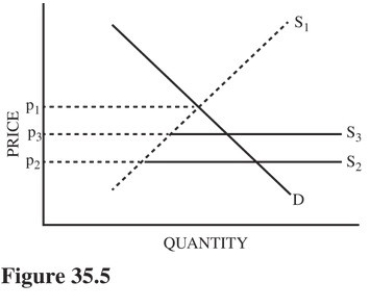 Refer to Figure 35.5.If S1 represents the U.S.domestic supply of a good and S2 represents supply in the United States under conditions of free trade,what does S3 most likely represent?
 (Multiple Choice)
4.9/5 (85)
(85) The World View article "U.S.Slaps China with Huge Anti-Dumping Tariffs" says new tariffs will be imposed on steel from China,and
(Multiple Choice)
4.7/5 (82)
(82) The United States imports heavily in all of the following markets except
(Multiple Choice)
4.8/5 (92)
(92) 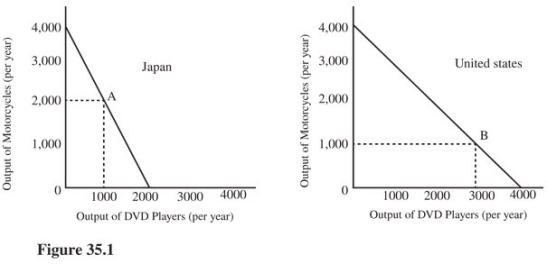 Compared to their initial positions at points A and B,as a result of complete specialization and trade,the output of the two countries added together in Figure 35.1 would result in an increase in
 (Multiple Choice)
4.9/5 (63)
(63) In the World View article on new tariffs on imported steel from China,the tariff is designed to
(Multiple Choice)
4.8/5 (92)
(92) Suppose the production of 12 tons of copper in the United States requires the same amount of resources as the production of 3 tons of aluminum.In Mexico,12 tons of copper requires the same amount of resources as 2 tons of aluminum.Implicitly
(Multiple Choice)
4.9/5 (79)
(79) Trade restrictions designed to benefit the import-competing industries will benefit the entire country.
(True/False)
4.8/5 (87)
(87) 
Filters
- Essay(0)
- Multiple Choice(0)
- Short Answer(0)
- True False(0)
- Matching(0)