



 Chat with AI
Exam 20: Cardiovascular System: the Heart

Exam 1: The Human Organism111 Questions
Exam 2: The Chemical Basis of Life155 Questions
Exam 3: Cell Biology211 Questions
Exam 4: Tissues153 Questions
Exam 5: Integumentary System139 Questions
Exam 6: Skeletal System: Bones and Bone Tissue150 Questions
Exam 7: Skeletal System: Gross Anatomy178 Questions
Exam 8: Joints and Movement119 Questions
Exam 9: Muscular System: Histology and Physiology194 Questions
Exam 10: Muscular System: Gross Anatomy135 Questions
Exam 11: Functional Organization of Nervous Tissue155 Questions
Exam 12: Spinal Cord and Spinal Nerves124 Questions
Exam 13: Brain and Cranial Nerves146 Questions
Exam 14: Integration of Nervous System Functions132 Questions
Exam 15: The Special Senses195 Questions
Exam 16: Autonomic Nervous System109 Questions
Exam 17: Functional Organization of the Endocrine System77 Questions
Exam 18: Endocrine Glands160 Questions
Exam 19: Cardiovascular System: Blood145 Questions
Exam 20: Cardiovascular System: the Heart180 Questions
Exam 21: Cardiovascular System: Blood Vessels and Circulation220 Questions
Exam 22: Lymphatic System and Immunity171 Questions
Exam 23: Respiratory System178 Questions
Exam 24: Digestive System258 Questions
Exam 25: Nutrition, Metabolism, and Temperature Regulation164 Questions
Exam 26: Urinary System207 Questions
Exam 27: Water, Electrolytes, and Acidbase Balance133 Questions
Exam 28: Reproductive System189 Questions
Exam 29: Development, Growth, Aging, and Genetics187 Questions
Select questions type


Match the condition with the description.
-coronary thrombosis
(Multiple Choice)
4.8/5  (82)
(82) A serious condition in which a large amount of fluid accumulates in the pericardial cavity and puts pressure of the heart is
(Multiple Choice)
4.8/5 (85)
(85) Which of the following would result from a reduced function of the sodium channels in the SA node?
(Multiple Choice)
4.8/5 (99)
(99) Use the following key to mark the most correct answer.
-(1) end-diastolic volume at rest;
(2) end-diastolic volume during exercise
B
(Multiple Choice)
4.8/5 (80)
(80) Blood flow through the coronary blood vessels decreases during myocardial contraction and increases during myocardial relaxation.
(True/False)
4.8/5 (84)
(84) Regurgitation of blood flow through the aortic semilunar valve would give rise to
(Multiple Choice)
4.9/5 (66)
(66) 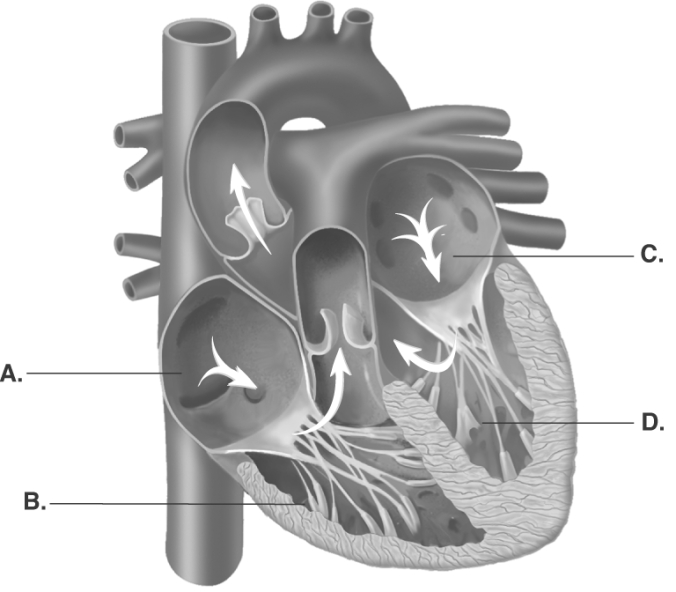 -Blood exiting the pulmonary semilunar valve is leaving this chamber of the heart.
 (Short Answer)
4.7/5 (80)
(80)  -Identify structure "D" on the heart diagram.
Of the types of damage resulting from a myocardial infarction, which is most likely to cause the greatest increase in the Q-T interval?
(Multiple Choice)
4.7/5 (82)
(82) The delivery of oxygen and nutrients to the tissues of the body is accomplished through ________ circulation.
(Multiple Choice)
4.7/5 (86)
(86) Use the following key to mark the most correct answer.
-(1) length of the refractory period in skeletal muscle cells;
(2) length of the refractory period in cardiac muscle cells
B
(Multiple Choice)
4.8/5 (72)
(72)  -The figure illustrates the cardiac action potential. What does "A" represent?
 (Multiple Choice)
4.9/5 (74)
(74) 
Filters
- Essay(0)
- Multiple Choice(0)
- Short Answer(0)
- True False(0)
- Matching(0)