



 Chat with AI
Exam 12: Perfect Competition

Exam 1: What Is Economics479 Questions
Exam 2: The Economic Problem439 Questions
Exam 3: Demand and Supply515 Questions
Exam 4: Elasticity533 Questions
Exam 5: Efficiency and Equity449 Questions
Exam 6: Government Actions in Markets410 Questions
Exam 7: Global Markets in Action200 Questions
Exam 8: Utility and Demand364 Questions
Exam 9: Possibilities, Preferences, and Choices464 Questions
Exam 10: Organizing Production385 Questions
Exam 11: Output and Costs494 Questions
Exam 12: Perfect Competition487 Questions
Exam 13: Monopoly606 Questions
Exam 14: Monopolistic Competition320 Questions
Exam 15: Oligopoly280 Questions
Exam 16: Public Choices and Public Goods356 Questions
Exam 17: Externalities and the Environment284 Questions
Exam 18: Markets for Factors of Production382 Questions
Exam 19: Economic Inequality354 Questions
Exam 20: Uncertainty and Information233 Questions
Exam 21: Extension A: Review11 Questions
Exam 22: Extension B: Review25 Questions
Exam 23: Extension C: Review14 Questions
Exam 24: Extension D: Review38 Questions
Exam 25: Extension E: Review11 Questions
Exam 26: Extension F: Review18 Questions
Select questions type


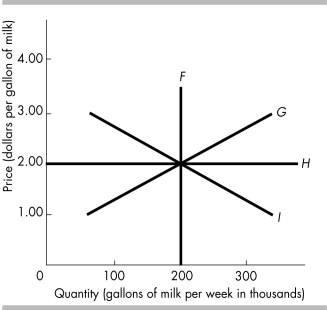 -In the above figure, if the milk industry is perfectly competitive, then the firm's marginal revenue curve is represented by
 (Multiple Choice)
4.8/5  (76)
(76)  -In the above figure, the firm is breaking even at points
A worldwide hops (a flower used in brewing) shortage will make stouts, ales and other specialty microbrews more pricy in 2008. Gayle Goshie, a hops farmer, blames overproduction for hops' previously cheap place on the agricultural market. The glut pushed many hops farmers out business, which gradually helped hops prices recover. Suppose farming hops is a perfectly competitive market. How did farmers going out of business help hops prices recover?
(Multiple Choice)
4.9/5 (82)
(82)  -In the above figure, if the price is $16, a profit-maximizing perfectly competitive firm will
 (Multiple Choice)
4.9/5 (84)
(84)  -In the above figure, the marginal cost of the last unit produced by the profit maximizing firm is
 (Multiple Choice)
4.8/5 (73)
(73) There is a technological advance in a perfectly market. Which of the following statements is NOT true?
(Multiple Choice)
4.9/5 (91)
(91) For a firm in perfect competition, a diagram shows quantity on the horizontal axis and both the firm's marginal cost (MC) and its marginal revenue (MR) on the vertical axis. The firm's profit-maximizing quantity occurs at the point where the
(Multiple Choice)
4.9/5 (83)
(83) The shutdown point occurs at the level of output for which the ________ is at its minimum.
(Multiple Choice)
5.0/5 (66)
(66) When marginal revenue equals marginal cost, a perfectly competitive firm is
(Multiple Choice)
4.8/5 (80)
(80) The difference between a firm's total revenue and its total opportunity cost is the firm's
(Multiple Choice)
4.8/5 (74)
(74) 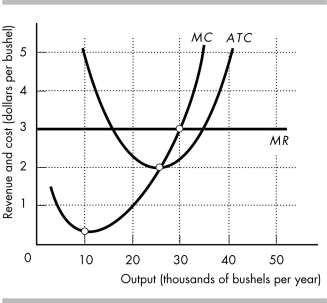 -The above figure illustrates a perfectly competitive wheat farmer.
a) What will be the firm's profit-maximizing price and output?
b) When the farmer produces 25,000 bushels of wheat, the difference between the firm's average total cost and the price is at its maximum. Explain why this amount of wheat either is or is not the profit-maximizing quantity.
-The above figure illustrates a perfectly competitive wheat farmer.
a) What will be the firm's profit-maximizing price and output?
b) When the farmer produces 25,000 bushels of wheat, the difference between the firm's average total cost and the price is at its maximum. Explain why this amount of wheat either is or is not the profit-maximizing quantity. (Essay)
4.8/5 (76)
(76) Which of the following is NOT present in a perfectly competitive market?
(Multiple Choice)
4.8/5 (79)
(79) 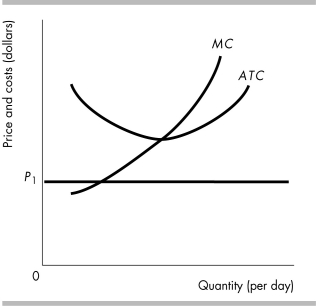 -Suppose the cost curves in the above figure apply to all firms in the market. Then, if the initial price is P1, in the long run the market
 (Multiple Choice)
4.8/5 (86)
(86)  -Consider the perfectly competitive firm in the above figure. The profit maximizing level of output for the firm is equal to
 (Multiple Choice)
4.8/5 (87)
(87) 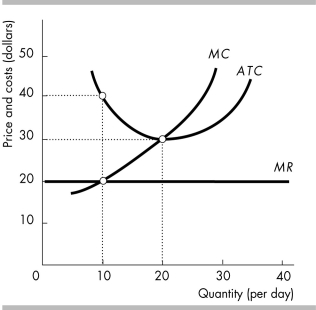 -The figure above shows a perfectly competitive firm. The firm is operating; that is, the firm has not shut down. The firm is
 (Multiple Choice)
4.8/5 (82)
(82) 
Filters
- Essay(0)
- Multiple Choice(0)
- Short Answer(0)
- True False(0)
- Matching(0)