



 Chat with AI
Exam 12: Perfect Competition

Exam 1: What Is Economics479 Questions
Exam 2: The Economic Problem439 Questions
Exam 3: Demand and Supply515 Questions
Exam 4: Elasticity533 Questions
Exam 5: Efficiency and Equity449 Questions
Exam 6: Government Actions in Markets410 Questions
Exam 7: Global Markets in Action200 Questions
Exam 8: Utility and Demand364 Questions
Exam 9: Possibilities, Preferences, and Choices464 Questions
Exam 10: Organizing Production385 Questions
Exam 11: Output and Costs494 Questions
Exam 12: Perfect Competition487 Questions
Exam 13: Monopoly606 Questions
Exam 14: Monopolistic Competition320 Questions
Exam 15: Oligopoly280 Questions
Exam 16: Public Choices and Public Goods356 Questions
Exam 17: Externalities and the Environment284 Questions
Exam 18: Markets for Factors of Production382 Questions
Exam 19: Economic Inequality354 Questions
Exam 20: Uncertainty and Information233 Questions
Exam 21: Extension A: Review11 Questions
Exam 22: Extension B: Review25 Questions
Exam 23: Extension C: Review14 Questions
Exam 24: Extension D: Review38 Questions
Exam 25: Extension E: Review11 Questions
Exam 26: Extension F: Review18 Questions
Select questions type


In a perfectly competitive market, the price elasticity of demand for the market demand is ________ and the price elasticity of demand for an individual firm's demand is ________.
(Multiple Choice)
4.8/5  (87)
(87) 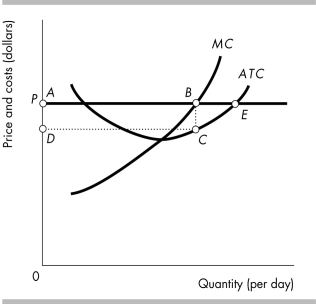 -Consider the perfectly competitive firm in the figure above. At the profit maximizing level of output, the firm will
 (Multiple Choice)
4.9/5 (88)
(88)  -In the above figure, the perfectly competitive firm's shutdown point is at a price of
 (Multiple Choice)
4.8/5 (86)
(86) The supply curve for a perfectly competitive firm is the portion of its marginal cost curve that lies above its marginal revenue curve.
(True/False)
4.9/5 (72)
(72) The demand for wheat from farm A is perfectly elastic because wheat from farm A is
(Multiple Choice)
4.8/5 (84)
(84)  -In the above figure, at a price of $4 per unit, a profit-maximizing perfectly competitive firm will
 (Multiple Choice)
4.9/5 (75)
(75) The market for maple syrup is perfectly competitive. Suppose that the market is in long-run equilibrium when the market demand for maple syrup increases. What happens in the short run?
(Multiple Choice)
4.9/5 (70)
(70) At its shutdown point, a perfectly competitive firm earns total revenue that
(Multiple Choice)
4.8/5 (74)
(74)  -The feature of the above figure that indicates that the firm is a perfectly competitive firm is the
 (Multiple Choice)
4.7/5 (72)
(72) 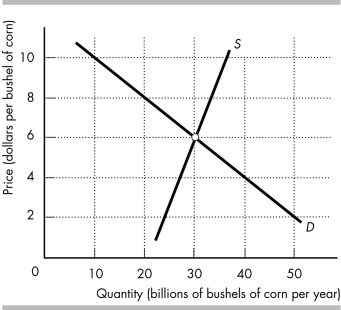 -Farmer Brown produces corn in a perfectly competitive market. Farmer Brown produces and sells 500 bushels of corn. The market supply and demand curves are illustrated in the above figure.
a) What is Farmer Brown's total revenue?
b) What is Farmer Brown's marginal revenue?
-Farmer Brown produces corn in a perfectly competitive market. Farmer Brown produces and sells 500 bushels of corn. The market supply and demand curves are illustrated in the above figure.
a) What is Farmer Brown's total revenue?
b) What is Farmer Brown's marginal revenue? (Essay)
4.9/5 (85)
(85) A perfectly competitive firm is definitely making an economic profit when
(Multiple Choice)
4.9/5 (77)
(77) In the long-run equilibrium for a perfectly competitive market,
(Multiple Choice)
4.9/5 (81)
(81) Jane's Copy Services is in perfect competition. Jane currently charges 10 cents per page, which is the going market price. Jane thinks that she can increase her profit if she lowers her price to 8 cents per page to increase the demand for her service. Is Jane right? Why or why not?
(Essay)
4.9/5 (81)
(81) If marginal revenue exceeds marginal cost, to increase its profit the firm will
(Multiple Choice)
4.9/5 (70)
(70) The market demand for wheat is ________ and the demand for wheat produced by an individual farm is ________.
(Multiple Choice)
4.8/5 (69)
(69) In perfect competition, restrictions on entry into an market
(Multiple Choice)
4.9/5 (74)
(74) 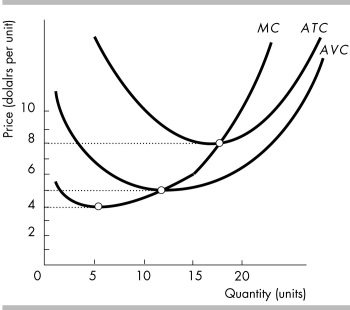 -In the above figure, at a price of $6, a perfectly competitive firm produces ________ and it ________.
 (Multiple Choice)
5.0/5 (72)
(72) 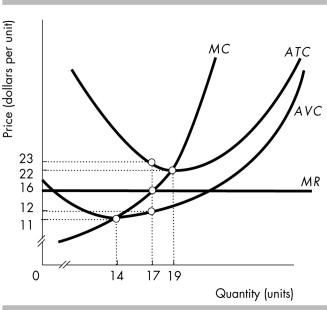 -Consider the perfectly competitive firm in the above figure. At what price will long-run equilibrium occur?
 (Multiple Choice)
4.9/5 (76)
(76) 
Filters
- Essay(0)
- Multiple Choice(0)
- Short Answer(0)
- True False(0)
- Matching(0)