



 Chat with AI
Exam 12: Perfect Competition

Exam 1: What Is Economics479 Questions
Exam 2: The Economic Problem439 Questions
Exam 3: Demand and Supply515 Questions
Exam 4: Elasticity533 Questions
Exam 5: Efficiency and Equity449 Questions
Exam 6: Government Actions in Markets410 Questions
Exam 7: Global Markets in Action200 Questions
Exam 8: Utility and Demand364 Questions
Exam 9: Possibilities, Preferences, and Choices464 Questions
Exam 10: Organizing Production385 Questions
Exam 11: Output and Costs494 Questions
Exam 12: Perfect Competition487 Questions
Exam 13: Monopoly606 Questions
Exam 14: Monopolistic Competition320 Questions
Exam 15: Oligopoly280 Questions
Exam 16: Public Choices and Public Goods356 Questions
Exam 17: Externalities and the Environment284 Questions
Exam 18: Markets for Factors of Production382 Questions
Exam 19: Economic Inequality354 Questions
Exam 20: Uncertainty and Information233 Questions
Exam 21: Extension A: Review11 Questions
Exam 22: Extension B: Review25 Questions
Exam 23: Extension C: Review14 Questions
Exam 24: Extension D: Review38 Questions
Exam 25: Extension E: Review11 Questions
Exam 26: Extension F: Review18 Questions
Select questions type


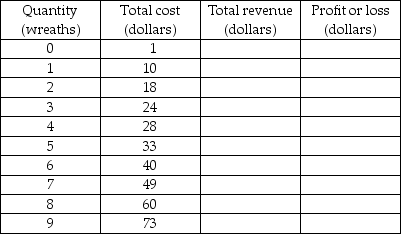 -The above table gives Amy's total cost schedule for producing holiday wreaths. Amy is a perfect competitor and can sell each wreath for $9.
a) Complete the table by calculating Amy's total revenue and her profit or loss schedule.
b) When Amy is producing 4 wreaths, what is her total cost? What is her total revenue? What is her economic profit or economic loss?
c) What number of wreaths maximizes Amy's profit?
-The above table gives Amy's total cost schedule for producing holiday wreaths. Amy is a perfect competitor and can sell each wreath for $9.
a) Complete the table by calculating Amy's total revenue and her profit or loss schedule.
b) When Amy is producing 4 wreaths, what is her total cost? What is her total revenue? What is her economic profit or economic loss?
c) What number of wreaths maximizes Amy's profit? (Essay)
4.8/5  (72)
(72)  -The above figure illustrates a firm's total revenue and total cost curves. Which one of the following statements is FALSE?
 (Multiple Choice)
4.8/5 (77)
(77)  -The table above gives the total revenue and total cost for a perfectly competitive firm producing chocolate chip cookies. If the firm increases its output from 2 pounds of cookies to 3 pounds, the marginal cost is ________ per pound of cookies.
 (Multiple Choice)
4.9/5 (71)
(71) 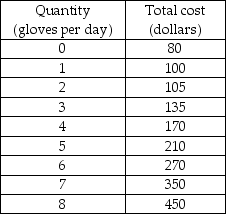 -The above table shows the per day total cost for Kiley's Baseball Glove Company. Each glove is priced at $50 and Kiley's Baseball Glove Company is a perfectly competitive firm. Between which two amounts of output does Kiley's Baseball Glove Company earn an economic profit?
 (Multiple Choice)
4.7/5 (86)
(86)  -In the above figure showing a perfectly competitive firm's total revenue line, the firm's marginal revenue
 (Multiple Choice)
4.8/5 (75)
(75) For a perfectly competitive firm, in the long-run equilibrium,
(Multiple Choice)
4.8/5 (76)
(76)  -In the above table, the average fixed cost at 4 units of output is
 (Multiple Choice)
4.9/5 (75)
(75) In perfect competition, the elasticity of demand for the product of a single firm is
(Multiple Choice)
4.8/5 (76)
(76) A firm's shutdown point is the output and price at which the firm just covers its
(Multiple Choice)
5.0/5 (83)
(83) Because of a decrease in the wage rate it must pay, a perfectly competitive firm's marginal costs decrease but its demand curve stays the same. As a result, the firm
(Multiple Choice)
4.9/5 (79)
(79) The difference between a perfectly competitive firm's total revenue and its total cost is
(Multiple Choice)
4.7/5 (67)
(67) If the market price of a perfectly competitive firm's product is below its average variable cost, then the firm's
(Multiple Choice)
4.9/5 (81)
(81) The U-pick berry market is perfectly competitive. Suppose that all U-pick blueberry farms have the same cost curves and all are making an economic profit. What happens as time passes? What is the long-run equilibrium outcome?
(Essay)
4.8/5 (81)
(81) Suppose firms in a perfectly competitive market are incurring an economic loss. Over time,
(Multiple Choice)
4.8/5 (82)
(82) Pumpkin growing is a perfectly competitive industry. Suppose that pumpkin growers are all incurring an economic loss. What happens as time passes? What is the long-run equilibrium outcome?
(Essay)
5.0/5 (72)
(72) Paul runs a shop that sells printers. Paul is a perfect competitor and can sell each printer for a price of $300. The marginal cost of selling one printer a day is $200; the marginal cost of selling a second printer is $250; and the marginal cost of selling a third printer is $350. To maximize his profit, Paul should sell
(Multiple Choice)
4.8/5 (70)
(70) 
Filters
- Essay(0)
- Multiple Choice(0)
- Short Answer(0)
- True False(0)
- Matching(0)