



 Chat with AI
Exam 13: Monopoly

Exam 1: What Is Economics479 Questions
Exam 2: The Economic Problem439 Questions
Exam 3: Demand and Supply515 Questions
Exam 4: Elasticity533 Questions
Exam 5: Efficiency and Equity449 Questions
Exam 6: Government Actions in Markets410 Questions
Exam 7: Global Markets in Action200 Questions
Exam 8: Utility and Demand364 Questions
Exam 9: Possibilities, Preferences, and Choices464 Questions
Exam 10: Organizing Production385 Questions
Exam 11: Output and Costs494 Questions
Exam 12: Perfect Competition487 Questions
Exam 13: Monopoly606 Questions
Exam 14: Monopolistic Competition320 Questions
Exam 15: Oligopoly280 Questions
Exam 16: Public Choices and Public Goods356 Questions
Exam 17: Externalities and the Environment284 Questions
Exam 18: Markets for Factors of Production382 Questions
Exam 19: Economic Inequality354 Questions
Exam 20: Uncertainty and Information233 Questions
Exam 21: Extension A: Review11 Questions
Exam 22: Extension B: Review25 Questions
Exam 23: Extension C: Review14 Questions
Exam 24: Extension D: Review38 Questions
Exam 25: Extension E: Review11 Questions
Exam 26: Extension F: Review18 Questions
Select questions type


Gene's Car Wash is a natural monopoly. To wash 100 cars a week, if Gene is unregulated, he would charge a price of $10. Gene's long-run average cost for washing 100 cars is $8, his average variable cost is $6, and his marginal cost is $4. If Gene was regulated using a marginal cost pricing rule, the price he would be allowed to charge to wash 100 cars is
(Multiple Choice)
5.0/5  (85)
(85) The use of a two-part price in a regulated natural monopoly
(Multiple Choice)
4.8/5 (87)
(87) 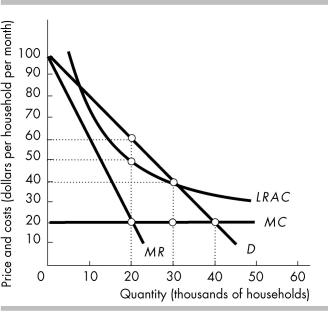 -Natural gas is a natural monopoly. The figure above shows the market for natural gas in the city of Lucknow. When an average cost price rule regulation is imposed, the price per household per month is ________.
 (Multiple Choice)
4.8/5 (84)
(84)  -For the unregulated, single-price monopoly shown in the figure above, when its profit is maximized, output will be
 (Multiple Choice)
4.7/5 (87)
(87)  -In the above figure, if this natural monopoly is not regulated the deadweight loss to society is
 (Multiple Choice)
4.9/5 (83)
(83)  -The figure above shows a monopoly's total revenue and total cost curves. The monopoly's marginal revenue equals its marginal cost when it produces
 (Multiple Choice)
4.9/5 (86)
(86) Explain the difference between price cap regulation in a natural monopoly and the effect of a price ceiling in a competitive market.
(Essay)
4.9/5 (91)
(91) The airline and trucking industries are two examples of industries that were regulated because they were natural monopolies.
(True/False)
5.0/5 (81)
(81)  -Natural gas is a natural monopoly. The figure shows the market for natural gas in the city of Lucknow. When an average cost price rule regulation is imposed, the price per household per month is ________.
 (Multiple Choice)
4.9/5 (81)
(81)  -The figure above shows the demand curve (D) faced by Visual, Inc., a cable TV company, and the firm's marginal revenue (MR), marginal cost (MC), and average cost (LRAC) curves. If Visual is regulated using rate of return regulation, and the regulator knows the firm's costs curves, the company will serve ________ million households and set a price of ________ per household per month.
 (Multiple Choice)
4.7/5 (81)
(81)  -In the figure above, compared to a perfectly competitive industry with the same costs, a single-price, unregulated monopoly will raise the price by
 (Multiple Choice)
4.8/5 (76)
(76) For a monopoly able to perfectly price discriminate, the marginal revenue curve coincides with the demand curve.
(True/False)
4.9/5 (72)
(72)
-In the figure above, the redistribution from the consumers to the producer if the firm is a single-price, unregulated monopoly rather than a perfectly competitive industry is
-In the figure above, the redistribution from the consumers to the producer if the firm is a single-price, unregulated monopoly rather than a perfectly competitive industry is (Multiple Choice)
4.8/5 (87)
(87) What are the characteristics of a market that allow a monopolist to successfully price discriminate between groups?
(Essay)
4.8/5 (69)
(69)  -If a monopoly is producing an amount of output level at which marginal revenue exceeds marginal cost, in order to increase its profit the monopoly will ________ its price and ________ its output.
 (Multiple Choice)
4.8/5 (69)
(69) A monopolist that operates along the elastic range of its demand will find that
(Multiple Choice)
5.0/5 (87)
(87) It is easier for a monopolist to price discriminate between groups for a service than for a good because
(Multiple Choice)
5.0/5 (73)
(73) 
Filters
- Essay(0)
- Multiple Choice(0)
- Short Answer(0)
- True False(0)
- Matching(0)