



 Chat with AI
Exam 13: Monopoly

Exam 1: What Is Economics479 Questions
Exam 2: The Economic Problem439 Questions
Exam 3: Demand and Supply515 Questions
Exam 4: Elasticity533 Questions
Exam 5: Efficiency and Equity449 Questions
Exam 6: Government Actions in Markets410 Questions
Exam 7: Global Markets in Action200 Questions
Exam 8: Utility and Demand364 Questions
Exam 9: Possibilities, Preferences, and Choices464 Questions
Exam 10: Organizing Production385 Questions
Exam 11: Output and Costs494 Questions
Exam 12: Perfect Competition487 Questions
Exam 13: Monopoly606 Questions
Exam 14: Monopolistic Competition320 Questions
Exam 15: Oligopoly280 Questions
Exam 16: Public Choices and Public Goods356 Questions
Exam 17: Externalities and the Environment284 Questions
Exam 18: Markets for Factors of Production382 Questions
Exam 19: Economic Inequality354 Questions
Exam 20: Uncertainty and Information233 Questions
Exam 21: Extension A: Review11 Questions
Exam 22: Extension B: Review25 Questions
Exam 23: Extension C: Review14 Questions
Exam 24: Extension D: Review38 Questions
Exam 25: Extension E: Review11 Questions
Exam 26: Extension F: Review18 Questions
Select questions type


 -Christy's Haircuts, the sole supplier of haircuts in a small town, faces the demand schedule shown in the table above. What is Christy's marginal revenue from the 25th haircut?
 (Multiple Choice)
4.9/5  (80)
(80) 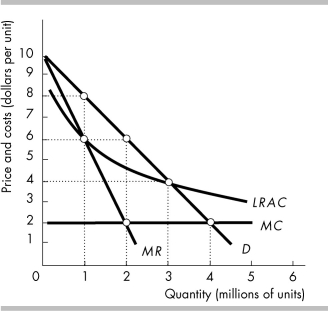 -The figure above shows the costs and demand curves for the Bigshow Cable Company. If the firm is required to set its price according to an average cost pricing rule, the price is ________ and the quantity produced is ________ million.
 (Multiple Choice)
4.9/5 (80)
(80) 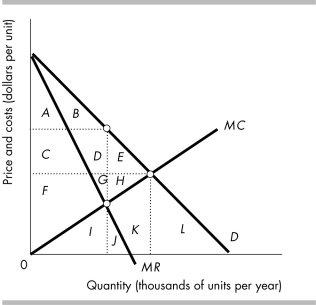 -Which area in the above figure equals the producer surplus under perfect price discrimination?
 (Multiple Choice)
4.7/5 (71)
(71)  -If an average cost pricing rule is imposed on the firm in the figure above, the price will be
 (Multiple Choice)
5.0/5 (74)
(74) In a regulated natural monopoly, a marginal cost pricing rule maximizes
(Multiple Choice)
4.8/5 (79)
(79)  -The unregulated, single-price monopolist illustrated in the figure above has a total cost of
 (Multiple Choice)
4.9/5 (82)
(82)  -Consider the market for cable television, a natural monopoly, shown in the figure above. If the regulator imposes an average cost pricing rule, deadweight loss is equal to
 (Multiple Choice)
4.8/5 (89)
(89)  -Given the market demand and cost data in the above figure, the existence of two firms equal sized firms producing a total of 8 million cubic feet of natural gas means that the long-run average cost of producing natural gas is
 (Multiple Choice)
4.9/5 (72)
(72) A single-price monopoly is characterized by a marginal revenue curve that is
(Multiple Choice)
4.9/5 (76)
(76) The fundamental reason a single-price monopoly creates a deadweight loss is that compared to the efficient outcome, the single-price monopoly
(Multiple Choice)
4.9/5 (89)
(89)
-The unregulated, single-price monopolist illustrated in the figure above will set a price of
-The unregulated, single-price monopolist illustrated in the figure above will set a price of (Multiple Choice)
4.9/5 (75)
(75) What is perfect price discrimination? Is perfect price discrimination efficient? Why or why not?
(Essay)
4.8/5 (71)
(71) A profit maximizing single-price monopolist charges a price equal to
(Multiple Choice)
4.8/5 (90)
(90)  -Compared to a competitive industry, a monopoly transfers
 -In the above figure, if a single-price monopolist charges the profit-maximizing price, the triangle dce represents
 (Multiple Choice)
4.9/5 (85)
(85) For a natural monopoly, if price is set equal to marginal cost then the firm incurs an economic loss.
(True/False)
4.9/5 (93)
(93) 
Filters
- Essay(0)
- Multiple Choice(0)
- Short Answer(0)
- True False(0)
- Matching(0)