



 Chat with AI
Exam 13: Monopoly

Exam 1: What Is Economics479 Questions
Exam 2: The Economic Problem439 Questions
Exam 3: Demand and Supply515 Questions
Exam 4: Elasticity533 Questions
Exam 5: Efficiency and Equity449 Questions
Exam 6: Government Actions in Markets410 Questions
Exam 7: Global Markets in Action200 Questions
Exam 8: Utility and Demand364 Questions
Exam 9: Possibilities, Preferences, and Choices464 Questions
Exam 10: Organizing Production385 Questions
Exam 11: Output and Costs494 Questions
Exam 12: Perfect Competition487 Questions
Exam 13: Monopoly606 Questions
Exam 14: Monopolistic Competition320 Questions
Exam 15: Oligopoly280 Questions
Exam 16: Public Choices and Public Goods356 Questions
Exam 17: Externalities and the Environment284 Questions
Exam 18: Markets for Factors of Production382 Questions
Exam 19: Economic Inequality354 Questions
Exam 20: Uncertainty and Information233 Questions
Exam 21: Extension A: Review11 Questions
Exam 22: Extension B: Review25 Questions
Exam 23: Extension C: Review14 Questions
Exam 24: Extension D: Review38 Questions
Exam 25: Extension E: Review11 Questions
Exam 26: Extension F: Review18 Questions
Select questions type


 -The figure above shows the costs and demand curves for the Bigshow Cable Company. If the regulator wants to set the price so that Bigshow earns the same normal profit as a perfectly competitive firm, what price should be set?
 (Multiple Choice)
4.8/5  (75)
(75) Compare and contrast the effect of perfect competition to the effect of perfect price discrimination on:
a) efficiency.
b) consumer surplus.
c) economic profit in the long run.
(Essay)
4.7/5 (78)
(78)  -In the figure above, the total revenue of a perfectly price-discriminating monopolist at the profit-maximizing output is equal to the area of
 (Multiple Choice)
4.8/5 (79)
(79) A single-price monopolist will find when it produces its profit-maximizing amount of output that
(Multiple Choice)
4.8/5 (93)
(93) Which of the following statements regarding a marginal-cost pricing rule for a natural monopoly is WRONG?
(Multiple Choice)
5.0/5 (87)
(87) Which of the following is true for a perfect price-discriminating monopoly?
(Multiple Choice)
4.9/5 (67)
(67)  -If the above figure illustrated a perfectly competitive industry, the equilibrium market price would be equal to
 (Multiple Choice)
4.9/5 (62)
(62)  -The figure above shows a monopoly's total revenue and total cost curves. The monopoly's economic profit is positive if it produces between
 (Multiple Choice)
4.7/5 (86)
(86)  -The unregulated, single-price monopolist illustrated in the figure above will produce
 (Multiple Choice)
4.8/5 (97)
(97) 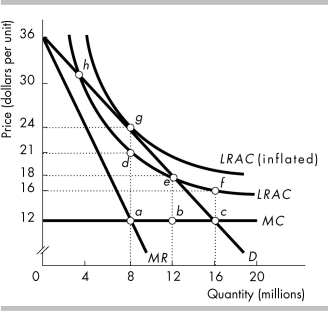 -In the above figure, if the natural monopoly is not regulated it will produce
 (Multiple Choice)
4.8/5 (85)
(85) A natural monopoly that is regulated to set its price equal to its marginal cost
(Multiple Choice)
4.9/5 (74)
(74) "Price discrimination allows a monopolist to increase his or her economic profits by capturing part of the consumer surplus and turning it into economic profit." Is the previous statement correct or incorrect? If the statement is correct, why is it important in understanding firms' behaviors? If it is incorrect, why is it incorrect?
(Essay)
4.7/5 (76)
(76)  -The figure above provides information about Light-U-Up Utilities, which is a natural monopoly that provides electricity. If Light-U-Up is regulated, what is its economic profit if it must follow an average cost pricing rule?
 (Multiple Choice)
4.8/5 (87)
(87) A single-price monopoly will set its price according to which of the following rules?
(Multiple Choice)
4.8/5 (76)
(76) Which of the following is definitely NOT an example of a natural monopoly?
(Multiple Choice)
4.9/5 (84)
(84)  -The figure above shows the demand and cost curves for a single-price monopoly. Which of the following statements is FALSE?
 (Multiple Choice)
4.9/5 (83)
(83)  -The table above shows the demand and total cost schedule for a monopolist hotel. What price should the monopolist charge if it is a single-price monopoly that maximizes its profit?
 (Multiple Choice)
4.7/5 (91)
(91) ________ is defined as any attempt to capture consumer surplus, producer surplus or economic profit.
(Multiple Choice)
4.9/5 (79)
(79) 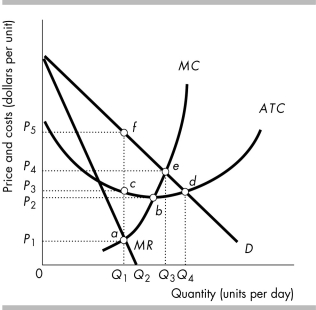 -In the above figure, what quantity will a single-price monopolist produce?
 (Multiple Choice)
4.8/5 (77)
(77) 
Filters
- Essay(0)
- Multiple Choice(0)
- Short Answer(0)
- True False(0)
- Matching(0)