



 Chat with AI
Exam 13: Monopoly

Exam 1: What Is Economics479 Questions
Exam 2: The Economic Problem439 Questions
Exam 3: Demand and Supply515 Questions
Exam 4: Elasticity533 Questions
Exam 5: Efficiency and Equity449 Questions
Exam 6: Government Actions in Markets410 Questions
Exam 7: Global Markets in Action200 Questions
Exam 8: Utility and Demand364 Questions
Exam 9: Possibilities, Preferences, and Choices464 Questions
Exam 10: Organizing Production385 Questions
Exam 11: Output and Costs494 Questions
Exam 12: Perfect Competition487 Questions
Exam 13: Monopoly606 Questions
Exam 14: Monopolistic Competition320 Questions
Exam 15: Oligopoly280 Questions
Exam 16: Public Choices and Public Goods356 Questions
Exam 17: Externalities and the Environment284 Questions
Exam 18: Markets for Factors of Production382 Questions
Exam 19: Economic Inequality354 Questions
Exam 20: Uncertainty and Information233 Questions
Exam 21: Extension A: Review11 Questions
Exam 22: Extension B: Review25 Questions
Exam 23: Extension C: Review14 Questions
Exam 24: Extension D: Review38 Questions
Exam 25: Extension E: Review11 Questions
Exam 26: Extension F: Review18 Questions
Select questions type


 -Consider the market for cable television in the figure above. This graph depicts a natural monopoly because the
 (Multiple Choice)
5.0/5  (89)
(89) A monopoly is a firm that produces a good or service for which no close substitute exists.
(True/False)
4.8/5 (83)
(83) 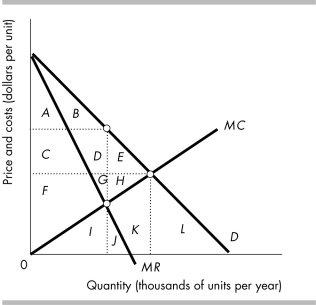 -Which area in the above figure equals the consumer surplus under perfect price discrimination?
 (Multiple Choice)
4.8/5 (81)
(81)  -In the figure above, the deadweight loss when the market is a single-price monopoly rather than perfectly competitive is the area of
 (Multiple Choice)
4.7/5 (78)
(78)  -Prime Pharmaceuticals has developed a new asthma medicine, for which it has a patent. An inhaler can be produced at a constant marginal cost of $2/inhaler. The demand curve, marginal revenue curve, and marginal cost curve for this new asthma inhaler are in the figure above. With its patent giving it a monopoly for its new inhaler, if Prime Pharmaceuticals could perfectly price discriminate, then which of the following is true?
 (Multiple Choice)
4.8/5 (85)
(85)  -In the figure above, the curve labeled "X" can be a
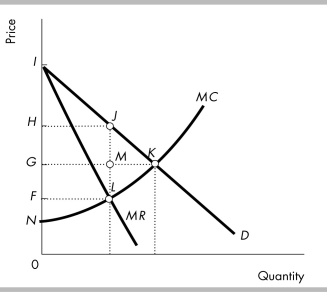 -In the market depicted in the above figure, if a single-price monopoly maximizes its profit ,which area shows the deadweight loss?
 (Multiple Choice)
4.8/5 (78)
(78) If the market illustrated in the above figure was a perfectly competitive market with the MC curve being the sum of all individual firms' marginal costs, then the perfectly competitive price and quantity would be
(Multiple Choice)
4.8/5 (85)
(85) Compared to a perfectly competitive industry, a single-price monopoly with the same costs will
(Multiple Choice)
4.8/5 (73)
(73)  -The figure above shows the demand and cost curves for a single-price monopoly. What price will the firm charge?
 (Multiple Choice)
4.7/5 (74)
(74) Under rate of return regulation, a natural monopoly ________.
(Multiple Choice)
4.7/5 (81)
(81)
-In the figure above, consumer surplus at the price that maximizes the profit for an unregulated, single-price monopolist is the area of
-In the figure above, consumer surplus at the price that maximizes the profit for an unregulated, single-price monopolist is the area of (Multiple Choice)
4.9/5 (84)
(84) Customers are most likely buying from a natural monopoly when they purchase
(Multiple Choice)
4.7/5 (80)
(80)  -In the above figure, if the natural monopoly is regulated with an average cost pricing rule and the firm does not inflate its costs, then consumer surplus will be
 (Multiple Choice)
4.8/5 (83)
(83) 
Filters
- Essay(0)
- Multiple Choice(0)
- Short Answer(0)
- True False(0)
- Matching(0)