



 Chat with AI
Exam 13: Monopoly

Exam 1: What Is Economics479 Questions
Exam 2: The Economic Problem439 Questions
Exam 3: Demand and Supply515 Questions
Exam 4: Elasticity533 Questions
Exam 5: Efficiency and Equity449 Questions
Exam 6: Government Actions in Markets410 Questions
Exam 7: Global Markets in Action200 Questions
Exam 8: Utility and Demand364 Questions
Exam 9: Possibilities, Preferences, and Choices464 Questions
Exam 10: Organizing Production385 Questions
Exam 11: Output and Costs494 Questions
Exam 12: Perfect Competition487 Questions
Exam 13: Monopoly606 Questions
Exam 14: Monopolistic Competition320 Questions
Exam 15: Oligopoly280 Questions
Exam 16: Public Choices and Public Goods356 Questions
Exam 17: Externalities and the Environment284 Questions
Exam 18: Markets for Factors of Production382 Questions
Exam 19: Economic Inequality354 Questions
Exam 20: Uncertainty and Information233 Questions
Exam 21: Extension A: Review11 Questions
Exam 22: Extension B: Review25 Questions
Exam 23: Extension C: Review14 Questions
Exam 24: Extension D: Review38 Questions
Exam 25: Extension E: Review11 Questions
Exam 26: Extension F: Review18 Questions
Select questions type


 -If the natural monopoly shown in the figure above is unregulated, then the deadweight loss will be
 (Multiple Choice)
4.8/5  (91)
(91) 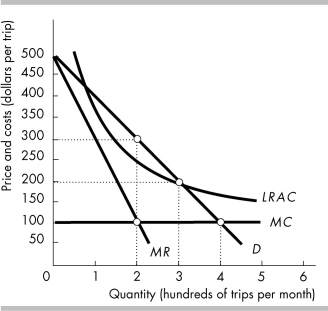 -The figure above shows the marginal revenue, marginal cost, and demand curves for an airline offering daily flights between Los Angeles and Toronto. If the airline is regulated using a marginal cost pricing rule total surplus will be ________.
 (Multiple Choice)
4.8/5 (71)
(71)
-If an average cost pricing rule is imposed on the natural monopoly shown in the figure above, then it will produce
-If an average cost pricing rule is imposed on the natural monopoly shown in the figure above, then it will produce (Multiple Choice)
4.7/5 (82)
(82) The WaveHouse on Mission Beach in San Diego features the Bruticus Maximus, a ten foot wave, which tests the skills of even the most talented surf and wake board riders on the planet. WaveHouse is the only place in San Diego where this service is offered. If you are a member of WaveHouse, you can ride for half the price that a non-member pays. This is an example of:
(Multiple Choice)
4.8/5 (77)
(77)  -Christy's Haircuts, the sole supplier of haircuts in a small town, faces the demand schedule shown in the table above. What is Christy's marginal revenue from the 35th haircut?
 (Multiple Choice)
5.0/5 (76)
(76)  -Interlace, Inc. produces and a unique soda. The company cannot price discriminate. The figure above shows Interlace's demand curve, marginal revenue curve, and marginal cost curve. When Interlace maximizes its profit, the deadweight loss is
 (Multiple Choice)
4.8/5 (69)
(69) Sue's Surfboards is the sole renter of surfboards on Big Wave Island. Sue does not price discriminate. For Sue's Surfboards, the change in total revenue from each additional surfboard rented is her
(Multiple Choice)
4.7/5 (75)
(75) Before summer 2008, if you wanted a cell phone in Bhutan, you only had one choice: B-Mobile, owned and operated by the government. What does Kuenga Gyalthen mean he states that, "Up until now, because of the monopoly, we've all been suffering. So, I mean, it's finally time the consumer actually is king for a little while."?
(Multiple Choice)
4.9/5 (70)
(70) If the price elasticity of demand is greater than 1, a monopoly's
(Multiple Choice)
4.9/5 (78)
(78) The primary reason why a monopoly can make a long-run economic profit is the existence of
(Multiple Choice)
4.9/5 (83)
(83) Which of the following is a characteristic of monopoly in the long run?
(Multiple Choice)
4.9/5 (78)
(78) 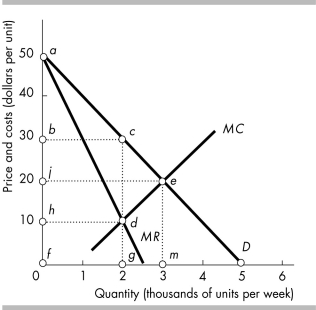 -The above figure illustrates a single-price unregulated monopolist. If the monopolist maximizes its profit, the consumer surplus equals ________.
 (Multiple Choice)
4.9/5 (80)
(80) In the case of a perfectly price-discriminating monopoly, there is no
(Multiple Choice)
4.9/5 (78)
(78)  -In the figure above, if the market is a single-price monopoly rather than a perfectly competitive industry, the transfer of consumer surplus from consumers to the producer is the area of
 (Multiple Choice)
4.9/5 (64)
(64) Suppose the government breaks up a single-price monopoly and turns it into a perfectly competitive industry. What will happen to price and the quantity produced? What will happen to the monopoly's economic profit and the deadweight loss associated with the monopoly?
(Essay)
4.8/5 (72)
(72) Compare and contrast the marginal cost and average cost pricing rules for regulating natural monopolies.
(Essay)
4.8/5 (89)
(89) Even though a perfect price discriminator can extract all of the consumer surplus, how can it be efficient?
(Essay)
4.7/5 (93)
(93) 
Filters
- Essay(0)
- Multiple Choice(0)
- Short Answer(0)
- True False(0)
- Matching(0)