



 Chat with AI
Exam 13: Monopoly

Exam 1: What Is Economics479 Questions
Exam 2: The Economic Problem439 Questions
Exam 3: Demand and Supply515 Questions
Exam 4: Elasticity533 Questions
Exam 5: Efficiency and Equity449 Questions
Exam 6: Government Actions in Markets410 Questions
Exam 7: Global Markets in Action200 Questions
Exam 8: Utility and Demand364 Questions
Exam 9: Possibilities, Preferences, and Choices464 Questions
Exam 10: Organizing Production385 Questions
Exam 11: Output and Costs494 Questions
Exam 12: Perfect Competition487 Questions
Exam 13: Monopoly606 Questions
Exam 14: Monopolistic Competition320 Questions
Exam 15: Oligopoly280 Questions
Exam 16: Public Choices and Public Goods356 Questions
Exam 17: Externalities and the Environment284 Questions
Exam 18: Markets for Factors of Production382 Questions
Exam 19: Economic Inequality354 Questions
Exam 20: Uncertainty and Information233 Questions
Exam 21: Extension A: Review11 Questions
Exam 22: Extension B: Review25 Questions
Exam 23: Extension C: Review14 Questions
Exam 24: Extension D: Review38 Questions
Exam 25: Extension E: Review11 Questions
Exam 26: Extension F: Review18 Questions
Select questions type


"If a natural monopoly is regulated using a marginal cost pricing rule, the firm makes zero economic profit." Is the previous statement correct or incorrect?
(Essay)
4.8/5  (79)
(79) 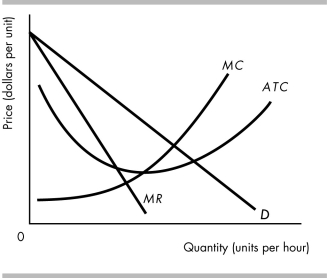 -The above figure represents the cost, demand, and marginal revenue curves for a monopolist.
a) Indicate the price and quantity a single-price monopolist selects by labeling the price Pm and the quantity Qm.
b) In the figure, lightly shade in the area that represents the single-price monopoly's economic profit.
c) Indicate the quantity a perfectly price-discriminating monopolist selects by labeling it Qppd.
d) In the figure, more darkly shade the area that represents the additional economic profit the monopoly earns as a result of the perfect price discrimination.
-The above figure represents the cost, demand, and marginal revenue curves for a monopolist.
a) Indicate the price and quantity a single-price monopolist selects by labeling the price Pm and the quantity Qm.
b) In the figure, lightly shade in the area that represents the single-price monopoly's economic profit.
c) Indicate the quantity a perfectly price-discriminating monopolist selects by labeling it Qppd.
d) In the figure, more darkly shade the area that represents the additional economic profit the monopoly earns as a result of the perfect price discrimination. (Essay)
4.9/5 (88)
(88) Which of the following statements regarding an average-cost pricing rule for a natural monopoly is WRONG?
(Multiple Choice)
4.8/5 (88)
(88) Competition keeps prices lower for consumers. So why do we have patent laws?
(Essay)
4.8/5 (71)
(71)  -In the figure above, a single-price unregulated monopoly sets a price equal to
 (Multiple Choice)
4.7/5 (79)
(79) 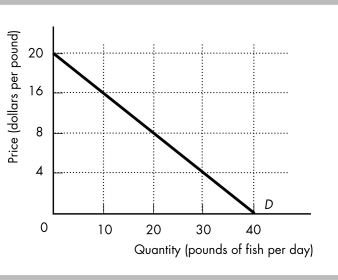 -The above figure represents the demand and marginal revenue curves for Sue's Seafood, a seller of fresh fish.
a) Over what range of output is demand elastic?
b) Over what range of output is demand inelastic?
c) What price maximizes total revenue?
d) What is the demand elasticity at the revenue maximizing price?
-The above figure represents the demand and marginal revenue curves for Sue's Seafood, a seller of fresh fish.
a) Over what range of output is demand elastic?
b) Over what range of output is demand inelastic?
c) What price maximizes total revenue?
d) What is the demand elasticity at the revenue maximizing price? (Essay)
4.7/5 (76)
(76)  -In the above figure, if the natural monopoly is regulated with an average cost pricing rule and the firm does not inflate its costs, then the firm will produce
 (Multiple Choice)
4.7/5 (88)
(88) Rate of return regulation sets the price at a level that enables the regulated firm to earn a specified target percent return on its
(Multiple Choice)
4.9/5 (83)
(83) For a natural monopoly, if price is equal to marginal cost, then
(Multiple Choice)
4.9/5 (77)
(77) Relative to a perfectly competitive market with the same cost and demand, a single-price monopolist produces ________ output and has a ________ price.
(Multiple Choice)
4.8/5 (85)
(85)  -The table above gives the demand for a monopolist's output. What is the marginal revenue when output is increased from 2 to 3 units?
 (Multiple Choice)
4.8/5 (90)
(90) When a person lobbies Congress to grant the person the exclusive right to sell a particular good, such lobbying activity is called
(Multiple Choice)
4.9/5 (67)
(67) For a single-price monopolist to sell one more unit of a good, it must
(Multiple Choice)
4.9/5 (70)
(70) In order to be able to price discriminate and maximize profit, a monopolist must be able to do all of the following EXCEPT
(Multiple Choice)
4.8/5 (74)
(74)  -An efficient allocation of resources is reached in the figure above when output equals
 (Multiple Choice)
4.9/5 (88)
(88) 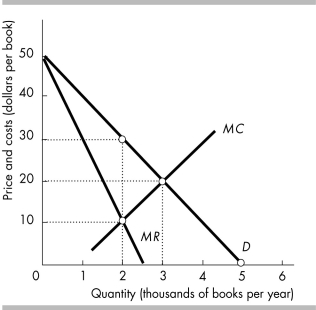 -Bob's Books is the only bookstore in town. The figure above shows the demand curve for books and Bob's Books' marginal revenue curve and marginal cost curve. Bob's Books maximizes its profit and sets the price of a book equal to ________ and has total annual revenue of ________.
 (Multiple Choice)
4.8/5 (73)
(73) Which of the following differs between a perfectly competitive market and a market with a perfectly price discriminating monopoly?
(Multiple Choice)
4.9/5 (68)
(68)  -If a marginal cost pricing rule is imposed on the firm in the figure above, the price will be
 (Multiple Choice)
4.8/5 (82)
(82) 
Filters
- Essay(0)
- Multiple Choice(0)
- Short Answer(0)
- True False(0)
- Matching(0)