



 Chat with AI
Exam 13: Monopoly

Exam 1: What Is Economics479 Questions
Exam 2: The Economic Problem439 Questions
Exam 3: Demand and Supply515 Questions
Exam 4: Elasticity533 Questions
Exam 5: Efficiency and Equity449 Questions
Exam 6: Government Actions in Markets410 Questions
Exam 7: Global Markets in Action200 Questions
Exam 8: Utility and Demand364 Questions
Exam 9: Possibilities, Preferences, and Choices464 Questions
Exam 10: Organizing Production385 Questions
Exam 11: Output and Costs494 Questions
Exam 12: Perfect Competition487 Questions
Exam 13: Monopoly606 Questions
Exam 14: Monopolistic Competition320 Questions
Exam 15: Oligopoly280 Questions
Exam 16: Public Choices and Public Goods356 Questions
Exam 17: Externalities and the Environment284 Questions
Exam 18: Markets for Factors of Production382 Questions
Exam 19: Economic Inequality354 Questions
Exam 20: Uncertainty and Information233 Questions
Exam 21: Extension A: Review11 Questions
Exam 22: Extension B: Review25 Questions
Exam 23: Extension C: Review14 Questions
Exam 24: Extension D: Review38 Questions
Exam 25: Extension E: Review11 Questions
Exam 26: Extension F: Review18 Questions
Select questions type


Compared to the profit-maximizing equilibrium of a natural monopoly, a price cap regulation ________ price and ________ output.
(Multiple Choice)
4.9/5  (71)
(71) Demand Schedule Facing a
Perfectly Price Discriminating Firm  -Using the demand schedule in the above table, if the firm's marginal cost is constant at $3.00, output for a perfectly price discriminating monopolist is
 (Multiple Choice)
4.9/5 (82)
(82) Suppose that a monopoly is currently producing the quantity at which marginal revenue is less than marginal cost. The monopoly can increase its profit by ________.
(Multiple Choice)
4.9/5 (84)
(84) 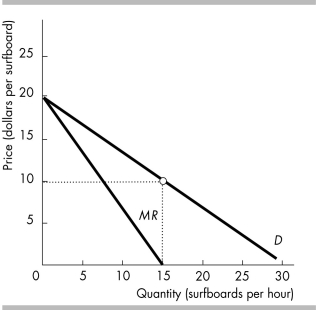 -Sue's Surfboards is the sole renter of surfboards on Big Wave Island. Sue's demand and marginal revenue curves are illustrated in the figure above. The change in the total revenue from renting the 15th surfboard is
 (Multiple Choice)
4.9/5 (85)
(85) A key difference between a monopoly and a perfectly competitive firm is that the monopolist
(Multiple Choice)
4.9/5 (98)
(98)  -The above figure shows the demand and cost curves for a monopolist. What is the maximum economic profit this firm can make?
 (Multiple Choice)
4.8/5 (71)
(71)  -If an average cost pricing rule is imposed on the natural monopoly shown in the figure above, then consumer surplus will be
 (Multiple Choice)
4.8/5 (82)
(82) Which of the following is NOT a characteristic of a monopoly?
(Multiple Choice)
4.9/5 (90)
(90) If the regulator wants to avoid any deadweight loss in a natural monopoly market, the regulator has the firm set its price equal to its
(Multiple Choice)
4.9/5 (78)
(78)  -If the firm in the figure above is unregulated, the deadweight loss will be
 (Multiple Choice)
4.9/5 (84)
(84) A major difference between a single-price monopolist and a perfectly competitive firm is that the
(Multiple Choice)
4.8/5 (83)
(83) 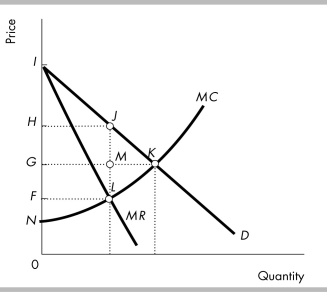 -In the market depicted in the above figure, if a single-price monopoly maximizes its profit, which area shows the consumer surplus?
 (Multiple Choice)
4.8/5 (84)
(84) While smoking is on the decline in the United States, China is still puffing away madly. That's not because the government is eager to protect its citizens from the hazards of smoking. It's because China is eager to protect its own tobacco industry which is a state monopoly. How would entry of foreign companies into the tobacco market affect the economic profit of the state monopoly?
(Multiple Choice)
4.8/5 (76)
(76) Which of the following is FALSE for a profit-maximizing single-price monopolist?
(Multiple Choice)
4.8/5 (86)
(86)  -The figure above shows the demand curve (D) faced by Visual, Inc., a cable TV company, and the firm's marginal revenue (MR), marginal cost (MC), and average cost (LRAC) curves. If Visual is regulated according to an average cost pricing rule, it will serve ________ million households and set a price of ________ per household per month.
 (Multiple Choice)
4.8/5 (75)
(75) Explain how a single-price monopoly determines its output and price. Compare this process to how a perfectly competitive firm determines its output and price.
(Essay)
4.9/5 (77)
(77) Which creates a larger deadweight loss, perfect competition or a single-price monopoly?
(Essay)
4.8/5 (74)
(74) Compare the outcome in a market with a single-price monopoly to that in a perfectly competitive market.
(Essay)
4.9/5 (75)
(75) 
Filters
- Essay(0)
- Multiple Choice(0)
- Short Answer(0)
- True False(0)
- Matching(0)