



 Chat with AI
Exam 2: Project Management

Exam 1: Using Operations to Compete107 Questions
Exam 2: Project Management151 Questions
Exam 3: Process Strategy149 Questions
Exam 4: Process Analysis192 Questions
Exam 5: Quality and Performance223 Questions
Exam 6: Capacity Planning133 Questions
Exam 7: Constraint Management160 Questions
Exam 8: Lean Systems179 Questions
Exam 9: Supply Chain Inventory Management216 Questions
Exam 10: Supply Chain Design93 Questions
Exam 11: Supply Chain Location Decisions126 Questions
Exam 12: Supply Chain Integration130 Questions
Exam 13: Supply Chain Sustainability and Humanitarian Logistics77 Questions
Exam 14: Forecasting183 Questions
Exam 15: Operations Planning and Scheduling191 Questions
Exam 16: Resource Planning149 Questions
Exam 17: Decision Making118 Questions
Exam 18: Waiting Line127 Questions
Exam 19: Special Inventory Models53 Questions
Exam 20: Linear Programming84 Questions
Exam 21: Simulation61 Questions
Exam 22: Financial Analysis60 Questions
Exam 23: Acceptance Sampling Plans88 Questions
Exam 24: Measuring Output Rates103 Questions
Exam 25: Learning Curve Analysis56 Questions
Exam 26: Operations Scheduling131 Questions
Select questions type


To calculate the probability of completing a project by a certain date:
(Multiple Choice)
5.0/5  (73)
(73) Table 2.10
 -Using Table 2.10,what is the latest start time for activity E?
 (Multiple Choice)
4.8/5 (80)
(80) The earliest start time is never the same as the latest start time.
(True/False)
4.7/5 (82)
(82) Table 2.3 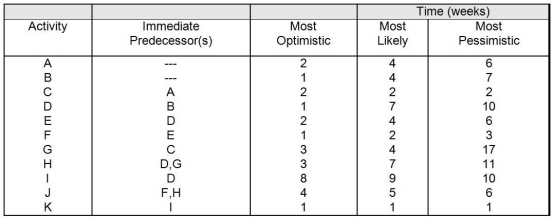 -Using Table 2.3,which activity is on the critical path?
 (Multiple Choice)
4.8/5 (74)
(74) Table 2.11
 -Using Table 2.11,what is the earliest completion time of this project without crashing?
 (Multiple Choice)
4.7/5 (74)
(74) Risk is a measure of the probability and consequences of not reaching a defined project goal.
(True/False)
4.7/5 (95)
(95) Table 2.2 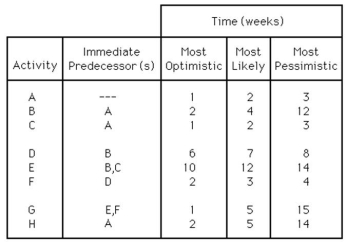 -Using Table 2.2,what is the earliest expected time of completion of the whole project?
 (Multiple Choice)
4.8/5 (90)
(90) Consider a project that consists of three consecutive activities of equal length as shown in the network diagram.The project manager would like to complete the project as quickly as possible and realizes that the diagram's logic is misleading.Instead of waiting until activity A is completed before activity B can begin,he can actually begin activity B once activity A has begun.The same reasoning holds for the relationship between activity B and activity C.The project manager decides to divide each activity in half,a technique known as "laddering".The second diagram shows the new network logic.In this diagram,activity A is divided into activity A1 and A2 where A1 must be finished before A2 can begin and before B1 can begin.The manager still isn't satisfied with the completion time of the project.Derive an expression or draw a diagram that demonstrates the fastest possible completion time of the project. 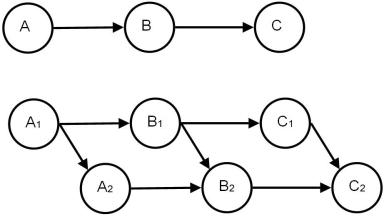
(Essay)
4.8/5 (77)
(77) Project managers should be able to organize a set of disparate activities.
(True/False)
4.9/5 (75)
(75) A Gantt chart is a project schedule that superimposes project activities on a time line.
(True/False)
4.8/5 (91)
(91) What options do project managers have to alleviate resource problems? Briefly describe each method.
(Essay)
4.8/5 (79)
(79) Table 2.14
You are responsible for managing a project with the following activities (times are given in weeks).  -Using Table 2.14,which activity has the largest slack,and how large is that slack?
 (Multiple Choice)
4.9/5 (78)
(78) In making an estimate of the most pessimistic time for an activity,a manager deliberately estimates this time too high (i.e. ,longer than it should be).What is the result of this action,assuming the beta distribution is being used to make time estimates?
(Multiple Choice)
4.8/5 (81)
(81) Table 2.6
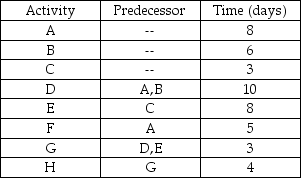 -Using Table 2.6,what is the latest start time for activity E?
 (Multiple Choice)
5.0/5 (75)
(75) A pure project organizational structure houses the project in a specific functional area.
(True/False)
4.9/5 (89)
(89) Table 2.12  -Using Table 2.12,what is the earliest completion time of this project if normal times are used for all activities?
 (Multiple Choice)
4.9/5 (78)
(78) Which one of these steps in implementing changes comes first?
(Multiple Choice)
4.7/5 (83)
(83) Describe how time-cost tradeoffs for project activities should be identified and analyzed.
(Essay)
4.8/5 (95)
(95) Table 2.13
(All activity times for the project are in weeks. )  -Using Table 2.13,if the expected time for activity E is changed to nine weeks,by how many weeks will the project's expected completion time increase?
 (Multiple Choice)
4.7/5 (69)
(69) 
Filters
- Essay(0)
- Multiple Choice(0)
- Short Answer(0)
- True False(0)
- Matching(0)