



 Chat with AI
Exam 2: Project Management

Exam 1: Using Operations to Compete107 Questions
Exam 2: Project Management151 Questions
Exam 3: Process Strategy149 Questions
Exam 4: Process Analysis192 Questions
Exam 5: Quality and Performance223 Questions
Exam 6: Capacity Planning133 Questions
Exam 7: Constraint Management160 Questions
Exam 8: Lean Systems179 Questions
Exam 9: Supply Chain Inventory Management216 Questions
Exam 10: Supply Chain Design93 Questions
Exam 11: Supply Chain Location Decisions126 Questions
Exam 12: Supply Chain Integration130 Questions
Exam 13: Supply Chain Sustainability and Humanitarian Logistics77 Questions
Exam 14: Forecasting183 Questions
Exam 15: Operations Planning and Scheduling191 Questions
Exam 16: Resource Planning149 Questions
Exam 17: Decision Making118 Questions
Exam 18: Waiting Line127 Questions
Exam 19: Special Inventory Models53 Questions
Exam 20: Linear Programming84 Questions
Exam 21: Simulation61 Questions
Exam 22: Financial Analysis60 Questions
Exam 23: Acceptance Sampling Plans88 Questions
Exam 24: Measuring Output Rates103 Questions
Exam 25: Learning Curve Analysis56 Questions
Exam 26: Operations Scheduling131 Questions
Select questions type


The ________ is the shortest time in which an activity can be completed if all goes exceptionally well.
(Essay)
4.7/5  (62)
(62) Table 2.6
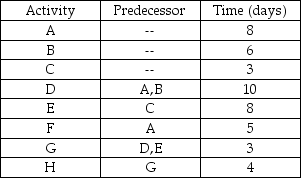 -Using Table 2.6,what is the earliest that activity D can be finished?
 (Multiple Choice)
4.9/5 (83)
(83) A relationship that determines the sequence for undertaking activities is a precedence relationship.
(True/False)
4.9/5 (79)
(79) Table 2.4
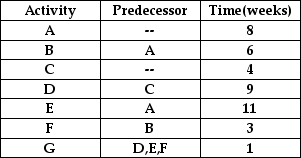 -Using Table 2.4,what is the largest amount of slack that any activity in the project has?
 (Multiple Choice)
5.0/5 (79)
(79) Table 2.10
 -Using Table 2.10,what is the critical path for this project using the normal times?
 (Multiple Choice)
4.9/5 (74)
(74) Consider the activities,durations,and predecessor relationships in the following network.Draw the network and answer the questions that follow.
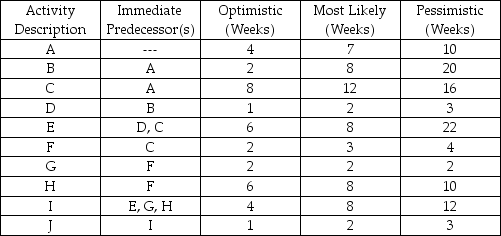 a.What is the expected time for activity B?
b.What is the variance for activity B?
c.Based on the calculation of estimated times,what is the critical path?
d.What is the estimated time of the critical path?
e.What is the activity variance along the critical path?
f.What is the probability of completion of the project before week 42?
a.What is the expected time for activity B?
b.What is the variance for activity B?
c.Based on the calculation of estimated times,what is the critical path?
d.What is the estimated time of the critical path?
e.What is the activity variance along the critical path?
f.What is the probability of completion of the project before week 42? (Essay)
4.7/5 (80)
(80) Table 2.10
-Using Table 2.10,what is the activity with the greatest amount of slack?
-Using Table 2.10,what is the activity with the greatest amount of slack? (Multiple Choice)
4.8/5 (86)
(86) Which one of the following conditions violates the assumptions of PERT/CPM networks?
(Multiple Choice)
4.9/5 (91)
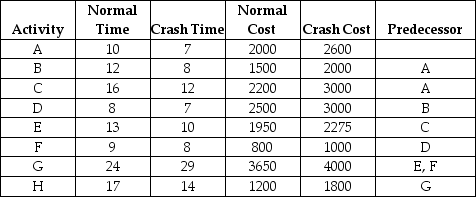
(91) The following table contains a list of activities,with precedence requirements and crash costs.All start and finish times and crash costs are on a per-week basis.
a.Determine the project cost and duration without crashing.
b.Determine the least expensive project cost if the duration is to be 10% shorter than normal project duration.
c.Determine the least expensive project cost if the duration is to be 20% shorter than normal project duration.
d.Create a graph that shows project expediting cost plotted as a function of the reduction in project duration.
(Essay)
5.0/5 (74)
(74) Assuming a beta distribution is being used,if the most pessimistic time for an activity increases by six weeks,what will happen to the expected time for that activity?
(Multiple Choice)
5.0/5 (67)
(67) Table 2.10
-Using Table 2.10,what is the minimum crashing cost to finish this project in 18 days?
-Using Table 2.10,what is the minimum crashing cost to finish this project in 18 days? (Multiple Choice)
4.8/5 (65)
(65) Table 2.5 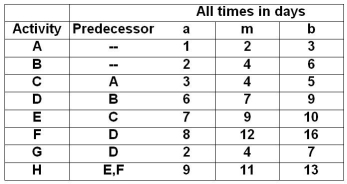 -Using Table 2.5,which activity is on the critical path?
 (Multiple Choice)
4.9/5 (92)
(92) Table 2.5
-Using Table 2.5,what is the standard deviation for the entire project?
-Using Table 2.5,what is the standard deviation for the entire project? (Multiple Choice)
4.7/5 (70)
(70) A(n)________ identifies the key threats to a project and prescribes ways to work around them.
(Essay)
4.9/5 (84)
(84) Which one of the following best describes the critical path of a PERT/CPM network?
(Multiple Choice)
4.9/5 (76)
(76) To obtain the latest start and latest finish time,we must work forward through the network.
(True/False)
4.8/5 (73)
(73) Table 2.14
You are responsible for managing a project with the following activities (times are given in weeks).  -Using Table 2.14,what is the probability of completing the project in 17 or fewer weeks?
 (Multiple Choice)
4.9/5 (82)
(82) Table 2.7
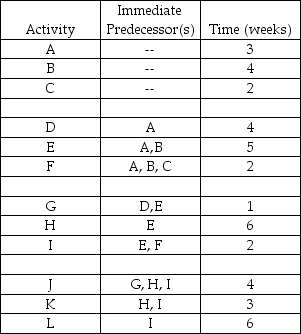 -Using Table 2.7,suppose activity I is delayed,taking eight days to complete instead of two days.Assume all other activity times remain the same.How much longer will the total project earliest completion time become?
 (Multiple Choice)
4.8/5 (76)
(76) List the three main goals of a project.Use the example of a project to implement a new billing procedure for a small lawn mowing business,describe how project management principles help achieve these goals.
(Essay)
4.9/5 (82)
(82) 
Filters
- Essay(0)
- Multiple Choice(0)
- Short Answer(0)
- True False(0)
- Matching(0)