



 Chat with AI
Exam 24: Measuring Output Rates

Exam 1: Using Operations to Compete107 Questions
Exam 2: Project Management151 Questions
Exam 3: Process Strategy149 Questions
Exam 4: Process Analysis192 Questions
Exam 5: Quality and Performance223 Questions
Exam 6: Capacity Planning133 Questions
Exam 7: Constraint Management160 Questions
Exam 8: Lean Systems179 Questions
Exam 9: Supply Chain Inventory Management216 Questions
Exam 10: Supply Chain Design93 Questions
Exam 11: Supply Chain Location Decisions126 Questions
Exam 12: Supply Chain Integration130 Questions
Exam 13: Supply Chain Sustainability and Humanitarian Logistics77 Questions
Exam 14: Forecasting183 Questions
Exam 15: Operations Planning and Scheduling191 Questions
Exam 16: Resource Planning149 Questions
Exam 17: Decision Making118 Questions
Exam 18: Waiting Line127 Questions
Exam 19: Special Inventory Models53 Questions
Exam 20: Linear Programming84 Questions
Exam 21: Simulation61 Questions
Exam 22: Financial Analysis60 Questions
Exam 23: Acceptance Sampling Plans88 Questions
Exam 24: Measuring Output Rates103 Questions
Exam 25: Learning Curve Analysis56 Questions
Exam 26: Operations Scheduling131 Questions
Select questions type


The predetermined data approach does not eliminate the need for time studies.

Free
(True/False)
4.9/5  (86)
(86) Correct Answer: Verified
False
Garman observes a worker assembling peanut valves and records the data displayed in the table.What is the select time for this job element? 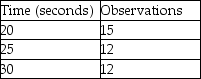
Free
(Multiple Choice)
4.7/5 (74)
(74) Correct Answer:Verified
VerifiedC
The most commonly used method for setting a time standard is called a(n)________.
Free
(Essay)
4.9/5 (82)
(82) Correct Answer:Verified
Verifiedtime study
A time study analyst has found the select time for a work element to be 14.0 minutes,with a sample standard deviation of 3.2 minutes.What is the minimum sample size needed if the estimate is to be within 4 percent of the average 95 percent of the time (z = 1.96)?
(Multiple Choice)
4.9/5 (75)
(75) An industrial engineer is conducting a time study for a work element.The select time is 4.5 minutes,and the sample standard deviation of the observed time is 20 seconds.What is the appropriate sample size if the estimate is to be 5 percent of the true average time 95 percent of the time?
(Multiple Choice)
4.9/5 (101)
(101) Table H.3
A worker was observed for four cycles in a repetitive task.The observer recorded the following times,in seconds,using the continuous method.The ratings for each element and frequency it is performed are also indicated in the table.The allowance fraction is 20 percent.
 -Use the information in Table H.3.What is the normal time for work element 2?
 (Multiple Choice)
4.8/5 (81)
(81) Elemental standard time data cannot be used to develop time standards for new work before production begins.
(True/False)
4.8/5 (77)
(77) A predetermined data approach to time standards can be completed only after actual production begins.
(True/False)
4.9/5 (78)
(78) A worker was observed for four cycles of a repetitive operation.The observed times for work elements are 11,10,8,and 11 seconds,respectively.What sample size is appropriate for estimating the time for this work element within + 3 percent of the true mean time with 95 percent confidence (z = 1.96)?
(Multiple Choice)
4.8/5 (74)
(74) Table H.3
A worker was observed for four cycles in a repetitive task.The observer recorded the following times,in seconds,using the continuous method.The ratings for each element and frequency it is performed are also indicated in the table.The allowance fraction is 20 percent.
-Use the information in Table H.3.What is the standard time for the complete cycle?
-Use the information in Table H.3.What is the standard time for the complete cycle? (Multiple Choice)
4.9/5 (78)
(78) A work sampling method is used to determine the proportion of the time a worker is idle.The following information was gathered on a random basis. 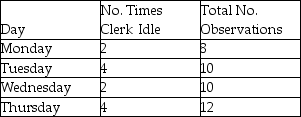 If the manager wants a 95 percent confidence level (z = 1.96)and a degree of precision of + 0.03,how many more observations are needed?
 (Multiple Choice)
4.9/5 (83)
(83) To set a time standard for a machining operation,the least likely approach to be used is the:
(Multiple Choice)
4.9/5 (66)
(66) Table H.1
A worker was observed for four cycles in a repetitive task that contains four distinct elements.The observer recorded the following items in seconds,using the continuous method.
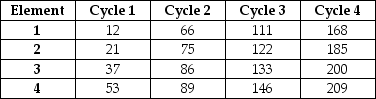 -Use the information in Table H.1.Assuming that work element 4 receives a performance rating factor of 1.2 and is performed once per cycle,what is the normal time for this work element?
 (Multiple Choice)
5.0/5 (91)
(91) When using work sampling,the times of day to collect data samples are selected at random over the length of the study.
(True/False)
4.8/5 (83)
(83) A larger sample size is required when the time estimate must be more certain.
(True/False)
4.8/5 (78)
(78) Table H.3
A worker was observed for four cycles in a repetitive task.The observer recorded the following times,in seconds,using the continuous method.The ratings for each element and frequency it is performed are also indicated in the table.The allowance fraction is 20 percent.
-Use the information in Table H.3.What is the normal time for the complete cycle?
-Use the information in Table H.3.What is the normal time for the complete cycle? (Multiple Choice)
5.0/5 (69)
(69) Table H.1
A worker was observed for four cycles in a repetitive task that contains four distinct elements.The observer recorded the following items in seconds,using the continuous method.
-Use the information in Table H.1.Assume that work element 1 receives a performance rating factor of 1.2 and all other elements receive a rating of 1.1.If work element 2 is performed every other cycle but every other element is performed every cycle,and the company has an allowance time of 0.10,what is the standard time for the complete cycle?
-Use the information in Table H.1.Assume that work element 1 receives a performance rating factor of 1.2 and all other elements receive a rating of 1.1.If work element 2 is performed every other cycle but every other element is performed every cycle,and the company has an allowance time of 0.10,what is the standard time for the complete cycle? (Multiple Choice)
4.8/5 (84)
(84) A time study analyst is determining the standard time for a work element.The select time is 6.0 minutes,and the standard deviation of the select time is 2.2 minutes,based on a pilot sample of 20 observations.What is the appropriate sample size if the estimate for the select time is to be within 10 percent of the true average time 95 percent of the time (z = 1.96)?
(Multiple Choice)
4.7/5 (83)
(83) 
Filters
- Essay(0)
- Multiple Choice(0)
- Short Answer(0)
- True False(0)
- Matching(0)