



 Chat with AI
Exam 24: Measuring Output Rates

Exam 1: Using Operations to Compete107 Questions
Exam 2: Project Management151 Questions
Exam 3: Process Strategy149 Questions
Exam 4: Process Analysis192 Questions
Exam 5: Quality and Performance223 Questions
Exam 6: Capacity Planning133 Questions
Exam 7: Constraint Management160 Questions
Exam 8: Lean Systems179 Questions
Exam 9: Supply Chain Inventory Management216 Questions
Exam 10: Supply Chain Design93 Questions
Exam 11: Supply Chain Location Decisions126 Questions
Exam 12: Supply Chain Integration130 Questions
Exam 13: Supply Chain Sustainability and Humanitarian Logistics77 Questions
Exam 14: Forecasting183 Questions
Exam 15: Operations Planning and Scheduling191 Questions
Exam 16: Resource Planning149 Questions
Exam 17: Decision Making118 Questions
Exam 18: Waiting Line127 Questions
Exam 19: Special Inventory Models53 Questions
Exam 20: Linear Programming84 Questions
Exam 21: Simulation61 Questions
Exam 22: Financial Analysis60 Questions
Exam 23: Acceptance Sampling Plans88 Questions
Exam 24: Measuring Output Rates103 Questions
Exam 25: Learning Curve Analysis56 Questions
Exam 26: Operations Scheduling131 Questions
Select questions type


Timing the work elements using the snap-back method requires:
(Multiple Choice)
5.0/5  (96)
(96) Why would the elemental standard data approach be used instead of a work sampling study when developing a time standard?
(Essay)
4.8/5 (84)
(84) Table H.3
A worker was observed for four cycles in a repetitive task.The observer recorded the following times,in seconds,using the continuous method.The ratings for each element and frequency it is performed are also indicated in the table.The allowance fraction is 20 percent.
 -Use the information in Table H.3.What is the select time for work element 2?
 (Multiple Choice)
5.0/5 (86)
(86) Which one of the following statements about work measurement is TRUE?
(Multiple Choice)
4.9/5 (83)
(83) Table H.3
A worker was observed for four cycles in a repetitive task.The observer recorded the following times,in seconds,using the continuous method.The ratings for each element and frequency it is performed are also indicated in the table.The allowance fraction is 20 percent.
-Use the information in Table H.3.What is the standard time for work element 1?
-Use the information in Table H.3.What is the standard time for work element 1? (Multiple Choice)
4.9/5 (88)
(88) A worker was observed for four cycles of a repetitive task.The observer used the continuous method for recording the times.The continuous times (in seconds)for each element are:  Which one of the following are the "select times" (
 )for each element? The first number is the select time for the first element,the second number is the select time for the second element,and so on.
Which one of the following are the "select times" ( )for each element? The first number is the select time for the first element,the second number is the select time for the second element,and so on. (Multiple Choice)
4.9/5 (79)
(79) The standard time for a work element is found by multiplying the select time by a performance rating factor.
(True/False)
4.9/5 (67)
(67) The sample size needed for a time study will increase as ________ and/or ________ increase.
(Essay)
4.8/5 (71)
(71) Perform a time study on yourself as you answer this question.Explicitly record your data,determine how long it will take to complete this exam and comment on the accuracy of your estimate.
(Essay)
4.9/5 (74)
(74) Which one of the following statements about the time study method is TRUE?
(Multiple Choice)
4.8/5 (76)
(76) The select time is the average observed time based only on representative times.
(True/False)
4.8/5 (87)
(87) An analyst divides each work element into a series of micro-motions common to a variety of tasks when using the ________.
(Essay)
4.8/5 (84)
(84) A major disadvantage of the work sampling method of work measurement is that:
(Multiple Choice)
5.0/5 (82)
(82) The process of creating labor standards based on the judgment of skilled observers is ________.
(Essay)
4.9/5 (78)
(78) An observer has recorded the following select (  )for a five-part task and has applied a rating factor (RF)to each.The times are in seconds.If there is a 15 percent allowance for "nonproductive" activities,compute the standard time for the total task.
 The standard time for the task is:
)for a five-part task and has applied a rating factor (RF)to each.The times are in seconds.If there is a 15 percent allowance for "nonproductive" activities,compute the standard time for the total task. The standard time for the task is: (Multiple Choice)
4.9/5 (83)
(83) A pilot work study has been conducted on a new operation with four work elements.The following times,in seconds,were obtained using the continuous method. 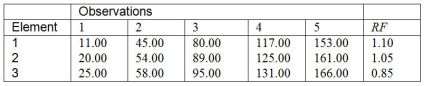 a.What is the normal time for this operation?
b.If an allowance of 20 percent is used,what is the standard time for this task?
c.What sample size is appropriate for estimating the time for element 3 within + 3 percent of the true mean time with 95 percent confidence (z = 1.96)?
a.What is the normal time for this operation?
b.If an allowance of 20 percent is used,what is the standard time for this task?
c.What sample size is appropriate for estimating the time for element 3 within + 3 percent of the true mean time with 95 percent confidence (z = 1.96)? (Essay)
4.8/5 (86)
(86) A work study has been conducted on a new operation with three work elements.The following times,in minutes,were obtained using the continuous method.  a.What is the normal time for this operation?
b.If an allowance of 20 percent is used,what is the standard time for this task?
a.What is the normal time for this operation?
b.If an allowance of 20 percent is used,what is the standard time for this task? (Essay)
4.9/5 (74)
(74) Table H.2
 -Use the information in Table H.2.If the allowance for this task is 20 percent,what is the standard time for the entire task?
 (Multiple Choice)
4.8/5 (75)
(75) Which one of the following statements about work measurement methods is TRUE?
(Multiple Choice)
4.7/5 (82)
(82) A(n)________ is the time required for a trained worker to perform a task following a prescribed method with normal effort and skill.
(Essay)
4.7/5 (81)
(81) 
Filters
- Essay(0)
- Multiple Choice(0)
- Short Answer(0)
- True False(0)
- Matching(0)