



 Chat with AI
Exam 13: Project Management

Exam 1: Introduction to Operations and Supply Chain Management79 Questions
Exam 2: Supplement Operational Decision-Making Tools: Decision Analysis43 Questions
Exam 3: Quality Management91 Questions
Exam 4: Statistical Process Control103 Questions
Exam 5: Supplement Operational Decision-Making Tools: Acceptance Sampling28 Questions
Exam 6: Product Design86 Questions
Exam 7: Service Design77 Questions
Exam 8: Processes and Technology47 Questions
Exam 9: Capacity and Facilities90 Questions
Exam 10: Supplement Operational Decision-Making Tools: Facility Location Models22 Questions
Exam 11: Human Resources90 Questions
Exam 12: Supplement Operational Decision-Making Tools: Work Measurement26 Questions
Exam 13: Project Management98 Questions
Exam 14: Supply Chain Management Strategy and Design73 Questions
Exam 15: Global Supply Chain Procurement and Distribution86 Questions
Exam 16: Supplement Operational Decision-Making Tools: Transportation and Transshipment Models28 Questions
Exam 17: Forecasting94 Questions
Exam 18: Inventory Management93 Questions
Exam 19: Supplement Operational Decision-Making Tools: Simulation25 Questions
Exam 20: Sales and Operations Planning85 Questions
Exam 21: Supplement Operational Decision-Making Tools: Linear Programming38 Questions
Exam 22: Enterprise Resource Planning92 Questions
Exam 23: Lean Systems86 Questions
Exam 24: Scheduling99 Questions
Select questions type


The following table of probabilistic time estimates (in weeks)and activity predecessors are provided for a project.
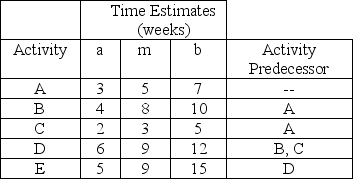 Table ZZ
-Using Table ZZ,the variance of the project's total completion time is
Table ZZ
-Using Table ZZ,the variance of the project's total completion time is (Multiple Choice)
4.9/5  (82)
(82) Which of the following is not a basic element in a project plan?
(Multiple Choice)
4.9/5 (77)
(77) Project scheduling is recognized as the most critical element in the project management process.
(True/False)
5.0/5 (89)
(89) Which of the following is not one of the basic steps involved in developing a schedule?
(Multiple Choice)
4.9/5 (95)
(95) The _______________ is a document that provides a common understanding,justification,and expected result for a project.
(Multiple Choice)
4.7/5 (73)
(73) The following table of probabilistic time estimates (in weeks)and activity predecessors are provided for a project.
Table ZZ
-Using Table ZZ,how much slack is associated with activity C?
Table ZZ
-Using Table ZZ,how much slack is associated with activity C? (Multiple Choice)
4.8/5 (85)
(85) In general,crashing costs decrease as a project's duration is systematically reduced to a target value.
(True/False)
4.9/5 (84)
(84) A project consists of the following four activities with activity times in days:
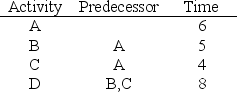 Table YY
-Using Table YY,the amount of slack associated with activity C is
Table YY
-Using Table YY,the amount of slack associated with activity C is (Multiple Choice)
4.9/5 (80)
(80) Managing quality is not an important part of project management.
(True/False)
4.8/5 (72)
(72) The estimated mean time for an activity with a most likely time (m)equal to 12 weeks,an optimistic time (a)equal to 9 weeks,and a pessimistic time (b)equal to 18 weeks is
(Multiple Choice)
4.8/5 (83)
(83) Earned value analysis reports a project's performance by tracking its forecasted completion date and anticipated budget variations.
(True/False)
4.8/5 (72)
(72) The critical path is the longest path through the project's network.
(True/False)
4.8/5 (68)
(68) Management and control of a companywide portfolio of projects is known as enterprise project management.
(True/False)
4.9/5 (91)
(91) Unlike PERT,CPM incorporates probabilistic time estimates into the project management process.
(True/False)
4.8/5 (80)
(80) Two key elements of project control are time management and cost management.
(True/False)
4.9/5 (80)
(80) 
Filters
- Essay(0)
- Multiple Choice(0)
- Short Answer(0)
- True False(0)
- Matching(0)