



 Chat with AI
Exam 20: Sales and Operations Planning

Exam 1: Introduction to Operations and Supply Chain Management79 Questions
Exam 2: Supplement Operational Decision-Making Tools: Decision Analysis43 Questions
Exam 3: Quality Management91 Questions
Exam 4: Statistical Process Control103 Questions
Exam 5: Supplement Operational Decision-Making Tools: Acceptance Sampling28 Questions
Exam 6: Product Design86 Questions
Exam 7: Service Design77 Questions
Exam 8: Processes and Technology47 Questions
Exam 9: Capacity and Facilities90 Questions
Exam 10: Supplement Operational Decision-Making Tools: Facility Location Models22 Questions
Exam 11: Human Resources90 Questions
Exam 12: Supplement Operational Decision-Making Tools: Work Measurement26 Questions
Exam 13: Project Management98 Questions
Exam 14: Supply Chain Management Strategy and Design73 Questions
Exam 15: Global Supply Chain Procurement and Distribution86 Questions
Exam 16: Supplement Operational Decision-Making Tools: Transportation and Transshipment Models28 Questions
Exam 17: Forecasting94 Questions
Exam 18: Inventory Management93 Questions
Exam 19: Supplement Operational Decision-Making Tools: Simulation25 Questions
Exam 20: Sales and Operations Planning85 Questions
Exam 21: Supplement Operational Decision-Making Tools: Linear Programming38 Questions
Exam 22: Enterprise Resource Planning92 Questions
Exam 23: Lean Systems86 Questions
Exam 24: Scheduling99 Questions
Select questions type


An economic strategy for adjusting demand can include adjusting capacity or managing demand.

Free
(True/False)
4.9/5  (78)
(78) Correct Answer: Verified
True
One objective of sales and operations planning is to develop a companywide game plan to satisfy production.
Free
(True/False)
4.8/5 (79)
(79) Correct Answer:Verified
VerifiedFalse
A bagel company bakes a specialty bagel that it sells by the dozen every day.These specialty bagels can only be baked early in the morning before the store opens for business.The company estimates that the daily demand (in dozens)for its specialty bagel is distributed as follows: 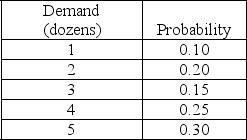 Specialty bagels are sold by the dozen only at a cost of $9.00 per dozen.The cost to make one bagel is $0.50.Leftover specialty bagels are sold by the dozen the next day for a 50% discount.The bagel company's cost of overestimating demand,Co,is
Free
(Multiple Choice)
4.8/5 (74)
(74) Correct Answer:Verified
VerifiedA
The following information relates to a company's aggregate production planning activities: 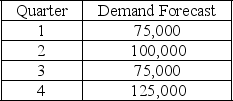 Beginning Workforce = 35 workers
Production per Employee = 1,250 units per quarter
Hiring Cost = $500 per worker
Firing Cost = $1,000 per worker
Inventory Carrying Cost = $20 per unit per quarter
If a level production strategy is used,then the cost of the level production plan (inventory costs plus hiring and firing costs)is
Beginning Workforce = 35 workers
Production per Employee = 1,250 units per quarter
Hiring Cost = $500 per worker
Firing Cost = $1,000 per worker
Inventory Carrying Cost = $20 per unit per quarter
If a level production strategy is used,then the cost of the level production plan (inventory costs plus hiring and firing costs)is (Multiple Choice)
4.7/5 (88)
(88) A chase demand strategy is one of several alternatives available for managing demand.
(True/False)
5.0/5 (81)
(81) The following information relates to a company's aggregate production planning activities: 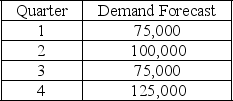 Beginning Workforce = 35 workers
Production per Employee = 1,250 units per quarter
Hiring Cost = $500 per worker
Firing Cost = $1,000 per worker
Inventory Carrying Cost = $20 per unit per quarter
If a chase demand strategy is used,then the total firing cost for the plan is
Beginning Workforce = 35 workers
Production per Employee = 1,250 units per quarter
Hiring Cost = $500 per worker
Firing Cost = $1,000 per worker
Inventory Carrying Cost = $20 per unit per quarter
If a chase demand strategy is used,then the total firing cost for the plan is (Multiple Choice)
4.8/5 (89)
(89) The following information relates to a company's aggregate production planning activities: 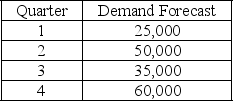 Beginning Workforce = 50 workers
Production per Employee = 250 units per quarter
Hiring Cost = $1000 per worker
Firing Cost = $1,500 per worker
Inventory Carrying Cost = $15 per unit per quarter
If a level production strategy is used,then the total cost of the plan (hiring cost,firing cost,and inventory carrying cost)is
Beginning Workforce = 50 workers
Production per Employee = 250 units per quarter
Hiring Cost = $1000 per worker
Firing Cost = $1,500 per worker
Inventory Carrying Cost = $15 per unit per quarter
If a level production strategy is used,then the total cost of the plan (hiring cost,firing cost,and inventory carrying cost)is (Multiple Choice)
4.9/5 (79)
(79) A company is developing a linear programming model for its aggregate production plan.If It = units in inventory at the end of period t,Pt = units produced in period t,and Dt = demand in period t,then the company's demand constraint to ensure that demand is met in quarter 3 is
(Multiple Choice)
5.0/5 (83)
(83) The process of breaking an aggregate plan into more detailed plans is referred to as
(Multiple Choice)
4.8/5 (72)
(72) The difference between planned production and customer orders is known as
(Multiple Choice)
4.8/5 (82)
(82) What is aggregate planning and what alternatives are generally feasible when developing the aggregate production plans?
(Essay)
4.8/5 (62)
(62) Given the information below,the number of available-to-promise units in period 4 is 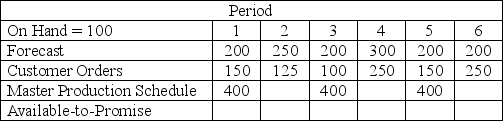
(Multiple Choice)
4.7/5 (80)
(80) The following information relates to a company's aggregate production planning activities: 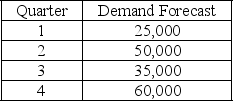 Beginning Workforce = 50 workers
Production per Employee = 250 units per quarter
Hiring Cost = $1000 per worker
Firing Cost = $1,500 per worker
Inventory Carrying Cost = $15 per unit per quarter
If a level production strategy is used,then the required output per quarter is
Beginning Workforce = 50 workers
Production per Employee = 250 units per quarter
Hiring Cost = $1000 per worker
Firing Cost = $1,500 per worker
Inventory Carrying Cost = $15 per unit per quarter
If a level production strategy is used,then the required output per quarter is (Multiple Choice)
4.9/5 (90)
(90) A hot dog vendor must decide on Monday how many hot dogs to have available for the coming Saturday's football game.Each hot dog costs the vendor $3.00 and is sold for $5.00.After the game any unsold hot dogs are discounted and sold to the university cafeteria for $1.75.The vendor believes that the demand for hot dogs follows the probability distribution shown below: 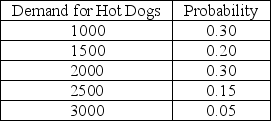 The vendor's cost of underestimating demand,Cu,is
 (Multiple Choice)
4.7/5 (80)
(80) An optimizing technique originally developed for aggregate planning in the paint factory is the
(Multiple Choice)
4.9/5 (88)
(88) Which of the following is an output of sales and operations planning?
(Multiple Choice)
4.8/5 (71)
(71) Financial constraints are one of the major inputs of the sales and operations planning process.
(True/False)
4.8/5 (74)
(74) The following information relates to a company's aggregate production planning activities: 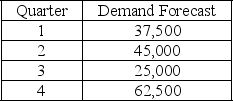 Beginning Workforce = 125 workers
Production per Employee = 500 units per quarter
Hiring Cost = $750 per worker
Firing Cost = $1,500 per worker
Inventory Carrying Cost = $10 per unit per quarter
If a level production strategy is used,the number of units to produce each quarter is
Beginning Workforce = 125 workers
Production per Employee = 500 units per quarter
Hiring Cost = $750 per worker
Firing Cost = $1,500 per worker
Inventory Carrying Cost = $10 per unit per quarter
If a level production strategy is used,the number of units to produce each quarter is (Multiple Choice)
4.9/5 (77)
(77) The following information relates to a company's aggregate production planning activities: 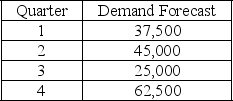 Beginning Workforce = 125 workers
Production per Employee = 500 units per quarter
Hiring Cost = $750 per worker
Firing Cost = $1,500 per worker
Inventory Carrying Cost = $10 per unit per quarter
If a level production strategy is used,the number of units in inventory at the end of quarter 3 is
Beginning Workforce = 125 workers
Production per Employee = 500 units per quarter
Hiring Cost = $750 per worker
Firing Cost = $1,500 per worker
Inventory Carrying Cost = $10 per unit per quarter
If a level production strategy is used,the number of units in inventory at the end of quarter 3 is (Multiple Choice)
4.9/5 (92)
(92) 
Filters
- Essay(0)
- Multiple Choice(0)
- Short Answer(0)
- True False(0)
- Matching(0)