



 Chat with AI
Exam 20: Sales and Operations Planning

Exam 1: Introduction to Operations and Supply Chain Management79 Questions
Exam 2: Supplement Operational Decision-Making Tools: Decision Analysis43 Questions
Exam 3: Quality Management91 Questions
Exam 4: Statistical Process Control103 Questions
Exam 5: Supplement Operational Decision-Making Tools: Acceptance Sampling28 Questions
Exam 6: Product Design86 Questions
Exam 7: Service Design77 Questions
Exam 8: Processes and Technology47 Questions
Exam 9: Capacity and Facilities90 Questions
Exam 10: Supplement Operational Decision-Making Tools: Facility Location Models22 Questions
Exam 11: Human Resources90 Questions
Exam 12: Supplement Operational Decision-Making Tools: Work Measurement26 Questions
Exam 13: Project Management98 Questions
Exam 14: Supply Chain Management Strategy and Design73 Questions
Exam 15: Global Supply Chain Procurement and Distribution86 Questions
Exam 16: Supplement Operational Decision-Making Tools: Transportation and Transshipment Models28 Questions
Exam 17: Forecasting94 Questions
Exam 18: Inventory Management93 Questions
Exam 19: Supplement Operational Decision-Making Tools: Simulation25 Questions
Exam 20: Sales and Operations Planning85 Questions
Exam 21: Supplement Operational Decision-Making Tools: Linear Programming38 Questions
Exam 22: Enterprise Resource Planning92 Questions
Exam 23: Lean Systems86 Questions
Exam 24: Scheduling99 Questions
Select questions type


All of the following are inputs to the aggregate production planning process except
(Multiple Choice)
4.8/5  (81)
(81) When demand fluctuations are extreme using overtime and undertime is a feasible strategy for adjusting capacity.
(True/False)
4.7/5 (88)
(88) A bagel company bakes a specialty bagel that it sells by the dozen every day.These specialty bagels can only be baked early in the morning before the store opens for business.The company estimates that the daily demand (in dozens)for its specialty bagel is distributed as follows:  Specialty bagels are sold by the dozen only at a cost of $9.00 per dozen.The cost to make one bagel is $0.50.Leftover specialty bagels are sold by the dozen the next day for a 50% discount.The optimal number of specialty bagels that should be baked tomorrow (in dozens)is
 (Multiple Choice)
4.8/5 (81)
(81) The level strategy for adjusting capacity is only appropriate when there is no variation in demand.
(True/False)
4.8/5 (78)
(78) The following information relates to a company's aggregate production planning activities:  Beginning Workforce = 35 workers
Production per Employee = 1,250 units per quarter
Hiring Cost = $500 per worker
Firing Cost = $1,000 per worker
Inventory Carrying Cost = $20 per unit per quarter
If a chase demand strategy is used,then the number of workers hired at the start of quarter 2 is
Beginning Workforce = 35 workers
Production per Employee = 1,250 units per quarter
Hiring Cost = $500 per worker
Firing Cost = $1,000 per worker
Inventory Carrying Cost = $20 per unit per quarter
If a chase demand strategy is used,then the number of workers hired at the start of quarter 2 is (Multiple Choice)
4.8/5 (95)
(95) The following information relates to a company's aggregate production planning activities:  Beginning Workforce = 125 workers
Production per Employee = 500 units per quarter
Hiring Cost = $750 per worker
Firing Cost = $1,500 per worker
Inventory Carrying Cost = $10 per unit per quarter
If a chase demand strategy is used,then the number of workers hired at the start of quarter 4 is
Beginning Workforce = 125 workers
Production per Employee = 500 units per quarter
Hiring Cost = $750 per worker
Firing Cost = $1,500 per worker
Inventory Carrying Cost = $10 per unit per quarter
If a chase demand strategy is used,then the number of workers hired at the start of quarter 4 is (Multiple Choice)
4.8/5 (94)
(94) A chase strategy involves hiring and firing workers so that production trails demand.
(True/False)
4.9/5 (79)
(79) A hot dog vendor must decide on Monday how many hot dogs to have available for the coming Saturday's football game.Each hot dog costs the vendor $3.00 and is sold for $5.00.After the game any unsold hot dogs are discounted and sold to the university cafeteria for $1.75.The vendor believes that the demand for hot dogs follows the probability distribution shown below:  The vendor's cost of overestimating demand,Co,is
 (Multiple Choice)
4.9/5 (79)
(79) The following information relates to a company's aggregate production planning activities:  Beginning Workforce = 125 workers
Production per Employee = 500 units per quarter
Hiring Cost = $750 per worker
Firing Cost = $1,500 per worker
Inventory Carrying Cost = $10 per unit per quarter
If a level production strategy is used,the number of workers required each quarter is
Beginning Workforce = 125 workers
Production per Employee = 500 units per quarter
Hiring Cost = $750 per worker
Firing Cost = $1,500 per worker
Inventory Carrying Cost = $10 per unit per quarter
If a level production strategy is used,the number of workers required each quarter is (Multiple Choice)
4.9/5 (71)
(71) A company is developing a linear programming model for its aggregate production plan.If Wt = workforce size for period t,Ht = number of workers hired for period t,and Ft = number of workers fired for period t,then the company's workforce constraint for period 4 is
(Multiple Choice)
4.9/5 (74)
(74) The term aggregate planning reflects the fact that plans are developed for ___________,rather than _____________.
(Multiple Choice)
4.9/5 (88)
(88) An aggregate operations plan specifies the production quantities for an entire product family or product line.
(True/False)
4.9/5 (70)
(70) The following information relates to a company's aggregate production planning activities:  Beginning Workforce = 125 workers
Production per Employee = 500 units per quarter
Hiring Cost = $750 per worker
Firing Cost = $1,500 per worker
Inventory Carrying Cost = $10 per unit per quarter
If a chase demand strategy is used,the total hiring and firing costs for the production plan is
Beginning Workforce = 125 workers
Production per Employee = 500 units per quarter
Hiring Cost = $750 per worker
Firing Cost = $1,500 per worker
Inventory Carrying Cost = $10 per unit per quarter
If a chase demand strategy is used,the total hiring and firing costs for the production plan is (Multiple Choice)
4.9/5 (82)
(82) Which of the following is not a strategy for adjusting capacity?
(Multiple Choice)
4.9/5 (66)
(66) The following information relates to a company's aggregate production planning activities:  Beginning Workforce = 125 workers
Production per Employee = 500 units per quarter
Hiring Cost = $750 per worker
Firing Cost = $1,500 per worker
Inventory Carrying Cost = $10 per unit per quarter
If a chase demand strategy is used,the number of workers fired at the start of quarter 3 is
Beginning Workforce = 125 workers
Production per Employee = 500 units per quarter
Hiring Cost = $750 per worker
Firing Cost = $1,500 per worker
Inventory Carrying Cost = $10 per unit per quarter
If a chase demand strategy is used,the number of workers fired at the start of quarter 3 is (Multiple Choice)
4.9/5 (72)
(72) A hotel manager must decide how many rooms to overbook.Room rates are $125 per night and each room costs $45 to maintain.A bumped customer is sent to another hotel at a cost of $75.Given the distribution of no-shows below,how many rooms should the manager overbook? 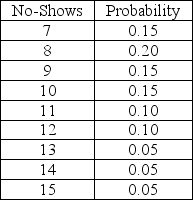
(Multiple Choice)
5.0/5 (76)
(76) A company is developing a linear programming model for its aggregate production plan.Each worker can produce 500 units per quarter.If Wt = workforce size in period t and Pt = number of units produced in period t,then the production constraint for period 3 is
(Multiple Choice)
4.9/5 (92)
(92) Adjusting available capacity by hiring and firing workers to match demand is an example of a(n)________ strategy.
(Multiple Choice)
4.8/5 (69)
(69) Disaggregation is the process of breaking a sales and operations plan into more detailed plans.
(True/False)
4.8/5 (72)
(72) 
Filters
- Essay(0)
- Multiple Choice(0)
- Short Answer(0)
- True False(0)
- Matching(0)