



 Chat with AI
Exam 11: Intermolecular Forces and the Physical Properties of Liquids and Solids

Exam 1: Chemistry: the Central Science129 Questions
Exam 2: Atoms Molecules and Ions120 Questions
Exam 3: Stoichiometry Ratios of Combination131 Questions
Exam 4: Reactions in Aqueous Solutions144 Questions
Exam 5: Thermochemistry134 Questions
Exam 6: Quantum Theory and the Electronic Structure of Atoms107 Questions
Exam 7: Electron Configuration and the Periodic Table120 Questions
Exam 8: Chemical Bonding I Basic Concepts95 Questions
Exam 9: Chemical Bonding Ii Molecular Geometry and Bonding Theories137 Questions
Exam 10: Gases131 Questions
Exam 11: Intermolecular Forces and the Physical Properties of Liquids and Solids135 Questions
Exam 12: Modern Materials108 Questions
Exam 13: Physical Properties of Solutions147 Questions
Exam 14: Chemical Kinetics114 Questions
Exam 15: Chemical Equilibrium135 Questions
Exam 16: Acids and Bases133 Questions
Exam 17: Acid-Base Equilibria and Solubility Equilibria129 Questions
Exam 18: Entropy Free Energy and Equilibrium61 Questions
Exam 19: Electrochemistry122 Questions
Exam 20: Nuclear Chemistry125 Questions
Exam 21: Environmental Chemistry131 Questions
Exam 22: Coordination Chemistry128 Questions
Exam 23: Metallurgy and the Chemistry of Metals115 Questions
Exam 24: Nonmetallic Elements and Their Compounds119 Questions
Exam 25: Organic Chemistry148 Questions
Select questions type


Which of the following lacks a regular three-dimensional arrangement of atoms?
(Multiple Choice)
5.0/5  (78)
(78) In the packing of identical atoms with cubic unit cells,the packing efficiency increases as the coordination number increases.
(True/False)
4.9/5 (76)
(76) Which one of the following pure substances will exhibit hydrogen bonding?
(Multiple Choice)
4.8/5 (57)
(57) How many phase changes are represented in the following heating curve of a pure substance? 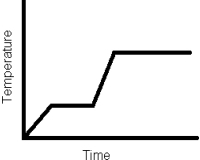
(Multiple Choice)
4.8/5 (93)
(93) Select the pair of substances in which the one with the higher vapor pressure at a given temperature is listed first.
(Multiple Choice)
4.9/5 (86)
(86) If the adhesive forces between a liquid and the walls of a capillary tube are greater than the cohesive forces within the liquid,
(Multiple Choice)
4.8/5 (80)
(80) Below is a representation of the unit cell for nickel(II)oxide.How many O2? anions are there in the unit cell? 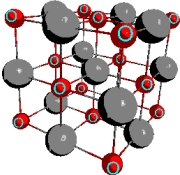
(Multiple Choice)
4.8/5 (90)
(90) Identify the dominant (strongest)type of intermolecular force present in H2S(g).
(Short Answer)
5.0/5 (68)
(68) Diethyl ether,(CH3CH2)2O,used as a solvent for extraction of organic compounds from aqueous solutions,has a high vapor pressure,which makes it a potential fire hazard in laboratories in which it is used.How much energy is released when 100.0 g is cooled from 53.0°C to 10.0°C? Normal boiling point 34.5°C
Heat of vaporization 351 J/g
Specific heat of
(CH3CH2)2O(l)3.74 J/g • °C
Specific heat of
(CH3CH2)2O(g)2.35 J/g • °C
(Multiple Choice)
4.8/5 (75)
(75) What quantity of heat is required to melt 2.00 kg of iron at its melting point (1809 K)? For iron, ΔHfus = 13.80 kJ/mol.
(Multiple Choice)
4.9/5 (66)
(66) A metal such as chromium in the body-centered cubic lattice has _______________ atom(s)per unit cell.
(Multiple Choice)
4.9/5 (77)
(77) Identify the dominant (strongest)type of intermolecular force present in RbCl(s).
(Short Answer)
4.9/5 (75)
(75) Below is a representation of liquid water in equilibrium with its water vapor in a rigid container at 35ºC.The circles represent water vapor. 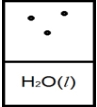 Which diagram below best represents liquid water in equilibrium with its water vapor at 70ºC? The heat of vaporization of water is 40.7 kJ/mol.(R = 8.314 J/K • mol)
 (Multiple Choice)
4.9/5 (66)
(66) The arrow in this phase diagram represents which phase change? 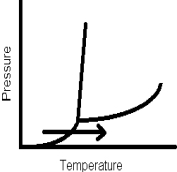
(Multiple Choice)
4.9/5 (80)
(80) In which of the following compounds will the molecules not form hydrogen bonds with each other?
(Multiple Choice)
4.7/5 (78)
(78) ___________ ___________ is a special type of dipole-dipole interaction.
(Short Answer)
4.9/5 (73)
(73) Naphthalene sublimes at room temperature and 1 atmosphere pressure; which statement is true concerning the triple point of naphthalene?
(Multiple Choice)
4.9/5 (76)
(76) The maximum number of phases of a single substance which can coexist in equilibrium is two.
(True/False)
4.8/5 (61)
(61) The energy required to increase the surface of a liquid per unit area is called the
(Multiple Choice)
4.8/5 (76)
(76) 
Filters
- Essay(0)
- Multiple Choice(0)
- Short Answer(0)
- True False(0)
- Matching(0)