



 Chat with AI
Exam 22: Coordination Chemistry

Exam 1: Chemistry: the Central Science129 Questions
Exam 2: Atoms Molecules and Ions120 Questions
Exam 3: Stoichiometry Ratios of Combination131 Questions
Exam 4: Reactions in Aqueous Solutions144 Questions
Exam 5: Thermochemistry134 Questions
Exam 6: Quantum Theory and the Electronic Structure of Atoms107 Questions
Exam 7: Electron Configuration and the Periodic Table120 Questions
Exam 8: Chemical Bonding I Basic Concepts95 Questions
Exam 9: Chemical Bonding Ii Molecular Geometry and Bonding Theories137 Questions
Exam 10: Gases131 Questions
Exam 11: Intermolecular Forces and the Physical Properties of Liquids and Solids135 Questions
Exam 12: Modern Materials108 Questions
Exam 13: Physical Properties of Solutions147 Questions
Exam 14: Chemical Kinetics114 Questions
Exam 15: Chemical Equilibrium135 Questions
Exam 16: Acids and Bases133 Questions
Exam 17: Acid-Base Equilibria and Solubility Equilibria129 Questions
Exam 18: Entropy Free Energy and Equilibrium61 Questions
Exam 19: Electrochemistry122 Questions
Exam 20: Nuclear Chemistry125 Questions
Exam 21: Environmental Chemistry131 Questions
Exam 22: Coordination Chemistry128 Questions
Exam 23: Metallurgy and the Chemistry of Metals115 Questions
Exam 24: Nonmetallic Elements and Their Compounds119 Questions
Exam 25: Organic Chemistry148 Questions
Select questions type


How should the color of the solution change as [Fe(CN)6]4- undergoes the following chemical change? [Fe(H2O)6]2+(aq)+ 6CN-(aq)→ [Fe(CN)6]4-(aq)+ 6H2O(l)
(Multiple Choice)
4.9/5  (83)
(83) Consider the following octahedral complex structures,each involving ethylene diamine and two different,unidentate ligands X and Y.  Which one of the following statements about these structures is incorrect?
 (Multiple Choice)
4.8/5 (74)
(74) Consider the following structures (1 and 2 are octahedral; 3 and 4 are square planar).  Which one of the following statements about the above structures is correct?
 (Multiple Choice)
4.9/5 (76)
(76) Two well-known complex ions containing Ni are [Ni(H2O)6]2+,which is green,and [Ni(en)3]2+,which is purple.Which one of these statements is true?
(Multiple Choice)
4.9/5 (85)
(85) Which response gives the correct coordination number (C.N.)and oxidation number (O.N.)of the transition metal atom in [Co(NH3)2(H2O)2Cl2]+?
(Multiple Choice)
4.8/5 (88)
(88) In the coordination compound [Pt(NH3)2Cl2],the coordination number and oxidation number of the central atom are _____ and _____,respectively.
(Multiple Choice)
4.8/5 (89)
(89) The following energy-level diagram could correspond to which coordination compound? 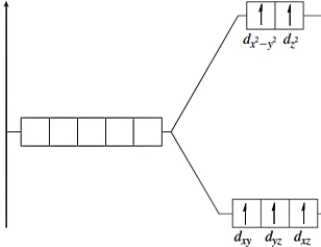 .
. (Multiple Choice)
4.8/5 (77)
(77) The method of distinguishing between the stability of a complex ion and its tendency to react in an exchange reaction is known as which of the following?
(Multiple Choice)
4.8/5 (87)
(87) The correct formula for the dibromobis(oxalato)cobaltate(III)ion is [Co(C2O4)Br2]3+.
(True/False)
4.8/5 (91)
(91) What is the name that refers to the number of donor atoms surrounding the central metal atom in a complex ion?
(Multiple Choice)
4.9/5 (60)
(60) Which is the appropriate energy-level diagram for the octahedral coordination complex hexaammineiron(III)?
(Multiple Choice)
4.9/5 (77)
(77) The maximum oxidation state of an element in the first transition series never exceeds its group number.
(True/False)
5.0/5 (72)
(72) In the coordination compound [Co(en)2Cl2]Cl,the coordination number and oxidation number of the central atom are _____ and _____,respectively.
(Multiple Choice)
4.8/5 (75)
(75) Coordination compounds may exhibit ___________ and __________ types of stereoisomerism.
(Short Answer)
4.9/5 (84)
(84) Iron(III)forms an octahedral complex with the ligand CN-.How many unpaired electrons are in the d orbitals of iron?
(Multiple Choice)
4.8/5 (79)
(79) Which of the following ions is most likely to form colored compounds?
(Multiple Choice)
4.9/5 (69)
(69) 
Filters
- Essay(0)
- Multiple Choice(0)
- Short Answer(0)
- True False(0)
- Matching(0)