



 Chat with AI
Exam 12: Infrared Spectroscopy and Mass Spectrometry

Exam 1: Introduction and Review127 Questions
Exam 2: Structure and Properties of Organic Molecules129 Questions
Exam 3: Structure and Stereochemistry of Alkanes129 Questions
Exam 4: The Study of Chemical Reactions128 Questions
Exam 5: Stereochemistry128 Questions
Exam 6: Alkyl Halides: Nucleophilic Substitution and Elimination132 Questions
Exam 7: Structure and Synthesis of Alkenes128 Questions
Exam 8: Reactions of Alkenes132 Questions
Exam 9: Alkynes124 Questions
Exam 10: Structure and Synthesis of Alcohols132 Questions
Exam 11: Reactions of Alcohols124 Questions
Exam 12: Infrared Spectroscopy and Mass Spectrometry120 Questions
Exam 13: Nuclear Magnetic Resonance Spectroscopy130 Questions
Exam 14: Ethers, Epoxides, and Thioethers127 Questions
Exam 15: Conjugated Systems, Orbital Symmetry, and Ultraviolet Spectroscopy130 Questions
Exam 16: Aromatic Compounds128 Questions
Exam 17: Reactions of Aromatic Compounds129 Questions
Exam 18: Ketones and Aldehydes132 Questions
Exam 19: Amines129 Questions
Exam 20: Carboxylic Acids125 Questions
Exam 21: Carboxylic Acid Derivatives128 Questions
Exam 22: Condensations and Alpha Substitutions of Carboxyl Compounds125 Questions
Exam 23: Carbohydrates and Nucleic Acids125 Questions
Exam 24: Amino Acids, Peptides, and Proteins127 Questions
Exam 25: Lipids127 Questions
Exam 26: Synthetic Polymers128 Questions
Select questions type


What are the predicted m/z values (masses )and relative heights of all the molecular ions of 1-bromoethane that would appear on a mass spectrum (excluding peaks produced by 13C and 2H)?
(Multiple Choice)
4.8/5  (84)
(84) Sodium borohydride can be used to reduce cyclohexanone to cyclohexanol. How could one use IR to determine if all starting material had been consumed?
(Short Answer)
4.8/5 (69)
(69) Which compound would be expected to show intense IR absorption at 1680 cm-1? 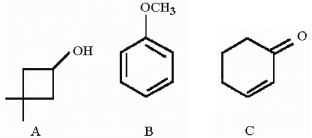
(Short Answer)
4.8/5 (90)
(90) How could IR spectroscopy be used to distinguish between the following pair of compounds?
CH3OCH2CH3 and CH3CH2CH2OH
(Short Answer)
4.9/5 (74)
(74) Which has a lower characteristic stretching frequency, the C O bond or the CO bond? Explain briefly.
(Essay)
4.8/5 (80)
(80) Which compound would be expected to show intense IR absorption at 2250 cm-1?
(Multiple Choice)
4.8/5 (85)
(85) Deduce a possible structure for the compound with the IR absorptions below.
C3H3Br: 3300, 2900, 2100 cm-1
(Short Answer)
4.9/5 (80)
(80) Which compound would show a larger than usual M+2 peak in the mass spectrum?
(Multiple Choice)
4.7/5 (69)
(69) In order for a vibration mode to be observable in the IR, the vibration must change the ________ of the molecule.
(Short Answer)
4.7/5 (67)
(67) Which of the following compounds would contain characteristic IR stretches at 3300 and 2200 cm-1?
(Multiple Choice)
4.8/5 (75)
(75) Which of the following bonds, CN, C=N, or C꓿N, has an IR stretch around 1600 cm-1?
(Short Answer)
4.8/5 (83)
(83) Rank the following bonds in order of increasing stretching frequency (cm-1) in IR spectroscopy: 
(Short Answer)
4.7/5 (76)
(76) Which of the following molecules has a characteristic broad stretch at 3300 cm-1?
(Multiple Choice)
4.9/5 (63)
(63) The natural abundances of chlorine's two major isotopes are 35Cl (75.5%) and 37Cl (24.5%). If the mass spectrum of chlorobenzene contains a peak at m/z 114 with an abundance of 15.0%, calculate the % abundance of the peak at m/z 112.
(Short Answer)
4.9/5 (74)
(74) Which statement best explains why a carbonyl absorbs infrared radiation at a higher frequency than an alkene absorption?
(Multiple Choice)
4.8/5 (75)
(75) Which of the following compounds has the lowest carbonyl stretching frequency? 
(Essay)
4.8/5 (73)
(73) Which of the following would not have a C-H stretch at about 3050 cm-1?
(Multiple Choice)
4.9/5 (94)
(94) 
Filters
- Essay(0)
- Multiple Choice(0)
- Short Answer(0)
- True False(0)
- Matching(0)