



 Chat with AI
Exam 14: Ethers, Epoxides, and Thioethers

Exam 1: Introduction and Review127 Questions
Exam 2: Structure and Properties of Organic Molecules129 Questions
Exam 3: Structure and Stereochemistry of Alkanes129 Questions
Exam 4: The Study of Chemical Reactions128 Questions
Exam 5: Stereochemistry128 Questions
Exam 6: Alkyl Halides: Nucleophilic Substitution and Elimination132 Questions
Exam 7: Structure and Synthesis of Alkenes128 Questions
Exam 8: Reactions of Alkenes132 Questions
Exam 9: Alkynes124 Questions
Exam 10: Structure and Synthesis of Alcohols132 Questions
Exam 11: Reactions of Alcohols124 Questions
Exam 12: Infrared Spectroscopy and Mass Spectrometry120 Questions
Exam 13: Nuclear Magnetic Resonance Spectroscopy130 Questions
Exam 14: Ethers, Epoxides, and Thioethers127 Questions
Exam 15: Conjugated Systems, Orbital Symmetry, and Ultraviolet Spectroscopy130 Questions
Exam 16: Aromatic Compounds128 Questions
Exam 17: Reactions of Aromatic Compounds129 Questions
Exam 18: Ketones and Aldehydes132 Questions
Exam 19: Amines129 Questions
Exam 20: Carboxylic Acids125 Questions
Exam 21: Carboxylic Acid Derivatives128 Questions
Exam 22: Condensations and Alpha Substitutions of Carboxyl Compounds125 Questions
Exam 23: Carbohydrates and Nucleic Acids125 Questions
Exam 24: Amino Acids, Peptides, and Proteins127 Questions
Exam 25: Lipids127 Questions
Exam 26: Synthetic Polymers128 Questions
Select questions type


Which of the following reactions is classified as a Williamson ether synthesis?
(Multiple Choice)
4.9/5  (81)
(81) Di-n-pentyl ether can be converted to 1-bromopentane by treatment with HBr through essentially a(n) ________ mechanism.
(Multiple Choice)
4.9/5 (76)
(76) When trans-hex-3-ene is treated with PhCO3H, the major organic product is:
(Multiple Choice)
4.9/5 (91)
(91) 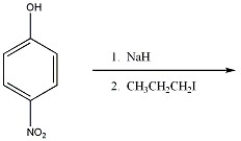
When hexan-1-ol is treated with conc. H2SO4 at moderate temperatures, ________ is formed via a(n) ________ mechanism.
(Multiple Choice)
4.9/5 (63)
(63) Can one prepare di-sec-butyl ether in good yield by heating butan-2-ol in the presence of sulfuric acid? Explain.
(Essay)
4.9/5 (84)
(84) 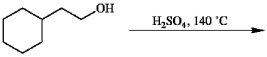

Which of the following reactions or series of reactions will lead to formation of trans-2-methoxycyclohexanol?
(Multiple Choice)
4.8/5 (71)
(71) Through what mechanism can a 1,2-halohydrin be converted into an epoxide?
(Multiple Choice)
4.8/5 (57)
(57) Provide an acceptable name for the compound shown below.
CH3OCH2CH(CH3)2
(Essay)
4.7/5 (80)
(80) Which of the following compounds would undergo autoxidation most readily?
(Multiple Choice)
4.8/5 (76)
(76) Predict the products of the following reaction and give a reasonable mechanism for their formation. 
(Essay)
4.8/5 (79)
(79) Provide the structure of the fragment in the mass spectrum of dipropyl ether that results from a cleavage.
(Essay)
4.8/5 (73)
(73) Which of the following reactions or series of reactions will lead to the formation of methoxycyclohexane?
(Multiple Choice)
4.8/5 (78)
(78) What compound is formed when methyloxirane is reacted with ethylmagnesium bromide followed by treatment with aqueous acid?
(Multiple Choice)
5.0/5 (77)
(77) 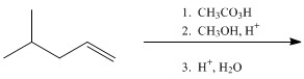
Show the best method for preparing methoxycyclopentane via the Williamson ether synthesis.
(Essay)
4.8/5 (78)
(78) What is the major difference in the structure of the product formed in a Grignard reaction when an alkyl magnesium halide (Grignard reagent) is reacted with an epoxide rather than an aldehyde or ketone followed by work-up with H3O+?
(Multiple Choice)
4.7/5 (82)
(82) 
Filters
- Essay(0)
- Multiple Choice(0)
- Short Answer(0)
- True False(0)
- Matching(0)