



 Chat with AI
Exam 22: Condensations and Alpha Substitutions of Carboxyl Compounds

Exam 1: Introduction and Review127 Questions
Exam 2: Structure and Properties of Organic Molecules129 Questions
Exam 3: Structure and Stereochemistry of Alkanes129 Questions
Exam 4: The Study of Chemical Reactions128 Questions
Exam 5: Stereochemistry128 Questions
Exam 6: Alkyl Halides: Nucleophilic Substitution and Elimination132 Questions
Exam 7: Structure and Synthesis of Alkenes128 Questions
Exam 8: Reactions of Alkenes132 Questions
Exam 9: Alkynes124 Questions
Exam 10: Structure and Synthesis of Alcohols132 Questions
Exam 11: Reactions of Alcohols124 Questions
Exam 12: Infrared Spectroscopy and Mass Spectrometry120 Questions
Exam 13: Nuclear Magnetic Resonance Spectroscopy130 Questions
Exam 14: Ethers, Epoxides, and Thioethers127 Questions
Exam 15: Conjugated Systems, Orbital Symmetry, and Ultraviolet Spectroscopy130 Questions
Exam 16: Aromatic Compounds128 Questions
Exam 17: Reactions of Aromatic Compounds129 Questions
Exam 18: Ketones and Aldehydes132 Questions
Exam 19: Amines129 Questions
Exam 20: Carboxylic Acids125 Questions
Exam 21: Carboxylic Acid Derivatives128 Questions
Exam 22: Condensations and Alpha Substitutions of Carboxyl Compounds125 Questions
Exam 23: Carbohydrates and Nucleic Acids125 Questions
Exam 24: Amino Acids, Peptides, and Proteins127 Questions
Exam 25: Lipids127 Questions
Exam 26: Synthetic Polymers128 Questions
Select questions type


Provide the major organic product of the reaction shown below. 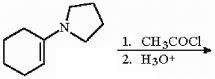
(Short Answer)
4.8/5  (81)
(81) Provide the sequence of synthetic steps necessary to convert cyclohexanone into the compound shown below. 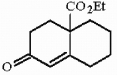
(Short Answer)
4.8/5 (91)
(91) Provide the structure of the aldol product that results when 4-methylpentanal is treated with sodium hydroxide.
(Essay)
4.8/5 (79)
(79) Starting with cyclohexene and employing a Dieckmann cyclization show how the compound below can be prepared. 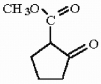
(Essay)
4.8/5 (92)
(92) What crossed-aldol product results when butanal is heated in the presence of excess benzaldehyde and sodium hydroxide?
(Essay)
4.8/5 (66)
(66) Disregarding stereoisomers, how many different enols can the β-diketone CH3COCH2COCH2CH3 form?
(Multiple Choice)
4.9/5 (76)
(76) Complete the following short synthesis by providing the necessary sequence of reagents. 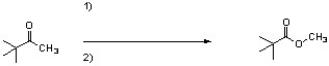
(Essay)
4.8/5 (78)
(78) When compound X is heated, PhCOCH(CH3)2 and CO2 are produced. Offer a structure for compound X.
(Essay)
4.8/5 (79)
(79) What product results when malonic ester is treated with the following sequence of reagents: 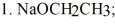


(Essay)
4.8/5 (80)
(80) Draw a correct structure of the expected product for the following reaction. 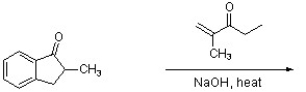
(Essay)
4.9/5 (82)
(82) In the iodoform reaction, a methyl ketone is converted to the ________ upon treatment with excess iodine and hydroxide.
(Multiple Choice)
4.9/5 (90)
(90) In the Michael reaction, addition to the α,β-unsaturated carbonyl occurs in a:
(Multiple Choice)
4.9/5 (78)
(78) Complete the following reaction by filling in the necessary reagents. 
(Essay)
4.9/5 (78)
(78) Provide the structure of the product which results from the base-catalyzed condensation followed by dehydration between benzophenone and propanal.
(Essay)
4.7/5 (76)
(76) 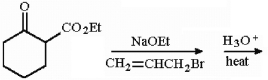
Provide the structure of the product that results when diethyl malonate is subjected to the following sequence: 1. NaOCH2CH3 2. CH3CH2CH2CH2I 3. H3O+, D.
(Essay)
4.9/5 (82)
(82) When 2-methylcyclohexanone is treated with catalytic base in excess D2O, how many deuterium atoms become incorporated in the organic compound?
(Multiple Choice)
4.9/5 (82)
(82) Provide the structure of the product that results when ethyl acetoacetate is subjected to the following sequence: 1. NaOCH2CH3 2. CH3CH2CH2CH2I 3. H3O+, D.
(Essay)
4.9/5 (72)
(72) 
Filters
- Essay(0)
- Multiple Choice(0)
- Short Answer(0)
- True False(0)
- Matching(0)