



 Chat with AI
Exam 24: Amino Acids, Peptides, and Proteins

Exam 1: Introduction and Review127 Questions
Exam 2: Structure and Properties of Organic Molecules129 Questions
Exam 3: Structure and Stereochemistry of Alkanes129 Questions
Exam 4: The Study of Chemical Reactions128 Questions
Exam 5: Stereochemistry128 Questions
Exam 6: Alkyl Halides: Nucleophilic Substitution and Elimination132 Questions
Exam 7: Structure and Synthesis of Alkenes128 Questions
Exam 8: Reactions of Alkenes132 Questions
Exam 9: Alkynes124 Questions
Exam 10: Structure and Synthesis of Alcohols132 Questions
Exam 11: Reactions of Alcohols124 Questions
Exam 12: Infrared Spectroscopy and Mass Spectrometry120 Questions
Exam 13: Nuclear Magnetic Resonance Spectroscopy130 Questions
Exam 14: Ethers, Epoxides, and Thioethers127 Questions
Exam 15: Conjugated Systems, Orbital Symmetry, and Ultraviolet Spectroscopy130 Questions
Exam 16: Aromatic Compounds128 Questions
Exam 17: Reactions of Aromatic Compounds129 Questions
Exam 18: Ketones and Aldehydes132 Questions
Exam 19: Amines129 Questions
Exam 20: Carboxylic Acids125 Questions
Exam 21: Carboxylic Acid Derivatives128 Questions
Exam 22: Condensations and Alpha Substitutions of Carboxyl Compounds125 Questions
Exam 23: Carbohydrates and Nucleic Acids125 Questions
Exam 24: Amino Acids, Peptides, and Proteins127 Questions
Exam 25: Lipids127 Questions
Exam 26: Synthetic Polymers128 Questions
Select questions type


The H-bonds formed in the tertiary structure of proteins can be differentiated from those formed in secondary structures. What is the major distinguishing factor?
(Multiple Choice)
4.9/5  (76)
(76) What is the major end product of the following reaction series? 
(Multiple Choice)
4.8/5 (89)
(89) Provide the single letter code for the following peptide
Arg-Phe-Tyr-Cys-Asp-Trp-Gln-Ala-Glu-Glu-His-Lys
(Short Answer)
4.9/5 (80)
(80) What name is given to a protein infectious agent that is thought to promote misfolding and polymerization of normal protein molecules and that is believed to cause Creutzfeldt-Jakob Disease?
(Short Answer)
4.9/5 (86)
(86) Draw structures for the forms of glycine present in basic, neutral, and acidic solutions.
(Essay)
4.9/5 (69)
(69) Provide the structure of the major organic product which results when L-phenylalanine is treated with a large excess of PhCH2OH and gaseous HCl.
(Essay)
4.8/5 (90)
(90) Which of the following amino acids has its isoelectric point at the lowest pH?
(Multiple Choice)
4.9/5 (79)
(79) Provide a reasonable synthesis of PhCH2CH(NH3+)CO2H from BrCH(CO2CH2CH3)2.
(Essay)
4.8/5 (82)
(82) Before Edman degradation, Fredrick Sanger developed the first method to analyze the N-terminal amino acid of a protein using 2,4-dinitrofluorobenzene in the following reaction. Propose a mechanism for this reaction. 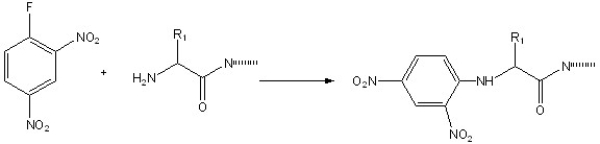
(Essay)
4.8/5 (84)
(84) Most naturally occurring amino acids are L-amino acids. Does this mean they are levorotatory? Explain.
(Essay)
4.8/5 (81)
(81) Which of the following amino acids has its isoelectric point at the highest pH?
(Multiple Choice)
4.7/5 (79)
(79) When the structure of a small dipeptide was examined using NMR, it was observed that the carbonyl oxygen atoms in the backbone structure are nearly always trans with respect to the H atoms on the amide nitrogens. Explain this observation and include diagrams.
(Essay)
4.8/5 (67)
(67) 
Filters
- Essay(0)
- Multiple Choice(0)
- Short Answer(0)
- True False(0)
- Matching(0)