



 Chat with AI
Exam 7: A Closer Look at Overhead Costs

Exam 1: Management Accounting: Information for Creating Value and Managing Resources67 Questions
Exam 2: Management Accounting: Cost Terms and Concepts87 Questions
Exam 3: Cost Behaviour, Cost Drivers and Cost Estimation93 Questions
Exam 4: Product Costing Systems88 Questions
Exam 5: Process Costing and Operation Costing87 Questions
Exam 6: Service Costing91 Questions
Exam 7: A Closer Look at Overhead Costs99 Questions
Exam 8: Activity-Based Costing91 Questions
Exam 9: Budgeting Systems92 Questions
Exam 10: Standard Costs for Control: Direct Material and Direct Labour105 Questions
Exam 11: Standard Costs for Control: Flexible Budgets and Manufacturing Overhead109 Questions
Exam 12: Managing and Reporting Performance102 Questions
Exam 13: Financial Performance Measures and Incentive Schemes93 Questions
Exam 14: Strategic Performance Measurement Systems80 Questions
Exam 15: Managing Suppliers and Customers90 Questions
Exam 16: Managing Costs and Quality92 Questions
Exam 17: Sustainability and Management Accounting76 Questions
Exam 18: Cost Volume Profit Analysis111 Questions
Exam 19: Information for Decisions: Relevant Costs and Benefits116 Questions
Exam 20: Pricing and Product Mix Decisions113 Questions
Exam 21: Information for Capital Expenditure Decisions125 Questions
Select questions type


The following information relates to the Moonie Park Manufacturing Company for the year 2012. 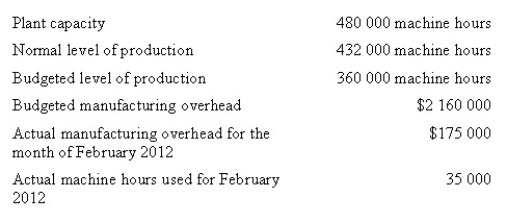 The predetermined overhead rates per machine hour based on practical capacity, normal capacity and budgeted capacity respectively are:
 (Multiple Choice)
4.8/5  (77)
(77) Consider the following statements about the two-stage cost allocation process.
i. Costs in various cost pools are distributed to all departments, including support and production departments.
ii. Support department costs are allocated to production departments.
iii. Costs are assigned to each production department that has worked on the product.
Which statement/s is/are correct?
(Multiple Choice)
4.8/5 (66)
(66) The support department cost allocation method that recognises some of the reciprocal services between support departments is called the:
(Multiple Choice)
4.7/5 (72)
(72) The Browning Company manufactures a single product; the standard costs per unit being variable manufacturing $8, fixed manufacturing $6. Selling and administrative costs are $2 per unit sold. The selling price is $20 per unit. Actual and budgeted fixed overhead is $900 000 for the year. Information about Browning's production activity for the year is: 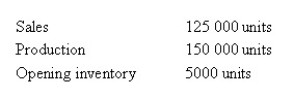 What is the value of closing inventory of finished goods under variable costing?
 (Multiple Choice)
4.8/5 (74)
(74) The process of assigning the costs in a cost pool to the cost objects is called:
(Multiple Choice)
4.8/5 (84)
(84) Which of the following would NOT be a volume-based cost driver in a traditional costing system?
(Multiple Choice)
4.8/5 (82)
(82) The Kelsey Manufacturing Company Ltd has two production departments (Assembly and Finishing) and two support departments (Janitorial and Personnel). The usage of the two support departments in 2012 is as follows: 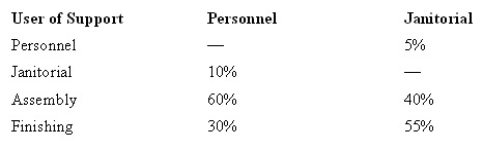 The budgeted costs in the support departments of 2012 were as follows:
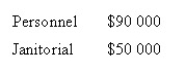 Using the step-down method, what is the total support department costs allocated to the Finishing Department with the Personnel Department cost allocated first?
The budgeted costs in the support departments of 2012 were as follows:
Using the step-down method, what is the total support department costs allocated to the Finishing Department with the Personnel Department cost allocated first? (Multiple Choice)
4.9/5 (95)
(95) Management would prefer to use either absorption costing or variable costing depending on:
(Multiple Choice)
4.7/5 (86)
(86) Jasmine Doh is considering using cost drivers that are measured in dollars (rather than physical units) for her company. Your advice is:
(Multiple Choice)
5.0/5 (84)
(84) The Lots More Store has a Janitorial Department and a Personnel Department that provide services to three Sales Departments. The Janitorial Department cost is allocated based on space and the Personnel Department cost is allocated based on employees. The following information is available. 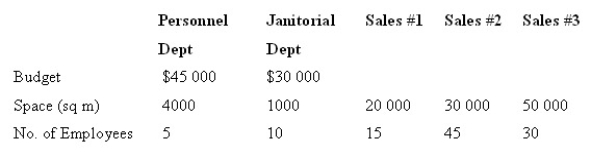 Using the direct method, calculate the amount of Janitorial Department cost allocated to Sales Department #2.
 (Multiple Choice)
4.9/5 (81)
(81) The Browning Company manufactures a single product; the standard costs per unit being variable manufacturing $8, fixed manufacturing $6. Selling and administrative costs are $2 per unit sold. The selling price is $20 per unit. Actual and budgeted fixed overhead is $900 000 for the year. Information about Browning's production activity for the year is: 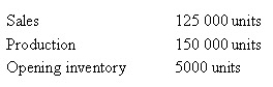 What is the profit under absorption costing?
 (Multiple Choice)
4.9/5 (69)
(69) Using the information below, what would be the profit under variable costing and absorption costing, respectively? 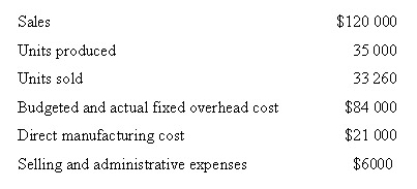
(Multiple Choice)
4.7/5 (82)
(82) Monex reported $65 000 in net profit for the year using absorption costing. The company had no units in beginning inventory, planned and actual production was 20 000 units and sales were 18 000 units during the year. Variable manufacturing costs were $20 per unit and total budgeted fixed manufacturing overhead was $100 000. There was no underapplied or overapplied overhead reported during the year. Determine the net profit under variable costing.
(Multiple Choice)
4.9/5 (80)
(80) Explain the difference between theoretical capacity and practical capacity when estimating the denominator volume. Discuss how the choice of capacity affects the overhead rate.
(Essay)
5.0/5 (84)
(84) Which of the following is a common base to distribute the cost of building depreciation to responsibility centres?
(Multiple Choice)
4.7/5 (86)
(86) Which of the following statements is false?
Manufacturing overhead costs are:
(Multiple Choice)
4.8/5 (74)
(74) 
Filters
- Essay(0)
- Multiple Choice(0)
- Short Answer(0)
- True False(0)
- Matching(0)