



 Chat with AI
Exam 12: Managing and Reporting Performance

Exam 1: Management Accounting: Information for Creating Value and Managing Resources67 Questions
Exam 2: Management Accounting: Cost Terms and Concepts87 Questions
Exam 3: Cost Behaviour, Cost Drivers and Cost Estimation93 Questions
Exam 4: Product Costing Systems88 Questions
Exam 5: Process Costing and Operation Costing87 Questions
Exam 6: Service Costing91 Questions
Exam 7: A Closer Look at Overhead Costs99 Questions
Exam 8: Activity-Based Costing91 Questions
Exam 9: Budgeting Systems92 Questions
Exam 10: Standard Costs for Control: Direct Material and Direct Labour105 Questions
Exam 11: Standard Costs for Control: Flexible Budgets and Manufacturing Overhead109 Questions
Exam 12: Managing and Reporting Performance102 Questions
Exam 13: Financial Performance Measures and Incentive Schemes93 Questions
Exam 14: Strategic Performance Measurement Systems80 Questions
Exam 15: Managing Suppliers and Customers90 Questions
Exam 16: Managing Costs and Quality92 Questions
Exam 17: Sustainability and Management Accounting76 Questions
Exam 18: Cost Volume Profit Analysis111 Questions
Exam 19: Information for Decisions: Relevant Costs and Benefits116 Questions
Exam 20: Pricing and Product Mix Decisions113 Questions
Exam 21: Information for Capital Expenditure Decisions125 Questions
Select questions type


Callahan Company consists of two divisions, Northern and Southern. During 2014, many of the accounting records were destroyed in a fire. The managing director has asked the accountant for information relating to 2014. The following information is available to the accountant. 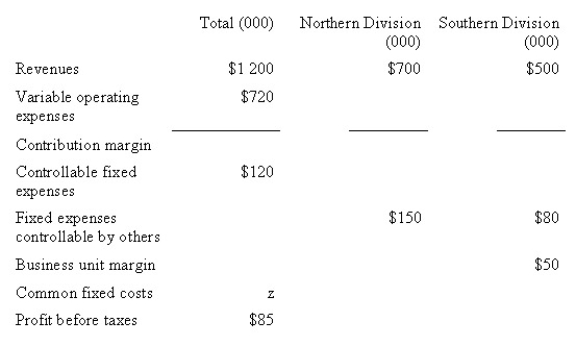 In addition, the contribution margin ratio for both divisions was the same. What were the common fixed costs (z) during 2014?
 (Multiple Choice)
4.9/5  (72)
(72) Service level agreements are used within organisations to establish which services are to be provided and set the transfer price for these services.
(True/False)
4.7/5 (66)
(66) Define goal congruence and explain how management can change the behaviour of managers through a decentralised organisation.
(Essay)
4.8/5 (87)
(87) Flash reports are produced monthly, reporting on critical information.
(True/False)
4.7/5 (76)
(76) Hamilton has no excess capacity. If the company wishes to implement the general transfer-pricing rule, the opportunity cost would be equal to:
(Multiple Choice)
4.8/5 (89)
(89) When organisational structures move to a flatter structure, it is anticipated that the levels of management are reduced, which in turn allows the organisation to react quicker to potential opportunities.
(True/False)
4.8/5 (82)
(82) Which of the following are characteristics of shared service units?
i. Head office dominates
ii. Usually structured as a cost centre
iii. Services tend to be standardised
(Multiple Choice)
4.8/5 (90)
(90) Corporate policy at Weber Pty Ltd requires that all transfers between divisions be recorded at variable cost as a transfer price. Divisional managers have complete autonomy in choosing their sources of customers and suppliers. The Milling Division sells a product called RK2. Forty per cent of the sales of RK2 are to the Products Division, while the remainder of the sales are to outside customers. The manager of the Milling Division is evaluating a special offer from an outside customer for 10 000 units of RK2 at a per unit price of $15. If the special offer were accepted, the Milling Division would be unable to supply those units to the Products Division. The Products Division could purchase those units from another supplier for $17 per unit. Annual capacity for the Milling Division is 25 000 units. The 2014 budget information for the Milling Division, based on full capacity, is presented below. 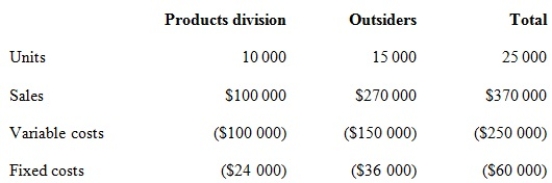 Assuming the Milling Division manager agrees to the special offer, what is the effect of the decision on the gross margin of Weber as a whole?
 (Multiple Choice)
4.9/5 (91)
(91) Which of the following statements about cost-based transfer prices is/are true?
i. A transfer price set at standard variable cost plus a mark-up provides an incentive for the supplying business to make the transfer.
ii. Absorption cost-based transfer prices are good for the company as a whole because all costs are considered.
iii. Transfer prices should be based on standard costs rather than actual costs since the cost of inefficiency should not be passed on.
(Multiple Choice)
4.8/5 (78)
(78) The biggest challenge in making a decentralised organisation function effectively is:
(Multiple Choice)
4.9/5 (79)
(79) Transfer prices should not be based on actual costs because:
(Multiple Choice)
4.9/5 (84)
(84) Which of the following statements unambiguously describes the term 'contribution margin'?
(Multiple Choice)
4.8/5 (81)
(81) If a manager were responsible for a division's performance and activities, the division would have to be classified as a cost centre.
(True/False)
4.9/5 (72)
(72) Hamilton has excess capacity. If the company wishes to implement the general transfer-pricing rule, the opportunity cost would be equal to:
(Multiple Choice)
4.8/5 (79)
(79) Fruities Ltd has two divisions, Durian Division and Juice Division. Durian Division has an annual capacity of 10 000 units of durian juice concentrate. Juice Division's annual requirement of durian juice concentrate is 8000 units. Fruities Ltd requires that divisions should purchase inputs internally where available and uses a cost-plus transfer price policy, where transfer price is set at variable cost plus 25 per cent. Therefore, Durian Division always satisfies the demand of the Juice Division first, before selling the remaining durian concentrate to external suppliers at the market price of $10 per unit. The variable cost of one unit of durian juice concentrate at Durian Division is $6.
What is the difference in Durian Division's profit under the cost-plus transfer price policy and a market-price transfer price policy?
(Multiple Choice)
4.9/5 (81)
(81) Corporate policy at Weber Pty Ltd requires that all transfers between divisions be recorded at variable cost as a transfer price. Divisional managers have complete autonomy in choosing their sources of customers and suppliers. The Milling Division sells a product called RK2. Forty per cent of the sales of RK2 are to the Products Division, while the remainder of the sales are to outside customers. The manager of the Milling Division is evaluating a special offer from an outside customer for 10 000 units of RK2 at a per unit price of $15.00. If the special offer were accepted, the Milling Division would be unable to supply those units to the Products Division. The Products Division could purchase those units from another supplier for $17 per unit. Annual capacity for the Milling Division is 25 000 units. The 2014 budget information for the Milling Division, based on full capacity, is presented below. 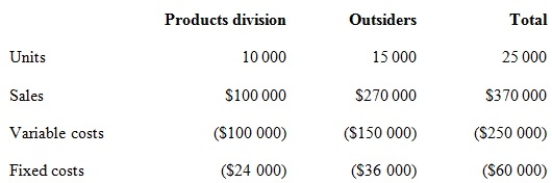 Assume that demand increases for the Milling Division. All 25 000 units can be sold at the regular price to outside customers and the Product Division's annual demand declines to 5000 units. What transfer price would be calculated under the general transfer-pricing formula?
 (Multiple Choice)
4.8/5 (85)
(85) Which of the following information should be taken into account when using a negotiated transfer price method to determine transfer price?
i. External market price
ii. Savings in selling and distribution costs when transferring internally
iii. Excess capacity in the selling division
iv. Excess capacity in the buying division
(Multiple Choice)
4.9/5 (72)
(72) Corporate policy at Weber Pty Ltd requires that all transfers between divisions be recorded at variable cost as a transfer price. Divisional managers have complete autonomy in choosing their sources of customers and suppliers. The Milling Division sells a product called RK2. Forty per cent of the sales of RK2 are to the Products Division, while the remainder of the sales are to outside customers. The manager of the Milling Division is evaluating a special offer from an outside customer for 10 000 units of RK2 at a per unit price of $15. If the special offer were accepted, the Milling Division would be unable to supply those units to the Products Division. The Products Division could purchase those units from another supplier for $17 per unit. Annual capacity for the Milling Division is 25 000 units. The 2014 budget information for the Milling Division, based on full capacity, is presented below. 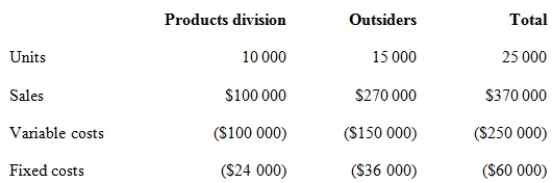 Assume that demand increases for the Milling Division. 20 000 units can be sold at the regular price to outside customers and the Products Division's annual demand remains at 10 000 units. What is the transfer price that would be calculated under the general transfer-pricing formula?
 (Multiple Choice)
4.8/5 (86)
(86) 
Filters
- Essay(0)
- Multiple Choice(0)
- Short Answer(0)
- True False(0)
- Matching(0)