



 Chat with AI
Exam 3: Digestion, absorption, and Metabolism

Exam 1: Nutrition: Food for Health51 Questions
Exam 2: Nutrition Guidelines: Applying the Science of Nutrition63 Questions
Exam 3: Digestion, absorption, and Metabolism71 Questions
Exam 4: Carbohydrates: Sugars, starches, and Fiber58 Questions
Exam 5: Lipids: Triglycerides, phospholipids, and Cholesterol76 Questions
Exam 6: Proteins and Amino Acids63 Questions
Exam 7: Energy Balance and Weight Management68 Questions
Exam 8: The Water-Soluble Vitamins61 Questions
Exam 9: The Fat-Soluble Vitamins65 Questions
Exam 10: Water and the Electrolytes56 Questions
Exam 11: Major Minerals and Bone Health81 Questions
Exam 12: The Trace Minerals83 Questions
Exam 13: Nutrition and Physical Activity79 Questions
Exam 14: Nutrition During Pregnancy and Lactation76 Questions
Exam 15: Nutrition From Infancy to Adolescence70 Questions
Exam 16: Nutrition and Aging: the Adult Years79 Questions
Exam 17: Food Safety82 Questions
Exam 18: World Hunger and Malnutrition77 Questions
Focus On Alcohol40 Questions
Focus On Eating Disorders28 Questions
Focus On Phytochemicals30 Questions
Focus on Nonvitamin/Nonmineral Supplements37 Questions
Focus on Biotechnology42 Questions
Select questions type


Explain why a person who consumes toast,fruit and coffee for breakfast is more likely to feel hunger sooner compared to a person who eats an egg and fried potatoes for breakfast.
(Essay)
4.9/5  (82)
(82) Coordinated muscular contractions that move food through the GI tract are called:
(Multiple Choice)
4.9/5 (85)
(85) Metabolic reactions that build molecules and body structures are referred to as:
(Multiple Choice)
4.9/5 (76)
(76) Which structure prevents swallowed food from entering the trachea?
(Multiple Choice)
4.8/5 (64)
(64) Explain how triglycerides and glucose differ in terms of absorption and circulation.
(Essay)
4.8/5 (67)
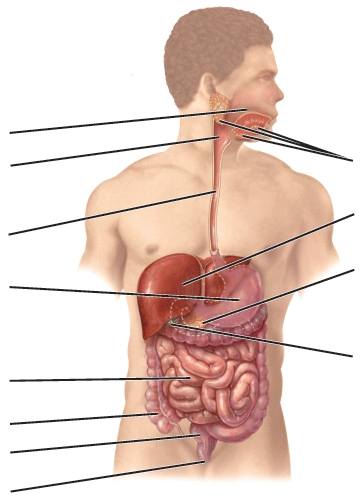
(67) Identify the organs of the digestive system.Briefly describe the digestive process that occurs in each organ or section of the system.
(Essay)
4.9/5 (85)
(85) At different stages of life,special diets may be needed to maximize nutrient intake and absorption.How does the digestive system of an infant differ from that of an older adult?
(Essay)
4.8/5 (66)
(66) The absorptive surface of the small intestine is increased by the presence of:
(Multiple Choice)
4.9/5 (74)
(74) After water soluble nutrients are absorbed in the intestine,they are carried to the __________ via the ___________.
(Multiple Choice)
4.9/5 (89)
(89) What is the difference between probiotics and prebiotics? How can these be used to promote gastrointestinal health?
(Essay)
4.8/5 (86)
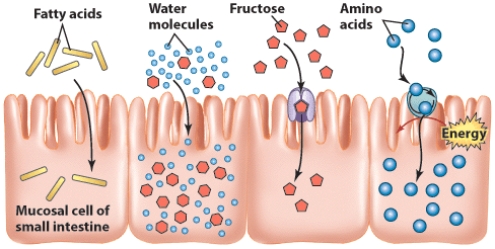
(86) Describe the type of absorption mechanism represented by each of the four separate parts in the figure.
(Essay)
4.9/5 (83)
(83) _________ are units of matter that cannot be further broken down by chemical means.
(Multiple Choice)
4.8/5 (78)
(78) During ________________,the digestive system can absorb whole intact proteins.
(Multiple Choice)
4.8/5 (93)
(93) Nutrients classified as "organic molecules" have a molecular structure which contains the element:
(Multiple Choice)
4.8/5 (81)
(81) What causes heartburn? What lifestyle changes can a person make to try to alleviate this problem?
(Essay)
4.7/5 (78)
(78) The stomach wall is protected from the acidity of the gastric juice by:
(Multiple Choice)
4.9/5 (94)
(94) 
Filters
- Essay(0)
- Multiple Choice(0)
- Short Answer(0)
- True False(0)
- Matching(0)