



 Chat with AI
Exam 27: Reactions of Organic Compounds

Exam 1: Matter - Its Properties and Measurement94 Questions
Exam 2: Atoms and the Atomic Theory100 Questions
Exam 3: Chemical Compounds100 Questions
Exam 4: Chemical Reactions100 Questions
Exam 5: Introduction to Reactions in Aqueous Solutions97 Questions
Exam 6: Gases100 Questions
Exam 7: Thermochemistry101 Questions
Exam 8: Electrons in Atoms100 Questions
Exam 9: The Periodic Table and Some Atomic Properties96 Questions
Exam 10: Chemical Bonding I: Basic Concepts97 Questions
Exam 11: Chemical Bonding II: Additional Aspects97 Questions
Exam 12: Intermolecular Forces: Liquids and Solids102 Questions
Exam 13: Solutions and Their Physical Properties100 Questions
Exam 14: Chemical Kinetics92 Questions
Exam 15: Principles of Chemical Equilibrium99 Questions
Exam 16: Acids and Bases100 Questions
Exam 17: Additional Aspects of Acid-Base Equilibria99 Questions
Exam 18: Solubility and Complex-Ion Equilibria95 Questions
Exam 19: Spontaneous Change: Entropy and Free Energy101 Questions
Exam 20: Electrochemistry103 Questions
Exam 21: Main Group Elements I: Groups 1, 2, 13, and 14116 Questions
Exam 22: Main Group Elements II: Groups 18, 17, 16, 15, and Hydrogen100 Questions
Exam 23: The Transition Elements102 Questions
Exam 24: Complex Ions and Coordination Compounds100 Questions
Exam 25: Nuclear Chemistry 1-41100 Questions
Exam 26: Structures of Organic Compounds96 Questions
Exam 27: Reactions of Organic Compounds94 Questions
Exam 28: Chemistry of the Living State99 Questions
Select questions type


During the nitration of a benzene ring in a mixture of HNO3 and H2SO4 the following species reacts as an electrophile:
(Multiple Choice)
4.7/5  (83)
(83) Give the correct mathematical expression for the rate law for E2 reactions (S is a substrate and B is a base).
(Multiple Choice)
4.9/5 (77)
(77) What product would you expect to obtain from a reaction between one isomer of 3-methyl-1-pentanol and HI?
(Multiple Choice)
4.8/5 (66)
(66) What alkene(s) would be produced in the following reaction? 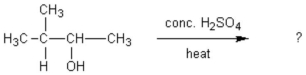
(Multiple Choice)
4.8/5 (94)
(94) Which of the following are nucleophiles?
I. CH3C(O)CH3
II. CH3Br
III. CH3CH2C≡C-
(Multiple Choice)
4.9/5 (85)
(85) The following can be said about the reaction profile of an SN1 reaction:
I. The rate determining step is formation of carbocation.
II. The reaction profile has one transition state.
III. The slow step is the first transition state.
IV. The second step is attack of electrophile on carbocation.
V.The reaction proceeds in a polar aprotic solvent.
(Multiple Choice)
4.8/5 (84)
(84) Write down the rate law for E1 reactions (S is a substrate and B is a base).
(Multiple Choice)
4.8/5 (71)
(71) Which of the following alcohols can eliminate water to produce alkene?
I) phenol
II) HOC(CH3)3
III) HOCH(CH3)2
(Multiple Choice)
5.0/5 (72)
(72) Which of the following statements correctly describe SN2 and SN1 reactions?
I. SN2 reactions proceed with retention of configuration.
II. SN1 reactions prefer polar protic solvents
III. SN1 reactions produce racemic products
IV. SN2 reactions are promoted in the presence of a substrate that produces a very stable carbocation
V.SN1 reactions have a unimolecular rate-determining step.
(Multiple Choice)
4.7/5 (74)
(74) Electrophilic substitution reactions are typical reactions of aromatic compounds.
(True/False)
4.9/5 (71)
(71) Which reagents would you choose to carry out the following transformations? I)  II)
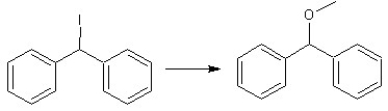 III)
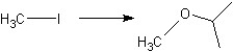
II) III) (Multiple Choice)
4.9/5 (91)
(91) The rate of E2 reaction between an alkyl halide RX and a base B is given by the following expression (k is a rate constant):
(Multiple Choice)
4.8/5 (72)
(72) What type of polymerization reaction occurred to produce the following polymer? 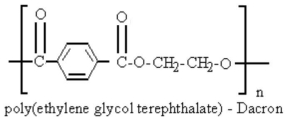
(Multiple Choice)
4.8/5 (76)
(76) Which of the following trends in nucleophilicity are correct?
I. Everything else being equal, a negatively charged nucleophile will react faster than a neutral one.
II. Generally, species containing elements of high electronegativity are good nucleophiles.
III. Anionic nucleophiles are more reactive in polar and aprotic solvents than in polar and protic solvents
IV. Generally, nucleophilicity is increasing with the increase in size of an atom.
V. Bulky groups adjacent to the nucleophilic atom enhance the nucleophilicity and reactivity of the species.
(Multiple Choice)
4.7/5 (90)
(90) Classify the following polymers as atactic, isotactic or syndiotactic: 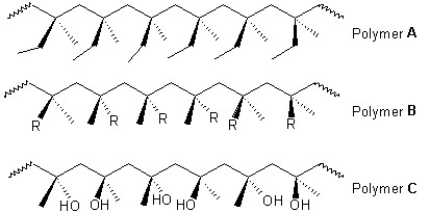
(Multiple Choice)
4.8/5 (78)
(78) Which of the four positions 1-4 marked on the structure of aromatic compound shown below would be preferentially substituted in an electrophilic aromatic substitution reaction? 
(Multiple Choice)
4.8/5 (87)
(87) Predict the product and mechanism type for the following reaction: 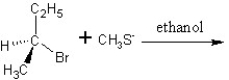
(Multiple Choice)
4.9/5 (70)
(70) 
Filters
- Essay(0)
- Multiple Choice(0)
- Short Answer(0)
- True False(0)
- Matching(0)