



 Chat with AI
Exam 27: Reactions of Organic Compounds

Exam 1: Matter - Its Properties and Measurement94 Questions
Exam 2: Atoms and the Atomic Theory100 Questions
Exam 3: Chemical Compounds100 Questions
Exam 4: Chemical Reactions100 Questions
Exam 5: Introduction to Reactions in Aqueous Solutions97 Questions
Exam 6: Gases100 Questions
Exam 7: Thermochemistry101 Questions
Exam 8: Electrons in Atoms100 Questions
Exam 9: The Periodic Table and Some Atomic Properties96 Questions
Exam 10: Chemical Bonding I: Basic Concepts97 Questions
Exam 11: Chemical Bonding II: Additional Aspects97 Questions
Exam 12: Intermolecular Forces: Liquids and Solids102 Questions
Exam 13: Solutions and Their Physical Properties100 Questions
Exam 14: Chemical Kinetics92 Questions
Exam 15: Principles of Chemical Equilibrium99 Questions
Exam 16: Acids and Bases100 Questions
Exam 17: Additional Aspects of Acid-Base Equilibria99 Questions
Exam 18: Solubility and Complex-Ion Equilibria95 Questions
Exam 19: Spontaneous Change: Entropy and Free Energy101 Questions
Exam 20: Electrochemistry103 Questions
Exam 21: Main Group Elements I: Groups 1, 2, 13, and 14116 Questions
Exam 22: Main Group Elements II: Groups 18, 17, 16, 15, and Hydrogen100 Questions
Exam 23: The Transition Elements102 Questions
Exam 24: Complex Ions and Coordination Compounds100 Questions
Exam 25: Nuclear Chemistry 1-41100 Questions
Exam 26: Structures of Organic Compounds96 Questions
Exam 27: Reactions of Organic Compounds94 Questions
Exam 28: Chemistry of the Living State99 Questions
Select questions type


Which are the most probable reactions and mechanisms in which tertiary haloalkanes participate?
I Substitution, SN1
II. Substitution SN2
III. Elimination E1
IV. Elimination E2
V. Addition
(Multiple Choice)
4.9/5  (72)
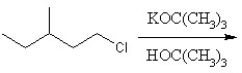
(72) 
Arrange the following radicals in the order of increasing stability: 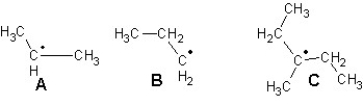
(Multiple Choice)
4.8/5 (86)
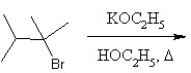
(86) 
Which type of polymerization and which monomer(s) would you use to prepare poly(1,4-phenylenediformamide) with the following structure? 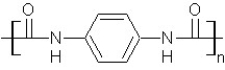
(Multiple Choice)
4.8/5 (77)
(77) Which of the following groups would be ortho, para directors in electrophilic aromatic substitution?
I. -CN
II. -SO3H
III. -NH2
IV. -OH
V. -Br
(Multiple Choice)
5.0/5 (70)
(70) SN2 reactions are nucleophilic substitution reactions for which the rate determining step is bimolecular.
(True/False)
4.8/5 (89)
(89) Which of the following mechanistic steps do you expect in bromination of benzene with Br2 and FeBr3 as a catalyst?
I. Formation of Br+[FeBr4]-
II. Attack of [FeBr4]- on benzene ring
III. Formation of arenium ion
IV. Deprotonation of arenium ion
V. Nucleophilic attack of Br+
(Multiple Choice)
4.7/5 (89)
(89) What is the major product in the reaction between 2-bromo-3-methylbutane and KOtBu in ethanol?
(Multiple Choice)
4.8/5 (79)
(79) What is the rate law for the SN1 reactions (S is substrate and N is nucleophile) ?
(Multiple Choice)
4.7/5 (77)
(77) Which of the following steps can be found in E1 reaction mechanism?
I. Formation of a carbocation
II. Attack of the base and removal of a proton from carbocation
III. Attack of a nucleophile
IV. Formation of a carboanion
(Multiple Choice)
4.8/5 (80)
(80) Identify the product(s) and mechanism for the following reaction: 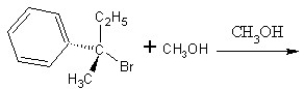
(Multiple Choice)
4.9/5 (83)
(83) Arrange the following in the order of decreasing nucleophilicity: H2N-, HO-, HCOO-, CH3O-
(Multiple Choice)
5.0/5 (81)
(81) Predict the major product for the reaction: 2-methyl-2-butene + HBr →
(Multiple Choice)
4.8/5 (86)
(86) The step reaction polymerizations are fast polymerization reactions
(True/False)
4.8/5 (75)
(75) 
Filters
- Essay(0)
- Multiple Choice(0)
- Short Answer(0)
- True False(0)
- Matching(0)