



 Chat with AI
Exam 25: Production and Growth

Exam 1: Ten Principles of Economics439 Questions
Exam 2: Thinking Like an Economist617 Questions
Exam 3: Interdependence and the Gains From Trade527 Questions
Exam 4: The Market Forces of Supply and Demand697 Questions
Exam 5: Elasticity and Its Application594 Questions
Exam 6: Supply, Demand, and Government Policies645 Questions
Exam 7: Consumers, Producers, and the Efficiency of Markets549 Questions
Exam 8: Application: the Costs of Taxation513 Questions
Exam 9: Application: International Trade492 Questions
Exam 10: Externalities524 Questions
Exam 11: Public Goods and Common Resources433 Questions
Exam 12: The Design of the Tax System549 Questions
Exam 13: The Costs of Production420 Questions
Exam 14: Firms in Competitive Markets543 Questions
Exam 15: Monopoly637 Questions
Exam 16: Monopolistic Competition580 Questions
Exam 17: Oligopoly488 Questions
Exam 18: The Markets for the Factors of Production564 Questions
Exam 19: Earnings and Discrimination490 Questions
Exam 20: Income Inequality and Poverty455 Questions
Exam 21: The Theory of Consumer Choice431 Questions
Exam 22: Frontiers of Microeconomics440 Questions
Exam 23: Measuring a Nations Income520 Questions
Exam 24: Measuring the Cost of Living529 Questions
Exam 25: Production and Growth505 Questions
Exam 26: Saving, Investment, and the Financial System564 Questions
Exam 27: The Basic Tools of Finance500 Questions
Exam 28: Unemployment678 Questions
Exam 29: The Monetary System515 Questions
Exam 30: Money Growth and Inflation481 Questions
Exam 31: Open-Economy Macroeconomics: Basic Concepts522 Questions
Exam 32: A Macroeconomic Theory of the Open Economy475 Questions
Exam 33: Aggregate Demand and Aggregate Supply562 Questions
Exam 34: The Influence of Monetary and Fiscal Policy on Aggregate Demand508 Questions
Exam 35: The Short-Run Trade-Off Between Inflation and Unemployment491 Questions
Exam 36: Six Debates Over Macroeconomic Policy372 Questions
Select questions type


Like physical capital, human capital is a produced factor of production.
(True/False)
4.9/5  (83)
(83) Country A had a population of 1,000, of whom 600 worked an average of 8 hours a day and had a productivity of 2.5. Country B had a population of 800, of whom 560 worked 8 hours a day and had productivity of 3.0. Country
(Multiple Choice)
4.9/5 (81)
(81) If WarmWear, a U.S.manufacturer of winter clothing, opens a new factory in Austria, then
(Multiple Choice)
5.0/5 (71)
(71) Economists generally believe that inward-oriented policies are more likely to foster growth than outward-oriented policies.
(True/False)
4.8/5 (80)
(80) Which of the following nations experienced average rates of economic growth of less than 2 percent over the last 100 years or so?
(Multiple Choice)
4.7/5 (80)
(80) The same size decrease in the amount of capital stock per worker will cause output per worker to fall by more in a country with a relatively high level of capital per worker than in a country with a relatively low level of capital per worker.
(True/False)
4.9/5 (77)
(77) Senator Smith says that in order to help poor countries develop, the United States should: 1. Prevent U.S. corporations from investing in poor countries because they take profits that the poor countries should have; 2. Not import goods from poor countries that use child labor; 3. Work to promote political stability in poor countries; and 4. Reduce poor countries' reliance on market forces in their economies. How many of these ideas are likely to help poor countries grow?
(Multiple Choice)
4.9/5 (81)
(81) At first patents might seem like a deterrent to growth because in effect they restrict the use of new technology. Yet many economists believe that patents generate growth. Explain why.
(Essay)
5.0/5 (88)
(88) In order for the standard of living within a country to be enhanced over time, which of the following is essential?
(Multiple Choice)
4.8/5 (87)
(87) Other things the same, which of the following could explain an increase in productivity?
(Multiple Choice)
4.8/5 (83)
(83) Consider the nations of Canada, the United Kingdom, and the United States. Since 1870, which of these nations has progressed, in an economic sense, more slowly than the other two nations?
(Essay)
5.0/5 (74)
(74) In a particular production process, if the quantities of all inputs used are increased by 60%, then the quantity of output increases by 60% as well. This means that
(Multiple Choice)
4.7/5 (66)
(66) Which of the following is indicated by the data on real income per person for various countries over the past 100 or so years?
(Multiple Choice)
4.9/5 (85)
(85) Mary looks over reports on four of her workers. Jack made 30 baskets in 5 hours. Rudy made 32 baskets in 8 hours. Sam made 40 baskets in 12 hours. Walter made 22 baskets in four hours. Who has the greatest productivity?
(Multiple Choice)
4.8/5 (82)
(82) What term do we use to refer to the understanding of the best ways to produce goods and services?
(Short Answer)
4.8/5 (85)
(85) Table 25-1.
Athens and Troy both produce only ribs and baked potatoes. 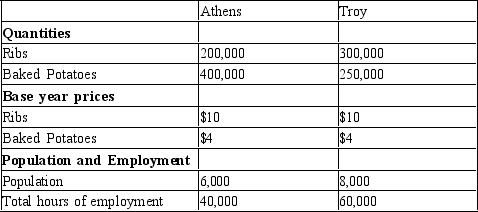 -Refer to Table 25-1. Which of the following is correct?
 (Multiple Choice)
4.7/5 (84)
(84) Assuming constant returns to scale, if two countries are otherwise the same, the one that is poorer grows faster.
(True/False)
4.9/5 (88)
(88) Consider the nations of India, Indonesia, and Japan. Over the past century, which of these three nations has experienced, by far, more rapid economic growth than the other two nations?
(Essay)
4.8/5 (88)
(88) The return to schooling for society is higher than the return to schooling for the individual if
(Multiple Choice)
4.8/5 (86)
(86) 
Filters
- Essay(0)
- Multiple Choice(0)
- Short Answer(0)
- True False(0)
- Matching(0)