



 Chat with AI
Exam 25: Production and Growth

Exam 1: Ten Principles of Economics439 Questions
Exam 2: Thinking Like an Economist617 Questions
Exam 3: Interdependence and the Gains From Trade527 Questions
Exam 4: The Market Forces of Supply and Demand697 Questions
Exam 5: Elasticity and Its Application594 Questions
Exam 6: Supply, Demand, and Government Policies645 Questions
Exam 7: Consumers, Producers, and the Efficiency of Markets549 Questions
Exam 8: Application: the Costs of Taxation513 Questions
Exam 9: Application: International Trade492 Questions
Exam 10: Externalities524 Questions
Exam 11: Public Goods and Common Resources433 Questions
Exam 12: The Design of the Tax System549 Questions
Exam 13: The Costs of Production420 Questions
Exam 14: Firms in Competitive Markets543 Questions
Exam 15: Monopoly637 Questions
Exam 16: Monopolistic Competition580 Questions
Exam 17: Oligopoly488 Questions
Exam 18: The Markets for the Factors of Production564 Questions
Exam 19: Earnings and Discrimination490 Questions
Exam 20: Income Inequality and Poverty455 Questions
Exam 21: The Theory of Consumer Choice431 Questions
Exam 22: Frontiers of Microeconomics440 Questions
Exam 23: Measuring a Nations Income520 Questions
Exam 24: Measuring the Cost of Living529 Questions
Exam 25: Production and Growth505 Questions
Exam 26: Saving, Investment, and the Financial System564 Questions
Exam 27: The Basic Tools of Finance500 Questions
Exam 28: Unemployment678 Questions
Exam 29: The Monetary System515 Questions
Exam 30: Money Growth and Inflation481 Questions
Exam 31: Open-Economy Macroeconomics: Basic Concepts522 Questions
Exam 32: A Macroeconomic Theory of the Open Economy475 Questions
Exam 33: Aggregate Demand and Aggregate Supply562 Questions
Exam 34: The Influence of Monetary and Fiscal Policy on Aggregate Demand508 Questions
Exam 35: The Short-Run Trade-Off Between Inflation and Unemployment491 Questions
Exam 36: Six Debates Over Macroeconomic Policy372 Questions
Select questions type


Countries with high population growth rates tend to have lower levels of educational attainment.
(True/False)
4.8/5  (64)
(64) Table 25-1.
Athens and Troy both produce only ribs and baked potatoes. 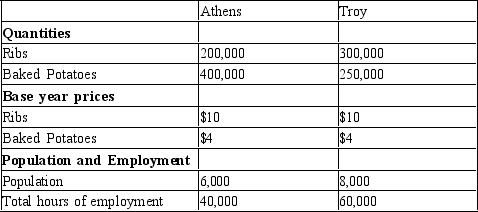 -Refer to Table 25-1. Which of the following is correct?
 (Multiple Choice)
4.8/5 (74)
(74) Which of the following is not an example of physical capital?
(Multiple Choice)
4.7/5 (69)
(69) Perry accumulated a lot of mathematical skills while in high school, college, and graduate school. Economists include these skills as part of Perry's
(Multiple Choice)
4.7/5 (64)
(64) The equipment and structures available to produce goods and services are called
(Multiple Choice)
4.8/5 (91)
(91) In 2010, the imaginary nation of Bovina had a population of 5,000 and real GDP of 500,000. In 2011 it had a population of 5,100 and real GDP of 520,200. During 2011 real GDP per person in Bovina grew by
(Multiple Choice)
4.8/5 (71)
(71) Adam and Doug both build birdhouses. Adam works 30 hours a week and produces 15 bird houses. Doug works 20 hours a week and produces 12 bird houses. Which of the following is correct?
(Multiple Choice)
4.9/5 (81)
(81) The short-run effects of an increase in the saving rate include
(Multiple Choice)
4.9/5 (81)
(81) International data on the history of real GDP growth rates shows that over the last 120 years or so, rich countries got richer and poor countries got poorer.
(True/False)
4.9/5 (77)
(77) Economist Michael Kremer found that world growth rates fell as population increased.
(True/False)
4.8/5 (85)
(85) Amy discovers a way to produce water heaters so they are less expensive and use less natural gas. Amy's discovery is
(Multiple Choice)
4.9/5 (85)
(85) "When workers already have a large quantity of capital to use in producing goods and services, giving them an additional unit of capital increases their productivity only slightly." This statement
(Multiple Choice)
4.9/5 (72)
(72) If a country increases its saving rate, which of the following permanently grow at a higher rate?
(Multiple Choice)
4.8/5 (79)
(79) Which of the following is an observation made by economist Michael Kremer?
(Multiple Choice)
4.8/5 (87)
(87) "When workers acquire tools, they become more productive." This statement reflects the general fact that is a determinant of productivity.
(Short Answer)
4.8/5 (76)
(76) 
Filters
- Essay(0)
- Multiple Choice(0)
- Short Answer(0)
- True False(0)
- Matching(0)