



 Chat with AI
Exam 24: Measuring the Cost of Living

Exam 1: Ten Principles of Economics439 Questions
Exam 2: Thinking Like an Economist617 Questions
Exam 3: Interdependence and the Gains From Trade527 Questions
Exam 4: The Market Forces of Supply and Demand697 Questions
Exam 5: Elasticity and Its Application594 Questions
Exam 6: Supply, Demand, and Government Policies645 Questions
Exam 7: Consumers, Producers, and the Efficiency of Markets549 Questions
Exam 8: Application: the Costs of Taxation513 Questions
Exam 9: Application: International Trade492 Questions
Exam 10: Externalities524 Questions
Exam 11: Public Goods and Common Resources433 Questions
Exam 12: The Design of the Tax System549 Questions
Exam 13: The Costs of Production420 Questions
Exam 14: Firms in Competitive Markets543 Questions
Exam 15: Monopoly637 Questions
Exam 16: Monopolistic Competition580 Questions
Exam 17: Oligopoly488 Questions
Exam 18: The Markets for the Factors of Production564 Questions
Exam 19: Earnings and Discrimination490 Questions
Exam 20: Income Inequality and Poverty455 Questions
Exam 21: The Theory of Consumer Choice431 Questions
Exam 22: Frontiers of Microeconomics440 Questions
Exam 23: Measuring a Nations Income520 Questions
Exam 24: Measuring the Cost of Living529 Questions
Exam 25: Production and Growth505 Questions
Exam 26: Saving, Investment, and the Financial System564 Questions
Exam 27: The Basic Tools of Finance500 Questions
Exam 28: Unemployment678 Questions
Exam 29: The Monetary System515 Questions
Exam 30: Money Growth and Inflation481 Questions
Exam 31: Open-Economy Macroeconomics: Basic Concepts522 Questions
Exam 32: A Macroeconomic Theory of the Open Economy475 Questions
Exam 33: Aggregate Demand and Aggregate Supply562 Questions
Exam 34: The Influence of Monetary and Fiscal Policy on Aggregate Demand508 Questions
Exam 35: The Short-Run Trade-Off Between Inflation and Unemployment491 Questions
Exam 36: Six Debates Over Macroeconomic Policy372 Questions
Select questions type


Suppose the typical household spends $3,500 on goods and services during the month of January, and $4,300 on the same goods and services in February. Using January as the base period, what is the consumer price index for February?
(Multiple Choice)
4.8/5  (82)
(82) Scenario 24-4
Quinn has job offers in Wrexington and across the country in Charlieville. The Wrexington job would pay a salary of $50,000 per year, and the Charlieville job would pay a salary of $40,000 per year. The CPI in Wrexington is 150, and the CPI in Charlieville is 90.
-Refer to Scenario 24-4. The Wrexington salary in Charlieville dollars is
(Multiple Choice)
4.9/5 (79)
(79) Table 24-15
The table below lists the prices of chips and salsa for the months of October, November, and December. Assume that the typical consumer buys 8 bags of chips and 4 jars of salsa each month, and that October is the base period. 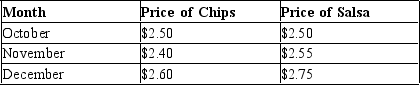 -Refer to Table 24-15. Calculate the inflation rate for December.
 (Short Answer)
4.9/5 (67)
(67) It is possible to observe a positive nominal interest rate together with a negative real interest rate.
(True/False)
4.9/5 (81)
(81) A decrease in the price of domestically produced nuclear reactors will be reflected in
(Multiple Choice)
4.8/5 (80)
(80) In the basket of goods that is used to compute the consumer price index, which of the following categories of consumer spending is the largest?
(Multiple Choice)
5.0/5 (74)
(74) When the overall level of prices in the economy is increasing, economists say that the economy is experiencing
(Multiple Choice)
4.8/5 (79)
(79) The consumer price index and the GDP deflator are two alternative measures of the overall price level. Which of the following statements about the two measures is correct?
(Multiple Choice)
4.9/5 (74)
(74) With respect to the consumer price index, which of the following serves as an example of how the substitution bias arises? Between 2010 and 2011, the price of a pound of peanuts
(Multiple Choice)
4.9/5 (78)
(78) Most, but not all, athletic apparel sold in the United States is imported from other nations. If the price of athletic apparel increases, the GDP deflator will
(Multiple Choice)
4.8/5 (92)
(92) Babe Ruth's 1931 salary was $80,000. Government statistics show a consumer price index of 15.2 for 1931 and 229.6 for 2012. Ruth's 1931 salary was equivalent to a 2012 salary of about
(Multiple Choice)
4.8/5 (78)
(78) Henri earned a salary of $50,000 in 2001 and $60,000 in 2012. The consumer price index was 177 in 2001 and 225 in 2012. Henri's 2001 salary in 2012 dollars is
(Multiple Choice)
4.9/5 (71)
(71) Table 24-8
The table below relates to the economy of Mainland, where the typical consumer's market basket consists of 2 televisions and 300 hamburgers.  -Refer to Table 24-8. The cost of the basket
 (Multiple Choice)
4.7/5 (87)
(87) When we express Babe Ruth's 1931 salary in today's dollars and compare his salary to those of current New York Yankee players, we find that the current median salary of today's Yankees is
(Multiple Choice)
4.7/5 (72)
(72) Table 24-6
The table below pertains to Napandsnack, an economy in which the typical consumer's basket consists of 2 pillows and 15 hotdogs.  -Refer to Table 24-6. If the base year is 2010, then the economy's inflation rate in 2010 was
 (Multiple Choice)
5.0/5 (91)
(91) Michael Jordan's rookie salary in 1984 was $550,000. The CPI in 1984 was 103.9, while the CPI in 2010 was 218.1. What is Michael Jordan's rookie salary in 2010 dollars?
(Short Answer)
4.8/5 (76)
(76) The CPI for 2008 is computed by dividing the price of the basket of goods and services in 2008 by the price of the basket of goods and services in the base year, then multiplying by 100.
(True/False)
4.8/5 (78)
(78) 
Filters
- Essay(0)
- Multiple Choice(0)
- Short Answer(0)
- True False(0)
- Matching(0)