



 Chat with AI
Exam 24: Measuring the Cost of Living

Exam 1: Ten Principles of Economics439 Questions
Exam 2: Thinking Like an Economist617 Questions
Exam 3: Interdependence and the Gains From Trade527 Questions
Exam 4: The Market Forces of Supply and Demand697 Questions
Exam 5: Elasticity and Its Application594 Questions
Exam 6: Supply, Demand, and Government Policies645 Questions
Exam 7: Consumers, Producers, and the Efficiency of Markets549 Questions
Exam 8: Application: the Costs of Taxation513 Questions
Exam 9: Application: International Trade492 Questions
Exam 10: Externalities524 Questions
Exam 11: Public Goods and Common Resources433 Questions
Exam 12: The Design of the Tax System549 Questions
Exam 13: The Costs of Production420 Questions
Exam 14: Firms in Competitive Markets543 Questions
Exam 15: Monopoly637 Questions
Exam 16: Monopolistic Competition580 Questions
Exam 17: Oligopoly488 Questions
Exam 18: The Markets for the Factors of Production564 Questions
Exam 19: Earnings and Discrimination490 Questions
Exam 20: Income Inequality and Poverty455 Questions
Exam 21: The Theory of Consumer Choice431 Questions
Exam 22: Frontiers of Microeconomics440 Questions
Exam 23: Measuring a Nations Income520 Questions
Exam 24: Measuring the Cost of Living529 Questions
Exam 25: Production and Growth505 Questions
Exam 26: Saving, Investment, and the Financial System564 Questions
Exam 27: The Basic Tools of Finance500 Questions
Exam 28: Unemployment678 Questions
Exam 29: The Monetary System515 Questions
Exam 30: Money Growth and Inflation481 Questions
Exam 31: Open-Economy Macroeconomics: Basic Concepts522 Questions
Exam 32: A Macroeconomic Theory of the Open Economy475 Questions
Exam 33: Aggregate Demand and Aggregate Supply562 Questions
Exam 34: The Influence of Monetary and Fiscal Policy on Aggregate Demand508 Questions
Exam 35: The Short-Run Trade-Off Between Inflation and Unemployment491 Questions
Exam 36: Six Debates Over Macroeconomic Policy372 Questions
Select questions type


Persistent increases in the overall level of prices have been the norm.
(True/False)
4.9/5  (89)
(89) The market basket used to calculate the CPI in Aquilonia is 4 loaves of bread, 6 gallons of milk, 2 shirts, and 2 pairs of pants. In 2005, bread cost $1.00 per loaf, milk cost $1.50 per gallon, shirts cost $6.00 each, and pants cost $10.00 per pair. In 2006, bread cost $1.50 per loaf, milk cost $2.00 per gallon, shirts cost $7.00 each, and pants cost $12.00 per pair. Using 2005 as the base year, what was Aquilonia's inflation rate in 2006?
(Multiple Choice)
4.8/5 (89)
(89) A decrease in the price of domestically produced industrial robots will be reflected in
(Multiple Choice)
4.8/5 (85)
(85) Suppose that U.S. mining companies purchase German-made ore trucks at a reduced price. By itself, what effect will this purchase have on the GDP deflator and on the consumer price index?
(Multiple Choice)
4.8/5 (73)
(73) In which of the following cases would there be an effect on the value of the U.S. consumer price index, but not on the value of the U.S. GDP deflator?
(Multiple Choice)
4.8/5 (72)
(72) Data from the Bureau of Labor Statistics show that the largest category of consumer spending is housing.
(True/False)
4.9/5 (77)
(77) The CPI is a measure of the overall cost of the goods and services bought by a typical consumer.
(True/False)
4.8/5 (85)
(85) In the basket of goods that is used to compute the consumer price index, which of the following categories of consumer spending is the smallest?
(Multiple Choice)
4.8/5 (85)
(85) Bob deposits $100 in a bank account that pays an annual interest rate of 5 percent. A year later, Bob withdraws his $105. If inflation was 5 percent during the year the money was deposited, then Bob's purchasing power has not changed.
(True/False)
4.7/5 (75)
(75) If the CPI today is 120 and the CPI five years ago was 80, then something that cost $1 five years ago would cost $1.50 in today's prices.
(True/False)
4.8/5 (81)
(81) When consumer spending is broken down into the major categories of goods and services, the largest single category is spending on transportation.
(True/False)
4.9/5 (77)
(77) By not taking into account the possibility of consumer substitution, the CPI
(Multiple Choice)
4.8/5 (78)
(78) When the consumer price index is computed, the base year is always the first year among the years being considered.
(True/False)
4.8/5 (68)
(68) If the nominal interest rate is 5 percent and the real interest rate is 2 percent, then the inflation rate is 3 percent.
(True/False)
4.8/5 (82)
(82) Table 24-1
The table below lists annual consumer price index and inflation rates for a country over the period 2005-2010. Assume the year 2005 is used as the base year. 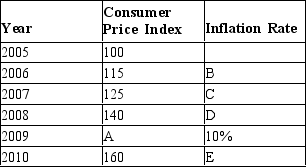 -Refer to Table 24-1. What belongs in space E?
 (Multiple Choice)
4.9/5 (86)
(86) If the CPI was 127 in 1972 and is 324 today, then $10 in 1972 purchased the same amount of goods and services as
(Multiple Choice)
4.7/5 (83)
(83) If the nominal interest rate is 8.3% and the inflation rate is 4.4%, what is the real interest rate?
(Short Answer)
4.7/5 (80)
(80) Because the consumer price index reflects the goods and services bought by consumers better than the GDP deflator does, it is the more common gauge of inflation.
(True/False)
4.8/5 (78)
(78) Scenario 24-1
The price tag on a tennis ball in 1975 read $0.10, and the price tag on a tennis ball in 2005 read $1.00. The CPI in 1975 was 52.3, and the CPI in 2005 was 191.3.
-Refer to Scenario 24-1. The price of a 1975 tennis ball in 2005 dollars is
(Multiple Choice)
4.9/5 (85)
(85) Suppose a basket of goods and services has been selected to calculate the CPI and 2009 has been selected as the base year. In 2007, the basket's cost was $64; in 2009, the basket's cost was $68; and in 2011, the basket's cost was $70. The value of the CPI in 2011 was
(Multiple Choice)
4.7/5 (84)
(84) 
Filters
- Essay(0)
- Multiple Choice(0)
- Short Answer(0)
- True False(0)
- Matching(0)