



 Chat with AI
Exam 6: Supply, Demand, and Government Policies

Exam 1: Ten Principles of Economics439 Questions
Exam 2: Thinking Like an Economist617 Questions
Exam 3: Interdependence and the Gains From Trade527 Questions
Exam 4: The Market Forces of Supply and Demand697 Questions
Exam 5: Elasticity and Its Application594 Questions
Exam 6: Supply, Demand, and Government Policies645 Questions
Exam 7: Consumers, Producers, and the Efficiency of Markets549 Questions
Exam 8: Application: the Costs of Taxation513 Questions
Exam 9: Application: International Trade492 Questions
Exam 10: Externalities524 Questions
Exam 11: Public Goods and Common Resources433 Questions
Exam 12: The Design of the Tax System549 Questions
Exam 13: The Costs of Production420 Questions
Exam 14: Firms in Competitive Markets543 Questions
Exam 15: Monopoly637 Questions
Exam 16: Monopolistic Competition580 Questions
Exam 17: Oligopoly488 Questions
Exam 18: The Markets for the Factors of Production564 Questions
Exam 19: Earnings and Discrimination490 Questions
Exam 20: Income Inequality and Poverty455 Questions
Exam 21: The Theory of Consumer Choice431 Questions
Exam 22: Frontiers of Microeconomics440 Questions
Exam 23: Measuring a Nations Income520 Questions
Exam 24: Measuring the Cost of Living529 Questions
Exam 25: Production and Growth505 Questions
Exam 26: Saving, Investment, and the Financial System564 Questions
Exam 27: The Basic Tools of Finance500 Questions
Exam 28: Unemployment678 Questions
Exam 29: The Monetary System515 Questions
Exam 30: Money Growth and Inflation481 Questions
Exam 31: Open-Economy Macroeconomics: Basic Concepts522 Questions
Exam 32: A Macroeconomic Theory of the Open Economy475 Questions
Exam 33: Aggregate Demand and Aggregate Supply562 Questions
Exam 34: The Influence of Monetary and Fiscal Policy on Aggregate Demand508 Questions
Exam 35: The Short-Run Trade-Off Between Inflation and Unemployment491 Questions
Exam 36: Six Debates Over Macroeconomic Policy372 Questions
Select questions type


Long lines and discrimination are examples of rationing methods that may naturally develop in response to a binding price ceiling.
(True/False)
4.8/5  (96)
(96) Figure 6-1
Panel (a) Panel (b) 
 -Refer to Figure 6-1. In which panel(s) of the figure would there be a shortage of the good at the price ceiling?
 (Multiple Choice)
5.0/5 (80)
(80) Table 6-6  -Refer to Table 6-6. If the government set a price floor at $2, would there be a shortage or surplus, and how large would be the shortage/surplus?
 (Essay)
4.9/5 (82)
(82) If the government passes a law requiring sellers of mopeds to send $200 to the government for every moped they sell, then
(Multiple Choice)
4.9/5 (85)
(85) Figure 6-27
This figure shows the market demand and market supply curves for good Z.  -Refer to Figure 6-27. Suppose a tax of $6 per unit is imposed on this market. How much will buyers pay per unit after the tax is imposed?
 (Multiple Choice)
4.8/5 (81)
(81) Figure 6-2  -Refer to Figure 6-2. The price ceiling causes quantity
 (Multiple Choice)
4.9/5 (84)
(84) Figure 6-1
Panel (a) Panel (b)
-Refer to Figure 6-1. The price ceiling shown in panel (a)
-Refer to Figure 6-1. The price ceiling shown in panel (a) (Multiple Choice)
4.8/5 (76)
(76) Using a supply and demand diagram, show a labor market with a binding minimum wage. Use the diagram to show those who are helped by the minimum wage and those who are hurt by the minimum wage.
(Essay)
4.8/5 (82)
(82) Suppose sellers of perfume are required to send $1.00 to the government for every bottle of perfume they sell. Further, suppose this tax causes the price paid by buyers of perfume to rise by $0.60 per bottle. Which of the following statements is correct?
(Multiple Choice)
4.8/5 (78)
(78) Suppose that the demand for light bulbs is inelastic, and the supply of light bulbs is elastic. A tax of $2 per bulb levied on light bulbs will increase the price paid by buyers of light bulbs by
(Multiple Choice)
4.9/5 (64)
(64) Figure 6-11 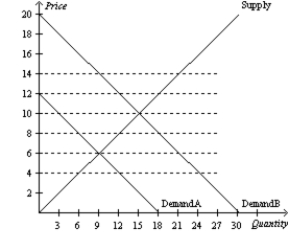 -Refer to Figure 6-11. If the government imposes a price ceiling at $6, it would be
 (Multiple Choice)
4.9/5 (82)
(82) Figure 6-29
Suppose the government imposes a $2 on this market.  -Refer to Figure 6-29. Suppose D1 represents the demand curve for gasoline in both the short run and long run, S1 represents the supply curve for gasoline in the short run, and S2 represents the supply curve for gasoline in the long run. After the imposition of the $2,
 (Multiple Choice)
4.8/5 (80)
(80) Figure 6-36  -Refer to Figure 6-36. If the government places a $2 tax in the market, the buyer pays $6.
 (True/False)
4.9/5 (83)
(83) Figure 6-25  -Refer to Figure 6-25. As the figure is drawn, who sends the tax payment to the government?
 (Multiple Choice)
4.7/5 (73)
(73) Suppose there is currently a tax of $50 per ticket on airline tickets. Buyers of airline tickets are required to pay the tax to the government. If the tax is reduced from $50 per ticket to $30 per ticket, then the
(Multiple Choice)
5.0/5 (87)
(87) Workers determine the supply of labor, and firms determine the demand for labor.
(True/False)
4.9/5 (74)
(74) 
Filters
- Essay(0)
- Multiple Choice(0)
- Short Answer(0)
- True False(0)
- Matching(0)