



 Chat with AI
Exam 6: Supply, Demand, and Government Policies

Exam 1: Ten Principles of Economics439 Questions
Exam 2: Thinking Like an Economist617 Questions
Exam 3: Interdependence and the Gains From Trade527 Questions
Exam 4: The Market Forces of Supply and Demand697 Questions
Exam 5: Elasticity and Its Application594 Questions
Exam 6: Supply, Demand, and Government Policies645 Questions
Exam 7: Consumers, Producers, and the Efficiency of Markets549 Questions
Exam 8: Application: the Costs of Taxation513 Questions
Exam 9: Application: International Trade492 Questions
Exam 10: Externalities524 Questions
Exam 11: Public Goods and Common Resources433 Questions
Exam 12: The Design of the Tax System549 Questions
Exam 13: The Costs of Production420 Questions
Exam 14: Firms in Competitive Markets543 Questions
Exam 15: Monopoly637 Questions
Exam 16: Monopolistic Competition580 Questions
Exam 17: Oligopoly488 Questions
Exam 18: The Markets for the Factors of Production564 Questions
Exam 19: Earnings and Discrimination490 Questions
Exam 20: Income Inequality and Poverty455 Questions
Exam 21: The Theory of Consumer Choice431 Questions
Exam 22: Frontiers of Microeconomics440 Questions
Exam 23: Measuring a Nations Income520 Questions
Exam 24: Measuring the Cost of Living529 Questions
Exam 25: Production and Growth505 Questions
Exam 26: Saving, Investment, and the Financial System564 Questions
Exam 27: The Basic Tools of Finance500 Questions
Exam 28: Unemployment678 Questions
Exam 29: The Monetary System515 Questions
Exam 30: Money Growth and Inflation481 Questions
Exam 31: Open-Economy Macroeconomics: Basic Concepts522 Questions
Exam 32: A Macroeconomic Theory of the Open Economy475 Questions
Exam 33: Aggregate Demand and Aggregate Supply562 Questions
Exam 34: The Influence of Monetary and Fiscal Policy on Aggregate Demand508 Questions
Exam 35: The Short-Run Trade-Off Between Inflation and Unemployment491 Questions
Exam 36: Six Debates Over Macroeconomic Policy372 Questions
Select questions type


A tax on the buyers of cereal will increase the price of cereal paid by buyers,
(Multiple Choice)
4.8/5  (71)
(71) Figure 6-6  -Refer to Figure 6-6. If the government imposes a price ceiling of $6 on this market, then there will be
 (Multiple Choice)
4.8/5 (79)
(79) In 1990, Congress passed a new luxury tax on items such as yachts, private airplanes, furs, jewelry, and expensive cars. The goal of the tax was to
(Multiple Choice)
5.0/5 (63)
(63) Figure 6-29
Suppose the government imposes a $2 on this market.  -Refer to Figure 6-29. The buyers will bear a higher share of the tax burden than sellers if the demand is
 (Multiple Choice)
4.9/5 (85)
(85) Table 6-4
The following table contains the demand schedule and supply schedule for a market for a particular good. Suppose sellers of the good successfully lobby Congress to impose a price floor $3 above the equilibrium price in this market. 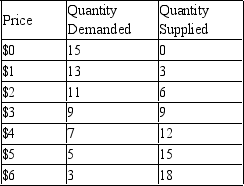 -Refer to Table 6-4. Following the imposition of a price floor $3 above the equilibrium price, irate buyers convince Congress to repeal the price floor and to impose a price ceiling $1 below the former price floor. The resulting market price is
 (Multiple Choice)
4.9/5 (69)
(69) Figure 6-23 
 -Refer to Figure 6-23. How much tax revenue does this tax produce for the government?
 (Multiple Choice)
4.8/5 (71)
(71) If a binding price floor is imposed on the video game market, then
(Multiple Choice)
4.9/5 (75)
(75) Suppose that a tax is placed on books. If the buyers pay the majority of the tax, then we know that the
(Multiple Choice)
4.9/5 (74)
(74) Sellers of a good bear the larger share of the tax burden when a tax is placed on a product for which the
(Multiple Choice)
4.8/5 (74)
(74) Figure 6-13
This figure shows the market demand and market supply curves for good X.  -Refer to Figure 6-13. Which of the following statements is not correct?
 (Multiple Choice)
5.0/5 (71)
(71) When a tax is placed on the buyers of tennis racquets, the size of the tennis racquet market
(Multiple Choice)
4.9/5 (68)
(68) When a binding price ceiling is imposed on a market to benefit buyers,
(Multiple Choice)
4.9/5 (92)
(92) Figure 6-26  -Refer to Figure 6-26. The price paid by buyers after the tax is imposed is
(Multiple Choice)
4.7/5 (85)
(85) Table 6-6  -Refer to Table 6-6. If the government set a price ceiling at $4, would there be a shortage or surplus, and how large would be the shortage/surplus?
 (Essay)
4.8/5 (74)
(74) Figure 6-5  -Refer to Figure 6-5. If the horizontal line on the graph represents a price ceiling, then the price ceiling is
 (Multiple Choice)
4.7/5 (90)
(90) 
Filters
- Essay(0)
- Multiple Choice(0)
- Short Answer(0)
- True False(0)
- Matching(0)