



 Chat with AI
Exam 4: The Market Forces of Supply and Demand

Exam 1: Ten Principles of Economics439 Questions
Exam 2: Thinking Like an Economist617 Questions
Exam 3: Interdependence and the Gains From Trade527 Questions
Exam 4: The Market Forces of Supply and Demand697 Questions
Exam 5: Elasticity and Its Application594 Questions
Exam 6: Supply, Demand, and Government Policies645 Questions
Exam 7: Consumers, Producers, and the Efficiency of Markets549 Questions
Exam 8: Application: the Costs of Taxation513 Questions
Exam 9: Application: International Trade492 Questions
Exam 10: Externalities524 Questions
Exam 11: Public Goods and Common Resources433 Questions
Exam 12: The Design of the Tax System549 Questions
Exam 13: The Costs of Production420 Questions
Exam 14: Firms in Competitive Markets543 Questions
Exam 15: Monopoly637 Questions
Exam 16: Monopolistic Competition580 Questions
Exam 17: Oligopoly488 Questions
Exam 18: The Markets for the Factors of Production564 Questions
Exam 19: Earnings and Discrimination490 Questions
Exam 20: Income Inequality and Poverty455 Questions
Exam 21: The Theory of Consumer Choice431 Questions
Exam 22: Frontiers of Microeconomics440 Questions
Exam 23: Measuring a Nations Income520 Questions
Exam 24: Measuring the Cost of Living529 Questions
Exam 25: Production and Growth505 Questions
Exam 26: Saving, Investment, and the Financial System564 Questions
Exam 27: The Basic Tools of Finance500 Questions
Exam 28: Unemployment678 Questions
Exam 29: The Monetary System515 Questions
Exam 30: Money Growth and Inflation481 Questions
Exam 31: Open-Economy Macroeconomics: Basic Concepts522 Questions
Exam 32: A Macroeconomic Theory of the Open Economy475 Questions
Exam 33: Aggregate Demand and Aggregate Supply562 Questions
Exam 34: The Influence of Monetary and Fiscal Policy on Aggregate Demand508 Questions
Exam 35: The Short-Run Trade-Off Between Inflation and Unemployment491 Questions
Exam 36: Six Debates Over Macroeconomic Policy372 Questions
Select questions type


Figure 4-15  -Refer to Figure 4-15. Which of the following would cause the supply curve to shift from Supply A to Supply C in the market for beach towels?
 (Multiple Choice)
4.9/5  (91)
(91) Figure 4-4
Yasmine Mercedes 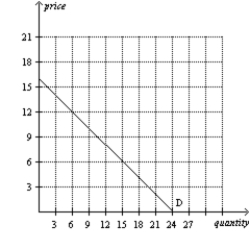
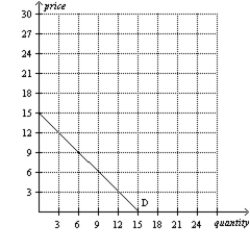 -Refer to Figure 4-4. Suppose Yasmine and Mercedes are the only two consumers in the market. When the market price falls from $12 to $6, the quantity demanded increases by
 (Multiple Choice)
4.8/5 (83)
(83) Adam Smith suggested that an invisible had guides market economies. In this analogy, what is the baton that the invisible hand uses to conduct the economic orchestra?
(Multiple Choice)
4.9/5 (74)
(74) You watch a lot of HGTV during your summer vacation, and you notice that most housing buyers list granite countertops in their "must have" lists when buying a new or existing house. You expect the demand for
(Multiple Choice)
5.0/5 (77)
(77) Given the table below, graph the demand and supply curves for flashlights. Make certain to label the equilibrium price and equilibrium quantity. 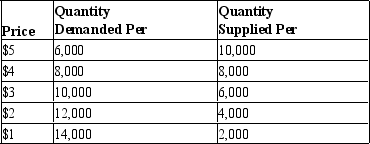 a. What is the equilibrium price and the equilibrium quantity?
b. Suppose the price is currently $5. What problem would exist in the market? What would you expect to happen to price? Show this on your graph.
c. Suppose the price is currently $2. What problem would exist in the market? What would you expect to happen to price? Show this on your graph.
a. What is the equilibrium price and the equilibrium quantity?
b. Suppose the price is currently $5. What problem would exist in the market? What would you expect to happen to price? Show this on your graph.
c. Suppose the price is currently $2. What problem would exist in the market? What would you expect to happen to price? Show this on your graph. (Essay)
5.0/5 (84)
(84) Figure 4-19  -Refer to Figure 4-19. If price in this market is currently $14, then there would be a(n)
 (Multiple Choice)
4.9/5 (73)
(73) Figure 4-24
The diagram below pertains to the demand for turkey in the United States.  -Refer to Figure 4-24. All else equal, an increase in the income of buyers who consider turkey to be an inferior good would cause a move from
 (Multiple Choice)
4.8/5 (77)
(77) Figure 4-23 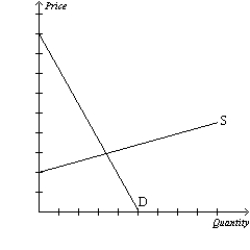 -Refer to Figure 4-23. In this market for watermelons, a severe drought occurs which affects the watermelon crop. The equilibrium price
 (Multiple Choice)
4.9/5 (74)
(74) Figure 4-11 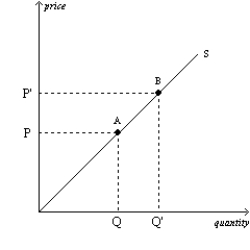 -Refer to Figure 4-11. The movement from point A to point B on the graph represents
 (Multiple Choice)
4.9/5 (73)
(73) Figure 4-29 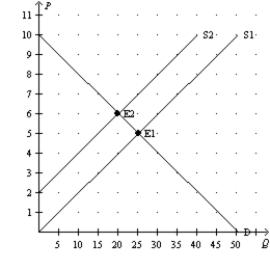 -Refer to Figure 4-29. The movement from S1 to S2 is a
 (Short Answer)
4.7/5 (68)
(68) If consumers often purchase muffins to eat while they drink their lattés at local coffee shops, what would happen to the equilibrium price and quantity of lattés if the price of muffins falls?
(Multiple Choice)
4.9/5 (73)
(73) Figure 4-10 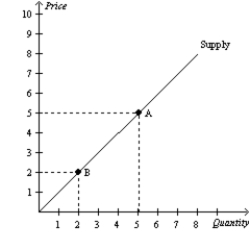 -Refer to Figure 4-10. The movement from Point A to Point B represents a(n)
 (Multiple Choice)
4.8/5 (74)
(74) The signals that guide the allocation of resources in a market economy are
(Multiple Choice)
4.9/5 (73)
(73) Table 4-6  -Refer to Table 4-6. If these are the only four sellers in the market, then when the price decreases from $4 to $2, the market quantity supplied
 (Multiple Choice)
4.7/5 (72)
(72) Suppose Spencer and Kate are the only two demanders of lemonade. Each month, Spencer buys six glasses of lemonade when the price is $1.00 per glass, and he buys four glasses when the price is $1.50 per glass. Each month, Kate buys four glasses of lemonade when the price is $1.00 per glass, and she buys two glasses when the price is $1.50 per glass. Which of the following points is on the market demand curve? 
(Multiple Choice)
4.7/5 (63)
(63) 
Filters
- Essay(0)
- Multiple Choice(0)
- Short Answer(0)
- True False(0)
- Matching(0)