



 Chat with AI
Exam 10: Long-Term Assets

Exam 1: Accounting in Business245 Questions
Exam 2: Analyzing and Recording Transactions201 Questions
Exam 3: Adjusting Accounts and Preparing Financial Statements227 Questions
Exam 4: Completing the Accounting Cycle177 Questions
Exam 5: Accounting for Merchandising Operations189 Questions
Exam 6: Inventories and Cost of Sales194 Questions
Exam 7: Accounting Information Systems166 Questions
Exam 8: Cash and Internal Controls195 Questions
Exam 9: Accounting for Receivables162 Questions
Exam 10: Long-Term Assets208 Questions
Exam 11: Current Liabilities and Payroll Accounting178 Questions
Exam 12: Accounting for Partnerships141 Questions
Exam 13: Accounting for Corporations210 Questions
Exam 14: Long-Term Liabilities158 Questions
Exam 15: Investments and International Operations156 Questions
Exam 16: Statement of Cash Flows173 Questions
Exam 17: Analysis of Financial Statements182 Questions
Exam 18: Managerial Accounting Concepts and Principles199 Questions
Exam 19: Job Order Cost Accounting165 Questions
Exam 20: Process Cost Accounting172 Questions
Exam 21: Cost Allocation and Performance Measurement173 Questions
Exam 22: Cost-Volume-Profit Analysis190 Questions
Exam 23: Master Budgets and Planning166 Questions
Exam 24: Flexible Budgets and Standard Costs178 Questions
Exam 25: Capital Budgeting and Managerial Decisions153 Questions
Select questions type


Intangible assets are nonphysical assets used in operations that confer on their owners long-term rights, privileges, or competitive advantages.
(True/False)
4.8/5  (85)
(85) _________________________ expenditures that make an item of property, plant and equipment more productive; they often involve adding a component to an asset or replacing one of its old components with a better one, and do not always increase an asset's life.
(Essay)
4.9/5 (75)
(75) A company had a building destroyed by fire. The building originally cost $650,000, and its accumulated depreciation as of the date of the fire was $300,000. The company received $400,000 cash from an insurance policy that covered the building and will use that money to help rebuild. Prepare the single journal entry to record the destruction of the building and the receipt of cash from the insurance company.
(Essay)
4.8/5 (72)
(72) Gain or loss on the disposal of assets is determined by comparing the disposed asset's carrying amount to the value of any assets received.
(True/False)
4.9/5 (76)
(76) The first step in accounting for an asset disposal is to calculate the gain or loss on disposal.
(True/False)
4.9/5 (76)
(76) The original cost of a machine was $60,000. After $45,000 of depreciation was recorded, the machine was traded in on a new machine priced at $75,000. A $10,500 trade-in allowance was received on the old machine and the balance of $64,500 was paid in cash. This transaction has commercial substance. Prepare the general journal entry to record this trade-in.
(Essay)
4.9/5 (70)
(70) A company purchased a machine on January 1 of the current year for $750,000. Calculate the annual depreciation expense for each year of the machine's life (estimated at 5 years or 20,000 hours, with a residual value of $75,000). During the machine's 5-year life its hourly usage was: 3,000; 4,000; 5,000; 5,000; and 3,000 hours.
(Essay)
4.8/5 (93)
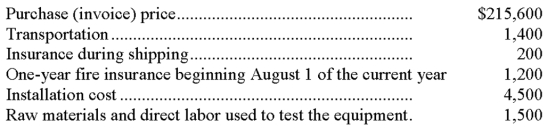
(93) A company purchased equipment on July 3 of the current year and placed it in service on August 1. The following costs were incurred in acquiring the equipment:
Determine the amount to be recorded as cost for the equipment.
(Essay)
4.8/5 (76)
(76) On April 1, Year 5 a company discarded a machine that had cost $10,000 and had accumulated depreciation of $8,000 as of December 31, Year 4. The asset had a 5-year life and $0 residual value. Prepare the journal entries to record the updating of the depreciation expense and discarding of this asset in Year 5.
(Essay)
4.7/5 (94)
(94) A company's old machine that cost $40,000 and had accumulated depreciation of $30,000 was traded in on a new machine having an estimated 20-year life with an invoice price of $50,000. The company also paid $43,000 cash, along with its old machine to acquire the new machine. If this transaction has commercial substance, the new machine should be recorded at:
(Multiple Choice)
4.8/5 (80)
(80) ____________________ refers to an item of property, plant and equipment that is no longer useful in producing goods or services with a competitive advantage because of new inventions and improvements.
(Essay)
4.8/5 (83)
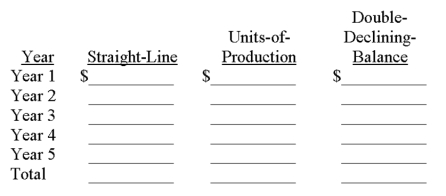
(83) A machine costing $450,000 with a four-year life and an estimated $30,000 residual value is installed by Lux Company on January 1. The factory estimates the machine will produce 1,050,000 units of product during its life. It actually produces the following units for the first 2 years: Year 1, 260,000; Year 2, 275,000. Enter the depreciation amounts for years 1 and 2 in the table below for each depreciation method. Show calculation of amounts below the table.

(Essay)
4.8/5 (82)
(82) A depreciation method that produces larger depreciation expense during the early years of an asset's life and smaller expense in the later years is a(an):
(Multiple Choice)
4.7/5 (83)
(83) What are some of the variables that make an item of property, plant and equipment's useful life difficult to predict?
(Essay)
4.7/5 (82)
(82) Marble Company purchased a machine costing $120,000, terms 1/10, n/30. The machine was shipped FOB shipping point and freight charges were $2,000. The machine requires special mounting and wiring connections costing $10,000. When installing the machine, $1,300 in damages occurred. Materials costing $1,500 are used in testing and adjusting the machine to produce a satisfactory product. Compute the cost recorded for this machine assuming Marble paid within the discount period.
(Multiple Choice)
4.8/5 (86)
(86) A company paid $770,000 plus $5,000 in closing costs for property that included land appraised at $384,000; land improvements appraised at $128,000; and a building appraised at $288,000. The plan is to use the building as a manufacturing plant. Determine the amounts that should be recorded as:

(Essay)
4.9/5 (73)
(73) A company had a bulldozer destroyed by fire. The bulldozer originally cost $125,000 with accumulated depreciation of $60,000. The proceeds from the insurance company were $90,000. The company should recognize:
(Multiple Choice)
4.9/5 (88)
(88) A company purchased a mineral deposit for $800,000. It expects this property to produce 1,200,000 tons of ore and to have a residual value of $50,000. In the current year, the company mined and sold 90,000 tons of ore. Its depletion expense for the current period equals:
(Multiple Choice)
5.0/5 (79)
(79) 
Filters
- Essay(0)
- Multiple Choice(0)
- Short Answer(0)
- True False(0)
- Matching(0)