



 Chat with AI
Exam 10: Long-Term Assets

Exam 1: Accounting in Business245 Questions
Exam 2: Analyzing and Recording Transactions201 Questions
Exam 3: Adjusting Accounts and Preparing Financial Statements227 Questions
Exam 4: Completing the Accounting Cycle177 Questions
Exam 5: Accounting for Merchandising Operations189 Questions
Exam 6: Inventories and Cost of Sales194 Questions
Exam 7: Accounting Information Systems166 Questions
Exam 8: Cash and Internal Controls195 Questions
Exam 9: Accounting for Receivables162 Questions
Exam 10: Long-Term Assets208 Questions
Exam 11: Current Liabilities and Payroll Accounting178 Questions
Exam 12: Accounting for Partnerships141 Questions
Exam 13: Accounting for Corporations210 Questions
Exam 14: Long-Term Liabilities158 Questions
Exam 15: Investments and International Operations156 Questions
Exam 16: Statement of Cash Flows173 Questions
Exam 17: Analysis of Financial Statements182 Questions
Exam 18: Managerial Accounting Concepts and Principles199 Questions
Exam 19: Job Order Cost Accounting165 Questions
Exam 20: Process Cost Accounting172 Questions
Exam 21: Cost Allocation and Performance Measurement173 Questions
Exam 22: Cost-Volume-Profit Analysis190 Questions
Exam 23: Master Budgets and Planning166 Questions
Exam 24: Flexible Budgets and Standard Costs178 Questions
Exam 25: Capital Budgeting and Managerial Decisions153 Questions
Select questions type


Explain the difference between revenue expenditures and capital expenditures and how they are recorded in the accounting system.
(Essay)
4.8/5  (92)
(92) A company exchanged its used machine for a new machine in a transaction that had commercial substance. The old machine cost $70,000, and the new one had a cash price of $95,000. The company had taken $60,000 depreciation on the old machine and was allowed a $2,500 trade-in allowance and the balance of $92,500 was paid in cash. What gain or loss should be recorded on the exchange?
(Essay)
5.0/5 (79)
(79) On January 1, a machine costing $260,000 with a 4-year life and an estimated $5,000 residual value was purchased. It was also estimated that the machine would produce 500,000 units during its life. The actual units produced during its first year of operation were 110,000. Determine the amount of depreciation expense for the first year under each of the following assumptions:
1. The company uses the straight-line method of depreciation.
2. The company uses the units-of-production method of depreciation.
3. The company uses the double-declining-balance method of depreciation.
(Essay)
4.7/5 (73)
(73) An item of property, plant and equipment's useful life might not be the same as its productive life.
(True/False)
4.9/5 (88)
(88) Depreciation expense is calculated using estimates of an asset's residual value and useful life.
(True/False)
5.0/5 (81)
(81) A company purchased mining property containing 15,000,000 tons of ore for $4,875,000. In Year 1, it mined 789,000 tons of ore and in Year 2, it mined 1,235,000 tons. Calculate the depletion expense for Year 1 and Year 2.
(Essay)
4.9/5 (82)
(82) On April 1, Year 1, SAS Corp. purchased and placed in service an item of property, plant and equipment. The following information is available regarding the item of property, plant and equipment:
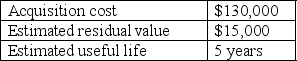 Make the necessary adjusting journal entries at December 31, Year 1, and December 31, Year 2 to record depreciation for each year under the following depreciation methods:
a. Straight-line.
b. Double-declining-balance.
Make the necessary adjusting journal entries at December 31, Year 1, and December 31, Year 2 to record depreciation for each year under the following depreciation methods:
a. Straight-line.
b. Double-declining-balance. (Essay)
4.9/5 (90)
(90) Lomax Enterprises purchased a depreciable asset for $22,000 on March 1, Year 1. The asset will be depreciated using the straight-line method over its four-year useful life. Assuming the asset's residual value is $2,000, what will be the amount of accumulated depreciation on this asset on December 31, Year 4?
(Multiple Choice)
4.9/5 (86)
(86) Identify each of the following assets by balance sheet classification by placing an X in the correct classification: Property, plant and equipment, Natural Resources, or Intangibles.
(Essay)
4.9/5 (79)
(79) On July 1 of the current year, a company purchased and placed in service a machine with a cost of $240,000. The company estimated the machine's useful life to be four years or 60,000 units of output with an estimated residual value of $60,000. During the current year, 15,000 units were produced.
Prepare the necessary December 31 adjusting journal entry to record depreciation for the current year assuming the company uses:
a. The straight-line method of depreciation.
b. The units-of-production method of depreciation.
c. The double-declining balance method of depreciation.
(Essay)
4.9/5 (74)
(74) When a company constructs a building, the cost of the building includes materials and labor, design fees, building permits, and insurance during construction.
(True/False)
4.8/5 (85)
(85) A company purchased a heating system on January 2 for $225,000. The system had an estimated useful life of 15 years. On January 3 of the thirteenth year, the company completed a renovation of the system at a cost of $33,000 and now expects the system to be more efficient and last 8 years beyond the original estimate. The company uses the straight-line method of depreciation.
(a) Prepare the journal entry at January 3, to record the renovation of the heating system.
(b) Prepare the journal entry at December 31, to record the revised depreciation for the thirteenth year.
(Essay)
4.9/5 (81)
(81) Explain how to calculate total asset turnover. Describe what it reveals about a company's financial condition, whether a higher or lower ratio is desirable, and how it is best applied for comparative purposes.
(Essay)
4.8/5 (94)
(94) The cost of fees for insuring the title and any accrued property taxes are included in the cost of land.
(True/False)
4.8/5 (73)
(73) Rockport Company reports the following in millions: net sales of $25,355 for 2011 and $22,340 for 2010; end-of-year total assets of $15,875 for 2011 and $13,860 for 2010. Compute its total asset turnover for 2011 and assess its level if competitors average a total asset turnover of 2.0 times.
(Essay)
4.8/5 (70)
(70) A company's property records revealed the following information about its property, plant and equipment:
 Calculate the depreciation expense for each machine for the year ended December 31 for Year 1, and for the year ended December 31 for Year 2.
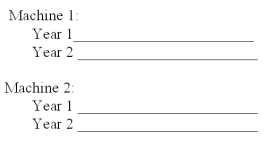
Calculate the depreciation expense for each machine for the year ended December 31 for Year 1, and for the year ended December 31 for Year 2.
(Essay)
4.7/5 (80)
(80) Mason Company sold a piece of equipment for $25,000 cash on December 31 after recording the annual depreciation on the asset. The equipment had an original cost of $92,500 and accumulated depreciation of $60,000. Prepare the general journal entry to record the sale of this asset.
(Essay)
4.9/5 (72)
(72) 
Filters
- Essay(0)
- Multiple Choice(0)
- Short Answer(0)
- True False(0)
- Matching(0)