



 Chat with AI
Exam 1: Accounting in Business

Exam 1: Accounting in Business245 Questions
Exam 2: Analyzing and Recording Transactions201 Questions
Exam 3: Adjusting Accounts and Preparing Financial Statements227 Questions
Exam 4: Completing the Accounting Cycle177 Questions
Exam 5: Accounting for Merchandising Operations189 Questions
Exam 6: Inventories and Cost of Sales194 Questions
Exam 7: Accounting Information Systems166 Questions
Exam 8: Cash and Internal Controls195 Questions
Exam 9: Accounting for Receivables162 Questions
Exam 10: Long-Term Assets208 Questions
Exam 11: Current Liabilities and Payroll Accounting178 Questions
Exam 12: Accounting for Partnerships141 Questions
Exam 13: Accounting for Corporations210 Questions
Exam 14: Long-Term Liabilities158 Questions
Exam 15: Investments and International Operations156 Questions
Exam 16: Statement of Cash Flows173 Questions
Exam 17: Analysis of Financial Statements182 Questions
Exam 18: Managerial Accounting Concepts and Principles199 Questions
Exam 19: Job Order Cost Accounting165 Questions
Exam 20: Process Cost Accounting172 Questions
Exam 21: Cost Allocation and Performance Measurement173 Questions
Exam 22: Cost-Volume-Profit Analysis190 Questions
Exam 23: Master Budgets and Planning166 Questions
Exam 24: Flexible Budgets and Standard Costs178 Questions
Exam 25: Capital Budgeting and Managerial Decisions153 Questions
Select questions type


An exchange of value between two entities is called:

Free
(Multiple Choice)
4.9/5  (80)
(80) Correct Answer: Verified
C
The rule that requires financial statements to reflect the assumption that the business will continue operating instead of being closed or sold, unless evidence shows that it will not continue, is the:
Free
(Multiple Choice)
4.9/5 (63)
(63) Correct Answer:Verified
VerifiedA
Match each of the following items 1 through 5 with the financial statement a through d in which each item would most likely appear. An item may appear on more than one statement. 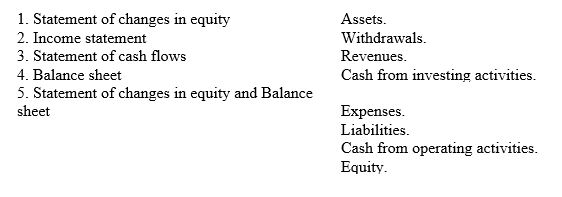
(Essay)
4.7/5 (75)
(75) Using the accounting equation, equity is equal to _______________________.
(Essay)
4.8/5 (75)
(75) Rent expense that is paid with cash appears on which of the following statements?
(Multiple Choice)
4.9/5 (85)
(85) Decreases in equity that represent costs of assets or services used to earn revenues are called:
(Multiple Choice)
4.9/5 (79)
(79) Graham Roofing Company, owned by R. Graham, began operations in May and completed the following transactions during that first month of operations. Show the effects of the transactions on the accounts of the accounting equation by recording increases and decreases in the appropriate columns in the table below. Do not determine new account balances after each transaction. Determine the final total for each account and verify that the equation is in balance.
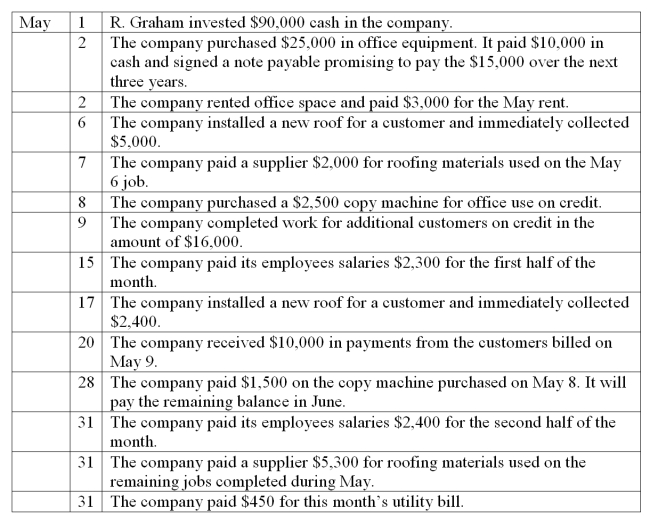
(Essay)
4.7/5 (74)
(74) If a parcel of land that was originally acquired for $85,000 is offered for sale at $150,000, is assessed for tax purposes at $95,000, is recognized by its purchasers as easily being worth $140,000, and is sold for $137,000, the land should be recorded in the purchaser's books at:
(Multiple Choice)
4.9/5 (80)
(80) The accounting assumption that requires every business to be accounted for separately from other business entities, including its owner or owners is known as the:
(Multiple Choice)
4.9/5 (72)
(72) The financial statement that shows the beginning balance of owner's equity; the changes in equity that resulted from new investments by the owner, net income (or net loss); withdrawals; and the ending balance, is the:
(Multiple Choice)
4.7/5 (76)
(76) Marian Mosely is the owner of Mosely Accounting Services. Which accounting principle requires Marian to keep her personal financial information separate from the financial information of Mosely Accounting Services?
(Multiple Choice)
4.8/5 (94)
(94) The accounting equation implies that: Assets + Liabilities = Equity.
(True/False)
4.7/5 (75)
(75) If assets are $99,000 and liabilities are $32,000, then equity equals:
(Multiple Choice)
4.7/5 (74)
(74) 
Filters
- Essay(0)
- Multiple Choice(0)
- Short Answer(0)
- True False(0)
- Matching(0)