



 Chat with AI
Exam 1: Accounting in Business

Exam 1: Accounting in Business245 Questions
Exam 2: Analyzing and Recording Transactions201 Questions
Exam 3: Adjusting Accounts and Preparing Financial Statements227 Questions
Exam 4: Completing the Accounting Cycle177 Questions
Exam 5: Accounting for Merchandising Operations189 Questions
Exam 6: Inventories and Cost of Sales194 Questions
Exam 7: Accounting Information Systems166 Questions
Exam 8: Cash and Internal Controls195 Questions
Exam 9: Accounting for Receivables162 Questions
Exam 10: Long-Term Assets208 Questions
Exam 11: Current Liabilities and Payroll Accounting178 Questions
Exam 12: Accounting for Partnerships141 Questions
Exam 13: Accounting for Corporations210 Questions
Exam 14: Long-Term Liabilities158 Questions
Exam 15: Investments and International Operations156 Questions
Exam 16: Statement of Cash Flows173 Questions
Exam 17: Analysis of Financial Statements182 Questions
Exam 18: Managerial Accounting Concepts and Principles199 Questions
Exam 19: Job Order Cost Accounting165 Questions
Exam 20: Process Cost Accounting172 Questions
Exam 21: Cost Allocation and Performance Measurement173 Questions
Exam 22: Cost-Volume-Profit Analysis190 Questions
Exam 23: Master Budgets and Planning166 Questions
Exam 24: Flexible Budgets and Standard Costs178 Questions
Exam 25: Capital Budgeting and Managerial Decisions153 Questions
Select questions type


Owner's investments are increases in equity from a company's earnings activities.
(True/False)
4.9/5  (94)
(94) General accounting principles arise from long-used accounting practices.
(True/False)
4.8/5 (79)
(79) The statement of cash flows shows the net effect of revenues and expenses for a reporting period.
(True/False)
4.8/5 (79)
(79) The accounting principle that requires accounting information to be based on actual cost and requires assets and services to be recorded initially at the cash or cash-equivalent amount given in exchange, is the:
(Multiple Choice)
4.9/5 (96)
(96) Cool Tours had beginning equity of $72,000; revenues of $90,000, expenses of $65,000, and withdrawals by owners of $9,000. Calculate the ending equity.
(Multiple Choice)
5.0/5 (78)
(78) Accounting is an information and measurement system that identifies, records, and communicates relevant, reliable, and comparable information about an organization's business activities.
(True/False)
4.9/5 (87)
(87) The International Accounting Standards Board (IASB) is the government group that establishes reporting requirements for companies that issue shares to the public.
(True/False)
4.9/5 (81)
(81) The purchase of supplies appears on the statement of cash flows as an investing activity because it involves the purchase of assets.
(True/False)
4.8/5 (70)
(70) Creditors claims on assets that reflect obligations to transfer assets are called ____________.
(Essay)
4.9/5 (92)
(92) The financial statement that identifies where a company's cash came from and where it went during the period is the:
(Multiple Choice)
4.8/5 (86)
(86) The International Accounting Standards board (IASB) has the authority to impose its standards on companies around the world.
(True/False)
4.8/5 (75)
(75) Harris Co. has a net income of $43,000, assets at the beginning of the year are $250,000 and assets at the end of the year are $300,000. Compute its return on assets.
(Multiple Choice)
4.9/5 (73)
(73) The accountant of Magic Video Games prepared a balance sheet immediately after each transaction was recorded. During September, the first month of operation, the following balance sheets were prepared:
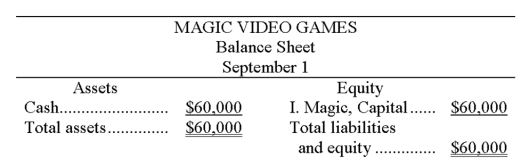
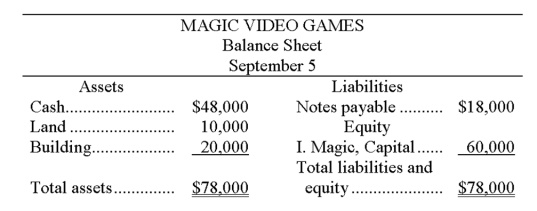
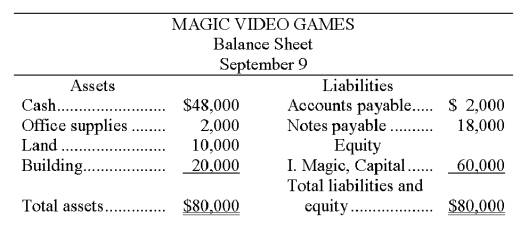 Required: Describe the nature of each of these five transactions for the month of September.
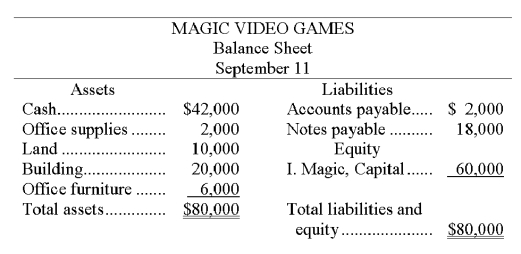
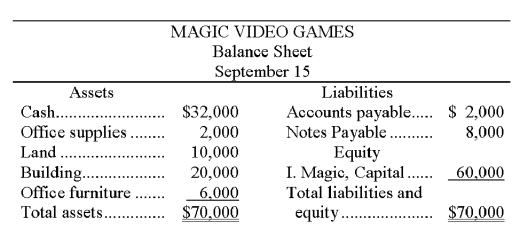
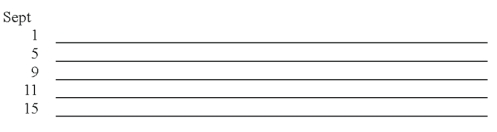
Required: Describe the nature of each of these five transactions for the month of September.
(Essay)
4.7/5 (75)
(75) Investing activities involve the buying and selling of assets such as land and equipment that are held for long-term use in the business.
(True/False)
4.8/5 (75)
(75) How does the going-concern principle affect reporting asset values of a business?
(Essay)
4.9/5 (73)
(73) 
Filters
- Essay(0)
- Multiple Choice(0)
- Short Answer(0)
- True False(0)
- Matching(0)